

More news on this day
Dubai International Airport again suspended operations after a new drone incident near its facilities, intensifying disruption for Emirates passengers and raising fresh questions about how the widening Middle East conflict is reshaping regional air travel and perceptions of safety.
Get the latest news straight to your inbox!
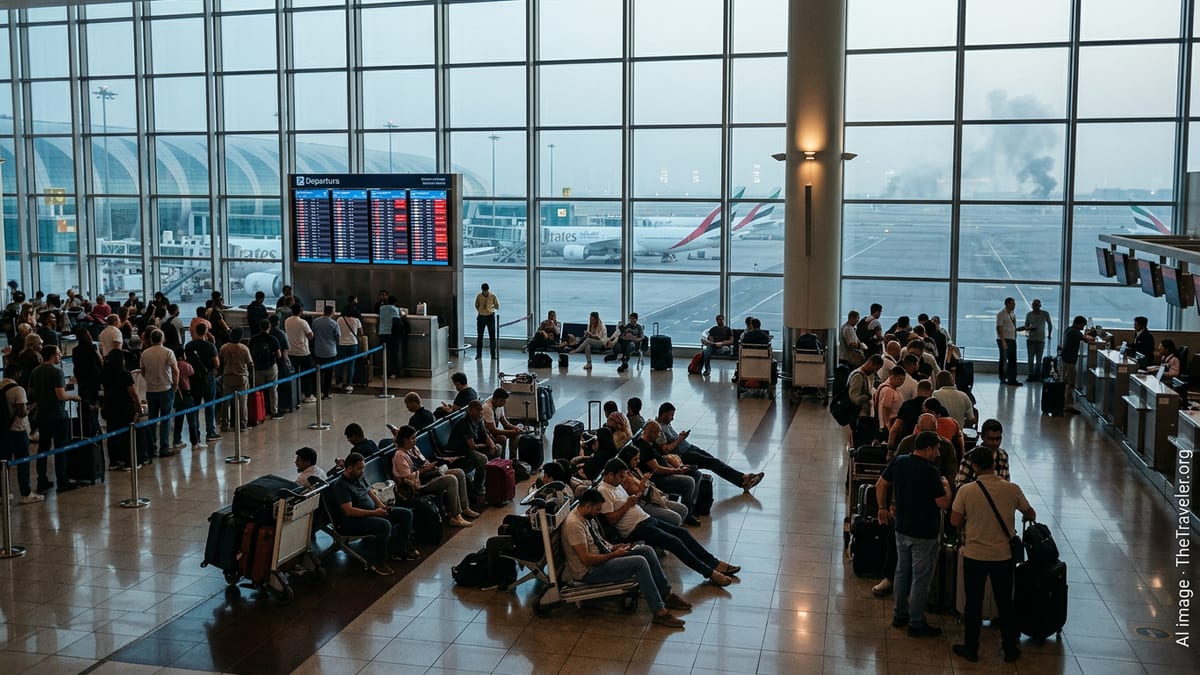
New Drone Impact Forces Fresh Halt at World’s Busiest Hub
Published coverage and eyewitness accounts indicate that activity around Dubai International Airport was temporarily halted after a drone impacted near key infrastructure, triggering visible smoke and renewed alarm among travelers. The latest incident comes less than two weeks after earlier drone and missile activity forced a previous shutdown and diversion of flights at the airport.
Regional news reports describe the wider pattern as part of ongoing Iranian strikes across the United Arab Emirates, with Dubai’s main hub repeatedly caught at the center of the disruption. Background reporting on the current phase of the conflict notes that a previous drone strike in early March hit a fuel tank at Dubai International and caused a fire, resulting in a partial suspension of operations while emergency teams responded.
While initial accounts of the newest incident are still being reconciled, flight-tracking data and airline statements point to a period of ground stops and go-arounds as aircraft on approach were redirected away from the airport’s airspace. Social media footage shared by passengers in recent hours appears to show aircraft holding over the Gulf, while some inbound flights diverted to alternative airports in the region.
In the absence of detailed official briefings, public information available from international media, aviation advisories and traveler reports collectively depict a pattern of short, sharp closures at Dubai International each time suspected drones reach the vicinity of the airfield, followed by cautious reopenings under tighter controls.
Emirates Scrambles to Manage Rolling Disruptions
The new shutdown has intensified pressure on Emirates, Dubai’s flag carrier and one of the world’s largest long-haul airlines, which has already been operating on a reduced and constantly shifting schedule since late February. Advisories circulated to passengers in recent days have urged travelers not to go to the airport without a confirmed active booking and have warned that same-day changes remain likely as security conditions evolve.
Travel guidance documents referencing Dubai’s operational status indicate that Emirates initially suspended many flights outright during the most intense phase of regional attacks, then gradually restarted a limited network as air defenses intercepted incoming threats. Even before the latest drone impact, Emirates was still canceling and consolidating departures, creating rolling backlogs of stranded travelers in Dubai and at outstations worldwide.
Online discussions among passengers suggest that any new incident near the airfield can trigger an immediate wave of disruptions across the airline’s global hub-and-spoke operation. Travellers describe long queues at rebooking counters, last-minute hotel vouchers for extended layovers, and rerouting via alternative hubs in Europe or Asia as Emirates attempts to keep people moving despite gaps in its Dubai schedule.
Available operational updates also point to tighter airport access for non-ticketed visitors and increased use of remote stands and bus transfers, as the airline and airport authority work together to maintain at least partial throughput whenever the airspace is deemed safe enough for restricted operations.
Escalating Conflict Redraws the Middle East Aviation Map
The renewed drone strike on Dubai International is part of a broader regional picture in which multiple Gulf airports and airspaces have periodically closed or restricted operations due to Iranian missile and drone activity. Timelines compiled by international outlets show that airspace over parts of the Gulf was closed on several days in late February, with ripple effects felt from Doha and Abu Dhabi to more distant hubs whose routes traditionally pass through the region.
Analysts quoted in recent travel security advisories note that long-range drones and ballistic missiles have forced airlines and air navigation providers to rethink standard air corridors across the Gulf, Iraq and the wider Levant. Routes that once tracked relatively direct great-circle paths are now being refiled around perceived hotspots, lengthening flight times and complicating crew duty schedules.
For Dubai specifically, being both a symbolic target and a critical global transfer point has produced a uniquely sensitive situation. Reports on the Iranian campaign against the United Arab Emirates describe multiple previous incidents in which drones or missile debris reached the Dubai metropolitan area, including at least one confirmed crash within the airport precinct earlier this month that interrupted repatriation flights for stranded tourists.
Industry observers highlight that while modern long-haul aircraft can be rerouted, airport-centric disruptions are much harder to absorb, particularly at a hub that often handles more than a quarter-million passengers per day in normal times. Every hour of closure in Dubai sends shockwaves down airline networks across Europe, Asia, Africa and Oceania, complicating aircraft rotations and leaving cabins either overbooked or nearly empty on short notice.
What Travelers Need to Know Right Now
For travelers scheduled to transit Dubai in the coming days, publicly available advisories and airline communications stress a few consistent points. First, flight status can change rapidly on the day of travel, so passengers are urged to monitor airline apps and airport information channels up to the time they leave for the airport. Several travel risk bulletins emphasize that travelers should not assume a flight will operate simply because it appeared on the schedule earlier in the week.
Second, there is a clear recommendation across multiple guidance documents not to proceed to Dubai International Airport unless a ticket is confirmed and the specific flight is showing as active and on time. With occasional ground stops and renewed drone alerts still possible, the airport has at times restricted entry to ticketed passengers only, and those without bookings risk facing long waits outside the terminal with limited information.
Third, passengers with tight connections through Dubai are being advised to expect potential missed connections and to pack accordingly. Travel assistance providers note that rerouting may involve overnight stops in Dubai or alternative hubs, and that hotel capacity near the airport can become strained during major disruption days. Flexible accommodation plans and adequate travel insurance coverage are being framed as important safeguards in the present environment.
Finally, those concerned about personal risk are being directed by government travel advisories to weigh their individual risk tolerance, stay alert to any updated guidance from their home country, and remain prepared for sudden changes to itinerary or routing. Current assessments characterize the overall risk to aviation as managed but fluid, with robust air-defense activity around Dubai mitigating some dangers while also introducing its own uncertainties when interceptions occur close to civilian infrastructure.
Balancing Safety, Reputation and the Future of Gulf Travel
The immediate priority for Dubai International Airport and Emirates remains restoring a predictable level of service while maintaining a safety margin that satisfies both regulators and a wary traveling public. Commentary in regional and international media suggests that Dubai’s leaders are acutely aware that the city’s brand as a safe, seamless transit gateway is central to its economic model.
At the same time, the repeated need to temporarily halt operations after drone incursions underscores how exposed even the most sophisticated aviation hubs are to evolving forms of conflict. Security experts writing in recent analysis pieces argue that the Gulf’s aviation sector is entering a new phase in which advanced air defenses, hardened fuel and control infrastructure, and rapid incident response protocols will be as important to competitiveness as runway capacity and terminal amenities.
For now, the picture for travelers is one of cautious continuity. Flights are still operating to and from Dubai most days, and many passengers continue to complete their journeys with minimal disruption. But the latest drone strike and temporary closure show how quickly conditions can shift, leaving itineraries, and sometimes entire travel plans, hanging on the trajectory of a single unmanned aircraft.
As the conflict in the region continues without a clear end date, the experience of navigating Dubai International Airport has become a real-time barometer of how modern warfare, global tourism and critical infrastructure intersect, and how both airlines and travelers are being forced to adapt in response.