

More news on this day
Travelers connecting through Dubai International Airport are facing a new wave of disruption as publicly available flight-monitoring data shows 81 delays and three cancellations affecting FlyDubai, Emirates and Air India Express services linking the hub with Delhi, Karachi, Cairo and Mumbai.
Get the latest news straight to your inbox!
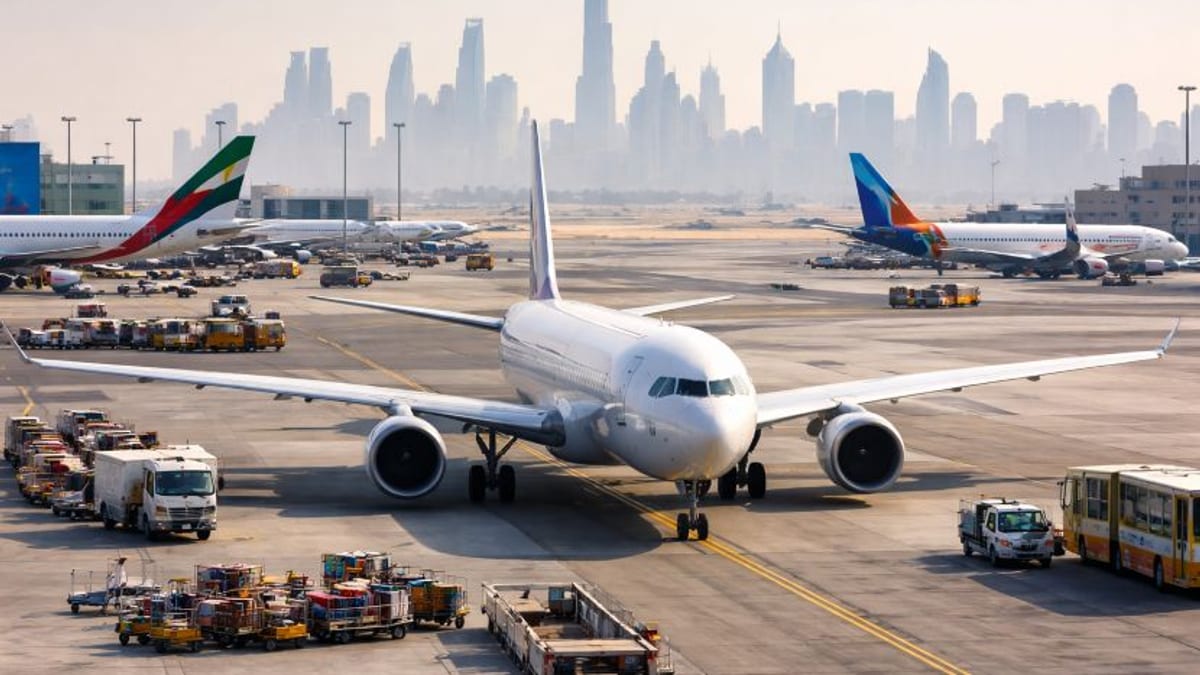
Image by Travel And Tour World
Delays Mount Across Key South Asia and Middle East Routes
Operational data compiled on Saturday indicates that flights serving major South Asian and Middle Eastern gateways have borne the brunt of the latest disruption at Dubai International. Services to and from Delhi, Karachi, Cairo and Mumbai show clusters of late departures and arrivals, pushing some rotations more than an hour behind schedule.
According to published coverage and independent flight tracking dashboards, the combined tally of affected movements involving FlyDubai, Emirates and Air India Express has reached 81 delayed flights and three outright cancellations within a short operating window. The pattern suggests a systemic strain on scheduling rather than isolated technical issues on individual aircraft.
Routes connecting Dubai with India and Pakistan already figure among the airport’s busiest corridors. Even modest timetable slippage quickly compounds into missed connections, aircraft waiting for inbound passengers and re-crewed flights. This amplification effect appears to be a key driver behind the spike in reported delays.
While some services are making up time en route, publicly visible arrival boards still show waves of knock-on lateness during peak bank periods, particularly in the early morning and late evening when long-haul connections are scheduled to feed through Dubai.
FlyDubai, Emirates and Air India Express Under Pressure
The three carriers most prominently affected all rely heavily on Dubai as a transfer or destination hub, leaving little slack in their operational networks. Emirates and FlyDubai both base extensive fleets at the airport, while Air India Express has used Dubai as a vital bridge for labor, family and leisure traffic between India and the Gulf.
Recent operational updates for Emirates indicate that the airline has been rebuilding capacity on key trunk routes after earlier regional airspace disruptions. However, schedule recovery at a mega-hub is highly sensitive to even small perturbations. When multiple widebody and narrowbody departures are held at gates, the congestion radiates outward to ground handling, fueling and air traffic flow management.
FlyDubai, which concentrates on short and medium-haul routes into South Asia, the Middle East and Eastern Europe, appears particularly exposed on turn-around times. Reports from passengers and publicly shared travel experiences in recent weeks describe tight connections between FlyDubai and Emirates services becoming more difficult to manage when any sector departs late.
For Air India Express, which operates a leaner point-to-point model, the latest disruption at Dubai coincides with a period of network adjustments between India and Gulf stations. A recently published media note from the Air India group outlined a mix of scheduled and ad hoc services to the United Arab Emirates, underlining the degree of ongoing fine-tuning on these sectors.
Passengers from Delhi, Karachi, Cairo and Mumbai Face Uncertainty
The impact is being felt most acutely by passengers originating in or transiting through Delhi, Karachi, Cairo and Mumbai. These cities supply a high proportion of Dubai’s transfer traffic, particularly workers on rotation, students, medical travelers and visiting families, all of whom often rely on tightly planned itineraries.
Travelers connecting onward to Europe, North America, Africa and Southeast Asia from these four cities are encountering longer layovers and, in some cases, missed onward flights when inbound sectors arrive substantially behind schedule. Publicly available comments on travel forums in recent days describe travelers spending extended periods in holding areas while waiting for rebooking or updated gate information.
Additional pressure is evident at security checkpoints and transfer desks during the affected waves, as multiple delayed arrivals converge at once. This bunching effect can be seen in passenger accounts that detail long queues, rapidly changing gate assignments and difficulty securing up-to-date information on revised departure times.
For travelers originating in Dubai and headed to Delhi, Karachi, Cairo or Mumbai, the uncertainty is similar. Some same-day trips have been pushed into overnight stays when specific departures moved from moderate delays into cancellation status, forcing passengers to seek hotel rooms or remain in the terminal until replacement flights are arranged.
Operational and Regional Factors Behind the Disruption
While the precise mix of causes behind the 81 delays and three cancellations varies flight by flight, several broad factors are visible in open-source reporting. Recent weeks have seen regional airspace constraints and route adjustments affecting carriers operating out of Dubai, extending flight times and tightening already busy schedules.
Operational data shared in aviation-focused discussions points to aircraft and crew rotations that are running close to their limits, a common outcome when airlines ramp capacity back up after earlier reductions. In such environments, a single late arrival can disrupt several follow-on sectors across different carriers sharing the same hub.
Weather has not been cited as a dominant factor in this particular disruption cycle, in contrast to earlier episodes at Gulf airports linked to seasonal storms or reduced visibility. Instead, the pattern resembles a rolling timetable imbalance, where incremental delays accumulate during peak waves before partially clearing during quieter periods.
Published commentary from aviation analysts notes that Dubai International, as one of the world’s busiest international hubs, has limited spare runway and gate capacity during banked connection periods. When multiple flights require additional ground time simultaneously, congestion spreads rapidly through the operation, resulting in the type of delay clusters described in current data.
What Travelers Can Do If Their Flight Is Affected
With the situation at Dubai International still fluid, travel experts recommend that passengers flying with Emirates, FlyDubai or Air India Express on routes touching Delhi, Karachi, Cairo or Mumbai closely monitor their flight status on official airline channels before leaving for the airport. Recent passenger accounts underline that online schedules and mobile apps are often updated before information filters through to third-party platforms.
Publicly shared advice from travelers who have navigated similar disruption at Dubai in recent weeks suggests allowing longer connection times than usual, particularly when combining a regional service with a long-haul sector. Those with tight layovers may wish to explore earlier feeder flights if change options are available, even at additional cost, to reduce the risk of misconnection.
Passengers already en route or in transit are encouraged, in open travel forums, to seek out staffed transfer desks promptly if their onward flight shows extended delay or disruption. In several recent cases described online, travelers who acted early secured limited seats on alternative departures while those who waited longer faced overnight stays.
As airlines work to clear backlogs and stabilize rotations, the disruption pattern at Dubai International may shift quickly from day to day. For now, however, the latest figures on delays and cancellations affecting services to and from Delhi, Karachi, Cairo and Mumbai highlight how sensitive one of the world’s busiest hubs remains to operational shocks, and how swiftly those shocks can ripple across South Asia’s most important air corridors.