

More news on this day
Thousands of travellers passing through Dubai International Airport faced hours of uncertainty on Saturday as a sudden partial closure of UAE airspace, imposed after coordinated US and Israeli strikes on Iran, triggered an abrupt wave of flight cancellations, diversions and rolling delays across one of the world’s busiest aviation hubs.
Airspace Closure Freezes Departures Across the Gulf
The General Civil Aviation Authority confirmed on February 28 that the UAE had temporarily and partially closed its airspace as what it called an exceptional precautionary measure, following rapidly escalating regional tensions after US and Israeli forces launched strikes on targets in Iran. The move effectively throttled departures and arrivals through Dubai International Airport and other key UAE gateways, forcing airlines to thin schedules, hold aircraft on the ground and divert inbound services already en route.
Officials stressed that the measure was not a shutdown of airports themselves but a tightly managed restriction on movements in national airspace. Even so, the impact at Dubai International was immediate and highly visible, with departure boards filling with red cancellation notices for services to Iran, Israel and other parts of the region, and a growing list of long-haul flights either delayed or diverted as carriers scrambled to rework routes around newly restricted skies.
The UAE decision came as multiple Gulf states, including Qatar and Kuwait, moved to suspend or sharply curtail airspace access in response to the widening conflict. With Israel closing its own airspace and Iran restricting operations in several cities, the cumulative patchwork of no-fly zones created a bottleneck over the Middle East that quickly rippled through global networks, particularly on Europe–Asia and transcontinental corridors that rely on Gulf hubs for connectivity.
Stranded Passengers Face Long Queues and Limited Information
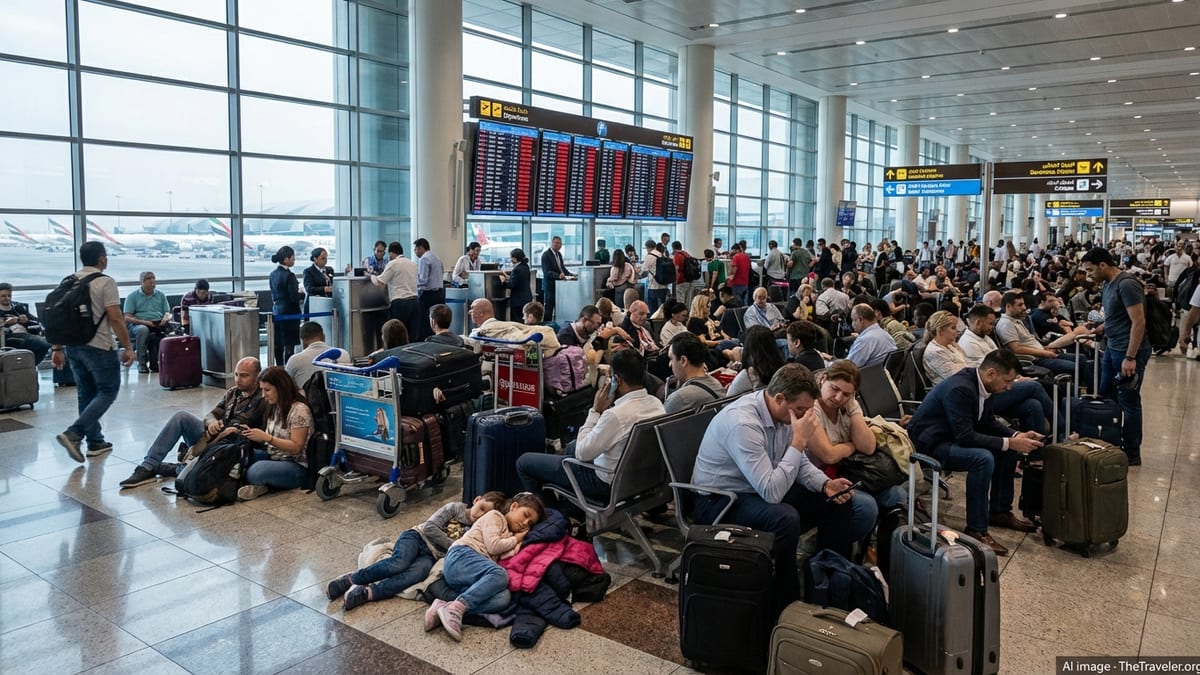
By midafternoon, departure halls at Dubai International were packed with passengers sitting on luggage trolleys, clustered near charging stations and forming long queues at airline desks in search of answers. Many transit travellers found themselves unexpectedly stranded as their onward connections vanished from information screens, while local residents returning to the UAE discovered their homeward flights had been turned back or grounded before departure.
Airport staff and airline agents fielded a torrent of rebooking requests as they tried to secure seats on the few services still able to operate or on flights scheduled in the coming days, once restrictions are expected to ease. With hotel rooms near the airport quickly filling up and rebooking windows stretching, some travellers reported being offered overnight accommodation and meal vouchers, while others were advised to remain in terminals until carriers could confirm new itineraries.
Families with young children and elderly passengers appeared among the hardest hit by the cascading delays. Many had embarked on long multi-leg journeys between Europe, Asia, Africa and Australasia, relying on Dubai as a critical transfer point. As operations slowed to a crawl, makeshift rest areas formed around quieter corners of the concourses, while airport announcements repeatedly urged passengers to stay in close contact with their airlines and to avoid heading to the airport without a confirmed flight.
Airlines Cancel, Divert and Reroute Amid Security Concerns
Carriers based in the UAE and beyond moved quickly to adjust operations in line with the changing security picture. Dubai’s flydubai confirmed that a number of its services had been cancelled, rerouted or forced to return to stand, particularly flights scheduled to operate to Iranian cities such as Tehran, Lar and Mashhad, as well as Tel Aviv in Israel. The airline described the disruption as part of an evolving situation and said safety of passengers and crew remained its overriding priority.
Other regional and international airlines also began suspending operations to key Middle Eastern destinations, either in response to formal airspace closures or out of caution as military activity expanded. European low cost carrier Wizz Air announced a halt to flights not only to Israel and Iran but also to Dubai, Abu Dhabi and Amman until early March, while German flag carrier Lufthansa paused operations to Tel Aviv, Beirut, Oman and Dubai over the weekend as it reassessed routings and risk levels.
Beyond outright cancellations, many intercontinental flights that would normally track across Iran or adjacent airspace were forced to adopt longer, more fuel intensive paths, increasing flying times and disrupting tightly timed connecting banks. Aviation analysts said the pattern resembled earlier flare ups in the region, but the combination of simultaneous Gulf airspace restrictions and full closures in Israel and parts of Iran threatened a deeper, more sustained shock to airline schedules.
Security Jitters Roil a Critical Global Hub
The restrictions followed announcements from Washington and Jerusalem that US and Israeli forces had begun what officials described as major operations against Iranian targets, with explosions reported in and around Tehran. Israel responded to the Iranian threat environment by freezing civil aviation, officially halting all takeoffs and landings at its airports as authorities focused on missile defence and civilian protection measures.
For the UAE, which has positioned itself as a neutral, connectivity driven hub, the partial airspace closure underlined the delicate balance between maintaining its global aviation role and protecting passengers and crews from conflict related risks. Authorities said the decision came only after a comprehensive assessment of security and operational factors and stressed that it would be lifted as soon as conditions allowed.
Travel security experts noted that while previous Middle East crises have caused temporary disruptions, the current confrontation directly affects several of the region’s most important air corridors at once. With US and Israeli assets active and Iran on high alert, the margin for error in crowded skies has narrowed, prompting regulators and airlines alike to take a conservative approach that inevitably translates into grounded aircraft and stranded travellers.
What Travellers Through Dubai Should Expect Next
Tourism and aviation officials cautioned that disruption at Dubai International and other Gulf airports could persist for several days, even if hostilities ease or airspace restrictions are gradually relaxed. Clearing backlogs of aircraft and passengers, rebalancing crew rosters and restoring normal route networks typically takes time, particularly for hub carriers that bank their operations around tight waves of arrivals and departures.
Passengers due to transit through Dubai in the coming 24 to 72 hours were urged to check flight status repeatedly before leaving home, keep contact details updated with airlines and remain flexible about rerouting options, including potential diversions via alternative hubs in Europe or Asia. Travel insurers, meanwhile, are likely to examine whether policies cover conflict related disruption, adding another layer of uncertainty for those facing expensive last minute changes.
For now, the scene at Dubai International captures a wider story unfolding across the Middle East’s skies: a region that has built its modern economic model around seamless air connectivity suddenly confronting the limits imposed by geopolitics. As screens fill with the word “cancelled” and travellers bed down on terminal floors, the scale of the challenge becomes clear, even as officials insist that the current standstill is a temporary, if jarring, pause rather than a new long term reality.