

More news on this day
Dubai International Airport and Dubai World Central have begun a gradual, tightly controlled resumption of flights after severe storms and regional airspace disruption forced widespread cancellations, leaving thousands of passengers stranded across the emirate.
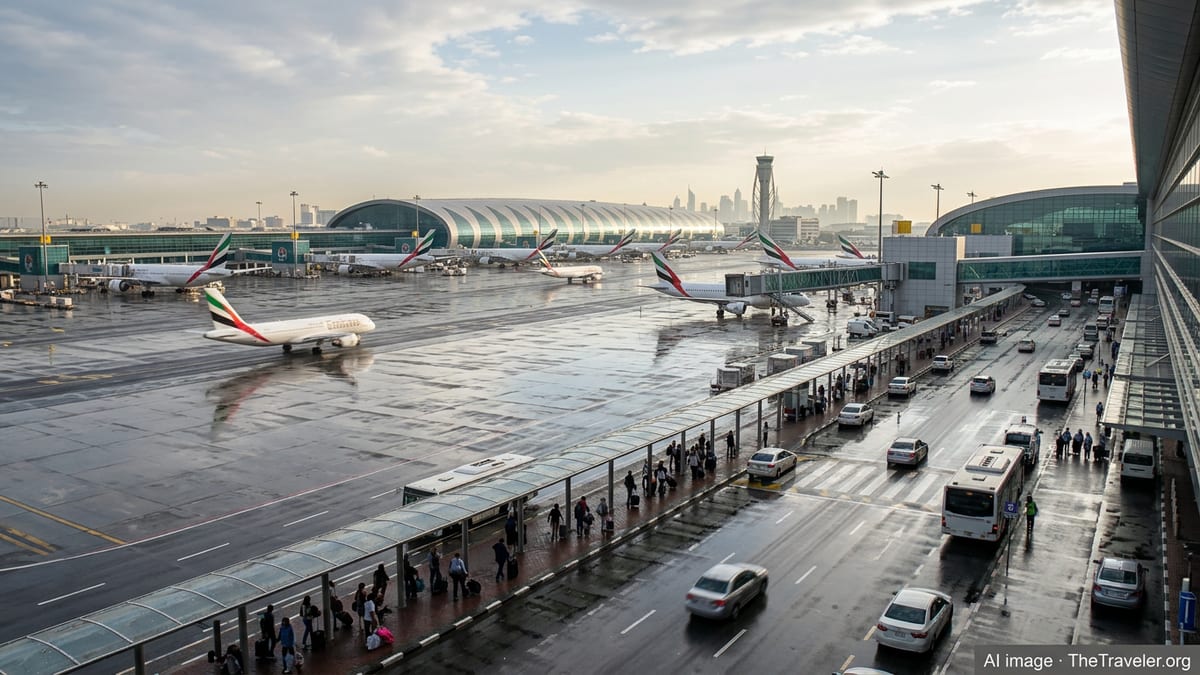
Gradual Reopening at DXB and DWC After Days of Disruption
Dubai Airports, which manages both Dubai International Airport (DXB) and Dubai World Central Al Maktoum International (DWC), confirmed that a small number of flights are now operating at both hubs following days of severe weather and knock-on airspace restrictions. Operations restarted in phases from the evening of March 2, with airport officials stressing that capacity remains significantly reduced and that the recovery will be incremental rather than immediate.
The extreme storms, which brought intense rainfall, localized flooding and difficult road conditions across parts of the United Arab Emirates, had forced one of the world’s busiest international hubs to effectively slow to a crawl. Aircraft diversions, ground delays and cancellations rippled through the global network, affecting connecting traffic well beyond Dubai and prompting airlines to activate emergency contingency plans.
Airport authorities said priority is currently being given to repositioning aircraft, operating essential services and clearing the backlog of passengers already in the system. That means many routine flights remain suspended or subject to last-minute schedule changes, even as the first departures and arrivals begin to appear on departures boards at both airports.
Officials cautioned that the operating environment is still fragile, with weather-related knock-on effects, congested airspace and crew duty-time limitations all constraining how quickly a normal schedule can be restored. Travellers are being told to expect queues, altered routings and potential further delays as the system slowly stabilises.
Airlines Prioritise Stranded Passengers and Essential Routes
Emirates and flydubai, the two largest operators at DXB, have begun operating a limited number of flights, focusing initially on key trunk routes and passengers whose earlier journeys were disrupted. Emirates has issued a series of rolling updates confirming that only customers with revalidated or newly confirmed bookings for specific departures should make their way to the airport, while warning that many services remain cancelled or heavily overbooked.
Flydubai has similarly advised customers that its operations are restricted to a curtailed schedule, with priority given to travellers who were already in transit when the storms hit. The airline has urged passengers to ensure that their contact details are up to date and to monitor its official channels for rebooking notifications, rather than attempting to resolve changes at airport check in, where queues remain long and capacity is limited.
Other international carriers using DXB and DWC have also started to reinstate select flights, but most are operating at far below their normal frequencies. Aviation analysts say that while the physical infrastructure at both airports has largely withstood the storms, the operational challenge now lies in rebalancing aircraft and crew across far-flung networks that were thrown off course over several days.
Industry observers note that recovery from such large-scale disruption is often uneven. Some destinations may see services restored quickly, while others experience prolonged gaps as airlines juggle aircraft availability, crew schedules and continuing airspace constraints in parts of the wider region.
Passengers Told Not to Travel to Airports Without Confirmation
Dubai Airports has delivered a clear message to travellers: do not go to DXB or DWC unless your airline has explicitly confirmed that your flight is operating and has provided a firm departure time. The operator said turning up at the terminal without verification not only risks a wasted journey for passengers but also adds pressure to already stretched airport facilities.
Airport officials and carriers have reported scenes of congestion in recent days as some travellers arrived in the hope of securing standby seats or same day rebookings. With many flights still grounded and capacity on operating services heavily constrained, those efforts have frequently proved unsuccessful, further crowding check in halls and customer service desks.
Passengers holding tickets for the coming days are being strongly urged to check flight status on airline apps or through official customer service channels before leaving home, and to look out for email or SMS alerts regarding cancellations or schedule changes. Authorities have also reminded residents and visitors to factor in possible delays on Dubai’s road network, which is still recovering from the storms, and to allow extra time if they do have a confirmed departure.
Travel agents and corporate travel managers are playing a key role in relaying these instructions, with many advising clients to wait for proactive contact from airlines rather than repeatedly calling hotlines or visiting ticket counters in person, where wait times remain high.
Knock-on Effects Across Global Routes and Cargo Flows
The disruption in Dubai is having a wider impact on global aviation, particularly on long haul corridors linking Europe, Asia, Africa and Australasia. DXB’s role as a major connecting hub means that even a partial shutdown can ripple through airline timetables on multiple continents, stranding passengers far from their final destinations and complicating aircraft rotations.
Logistics experts report that air cargo flows are also being squeezed, as the reduction in passenger flights removes significant belly hold capacity from key lanes. Freight operators are attempting to reroute high priority shipments through alternative hubs in the Gulf and beyond, but slots and aircraft are limited at short notice, which could lead to delays for some time sensitive goods.
Tourism officials in Dubai say it is too early to quantify the short term economic impact of the storms and resulting aviation disruption. However, hotels near the airports and in central districts have been operating at high occupancy as stranded travellers seek last minute accommodation, while some leisure visitors have seen their holidays unexpectedly extended or curtailed.
Analysts expect that, barring further severe weather or new airspace restrictions, Dubai’s aviation sector should gradually return to normal patterns over the coming weeks, thanks to the scale of its infrastructure and the operational experience of its carriers. Even so, they caution that travellers may continue to feel the aftershocks of the recent storms in the form of lingering delays, rebookings and altered routings.
What Travellers Should Do Now
For passengers due to travel through Dubai in the coming days, aviation and consumer experts are emphasising preparation and patience. The first step, they say, is to verify every flight segment directly with the operating airline, using official apps or websites, and to refresh that information repeatedly in the 24 hours before departure, as schedules are being adjusted at short notice.
Travellers holding flexible tickets or non essential itineraries are being encouraged, where possible, to consider postponing journeys until operations at DXB and DWC have stabilised. Those who must travel are advised to build in longer connection times, keep an eye on gate changes, and carry essentials such as medication, chargers and a change of clothes in hand luggage in case of unexpected overnight stays.
Passengers already in Dubai but without confirmed onward flights are being told to stay in their accommodation until they receive a clear rebooking message. Heading to the airport in the hope of a last minute seat, experts warn, is more likely to result in long queues than in a confirmed boarding pass at this stage of the recovery.
As limited services slowly ramp up, Dubai’s authorities and airlines are urging the travelling public to follow official updates closely and to treat timetable information as fluid rather than fixed. With weather conditions improving but the system still under strain, a cautious return to the skies is underway, one carefully managed flight at a time.