

More news on this day
As flight schedules are repeatedly torn up by regional tensions and airspace closures, a quieter story has emerged at Dubai International Airport: staff turning to acts of everyday kindness to steady anxious travellers and restore a sense of calm amid the chaos.
Get the latest news straight to your inbox!
Delays, diversions and a region on edge
Dubai International Airport has spent recent weeks navigating one of its most turbulent periods in years, as airspace closures and security concerns ripple across the Gulf. Publicly available information shows that air traffic has been disrupted repeatedly, with temporary suspensions, diversions and longer-than-usual ground holds affecting passengers across multiple carriers.
Reports from regional media indicate that the airport, one of the world’s busiest hubs, was forced to slow or halt operations on several occasions after missile and drone activity prompted authorities to restrict airspace. Airlines have announced rolling cancellations and schedule reductions on routes to and from Dubai, leaving thousands of travellers facing missed connections and overnight delays.
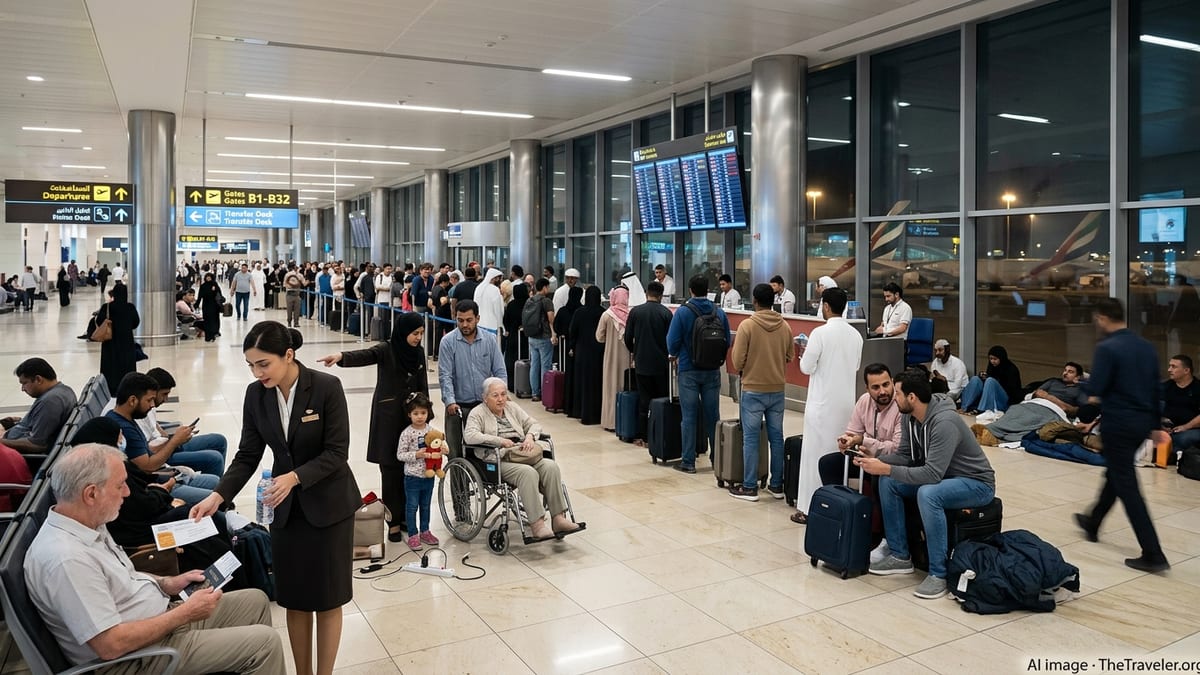
Despite the operational strain, the airport has remained a critical transit point for those trying to return home or continue long-haul journeys. Crowded departure halls, improvised sleeping areas and extended queues have become familiar scenes, underscoring how deeply the disruptions have affected global travel patterns.
Against that challenging backdrop, attention has increasingly turned to how front-line teams at the airport are interacting with stranded passengers, and how small gestures are softening the impact of major logistical upheaval.
Meal vouchers, rebookings and a focus on reassurance
According to travel updates and passenger accounts shared online, airlines operating at Dubai International have leaned heavily on customer-care measures as delays mounted. Complimentary meal vouchers, hotel accommodation for extended layovers and fee-free rebooking options have been widely reported as carriers attempt to manage large volumes of disrupted itineraries.
Some passengers describe being proactively rebooked onto alternative connections without needing to queue at transfer desks, reducing uncertainty for those already facing long waits. Others recount being offered refreshments and clear, repeated announcements when boarding times shifted multiple times in a single day.
Operational bulletins and publicly available airline guidance suggest that these gestures go beyond standard delay protocols. With regional airspace conditions changing at short notice, carriers have been under pressure to adjust in real time, while maintaining a level of service that reassures travellers who may be nervous about both safety and onward travel.
For many passengers, the practical support of food, water and a confirmed onward seat has become the first sign that, even in a volatile environment, their journey is still being actively managed.
Front-line staff praised for calm under pressure
Alongside official updates, a wave of first-hand stories posted on social platforms has highlighted the human side of the response at Dubai International. Travellers describe ground-handling teams, gate agents and security staff remaining composed during crowded scenes, offering directions, answering repeated questions and, in some cases, simply taking time to listen.
In several widely shared posts, passengers speak of staff members walking elderly travellers through security checks, arranging wheelchairs for those struggling after long flights, and gently reassuring families with young children during sudden evacuations or gate changes. Some accounts mention employees staying beyond their scheduled shifts to help manage queues or escort people to rebooking counters.
These small moments of assistance, often unremarkable in calmer periods, have taken on new significance amid rolling disruptions. Observers note that a few kind words, a bottle of water handed to someone who has been waiting for hours, or a staff member helping to translate announcements can dramatically change how a long delay is remembered.
The tone of many of these passenger accounts contrasts sharply with the frustration typically associated with flight disruptions, suggesting that the attitude of staff on the ground has played a key role in defusing tension.
Online reactions highlight a “different side” of disruption
The stories emerging from Dubai International have generated strong reactions online, with posts praising airport and airline staff attracting significant engagement. Commenters have described feeling “looked after” despite missed flights, and some have contrasted their recent experiences in Dubai with more negative encounters at other major hubs.
Travel discussion forums and social feeds feature messages from passengers who say they expected anger and confusion, but instead encountered what they saw as an atmosphere of patience. Several posts describe complete strangers sharing phone chargers, watching over each other’s bags and keeping children entertained in crowded gate areas, after airport staff helped to set expectations about waiting times.
According to this publicly visible feedback, it is these informal, human moments that have left the deepest impression. While few travellers welcome an unexpected overnight stay in an airport, many of the accounts circulating in recent days frame Dubai’s response as evidence that small gestures of empathy can significantly soften the blow.
The online response has also underscored how quickly narratives about an airport can shift. In a region currently associated with headlines about conflict and closures, the stories from Dubai International are offering a quieter counterpoint focused on cooperation and care.
A hub under strain that remains determinedly open
Industry analysts note that Dubai’s position as a global connecting hub leaves it especially exposed whenever regional airspace becomes constrained. Even short suspensions can reverberate across continents, stranding passengers far from home and complicating crew and aircraft rotations.
Despite that vulnerability, publicly available information shows that Dubai International has consistently sought to resume at least partial operations as conditions allow, adjusting schedules to balance safety requirements with the needs of tens of thousands of transit passengers. This approach has required rapid coordination between airlines, ground services and airport management teams, all while the terminals remain crowded with travellers seeking answers.
For now, forecasts suggest that the region may continue to face intermittent disruption. Yet in Dubai, the narrative that is capturing public attention is not only about cancelled flights and damaged timetables, but about staff quietly handing out meal vouchers, guiding confused families through unfamiliar terminals and offering a steady presence in uncertain times.
As global aviation continues to navigate a period of volatility, the recent scenes at Dubai International Airport illustrate how even modest gestures on the concourse can resonate far beyond the departure gate, shaping how passengers remember some of their most stressful journeys.