

More news on this day
Dubai’s role as a safe, ultra-connected global hub was shattered on February 28 as explosions over the city, including an incident at Palm Jumeirah, triggered a sudden nationwide airspace closure and plunged Gulf aviation into chaos amid a rapidly escalating Iran-Israel conflict.
Explosions Rattle Dubai Skyline and Palm Jumeirah
Loud blasts and streaks of interceptor fire lit the skies over Dubai on Saturday as Iranian missiles and drones targeted the United Arab Emirates in the wake of joint United States and Israeli strikes on Iran. Residents reported powerful detonations across multiple districts, with social media videos showing flashes over the coast and smoke rising behind the city’s landmark skyline.
Authorities confirmed an incident at a building in the Palm Jumeirah area, one of Dubai’s most recognisable man-made islands and a major tourism magnet. Emergency services rushed to the scene, where a fire was swiftly contained and debris was visible around a waterfront hotel complex. Officials said there were no immediate reports of mass casualties, attributing the limited impact to the country’s layered air defence systems.
The UAE Ministry of Defence stated that its forces intercepted successive waves of ballistic missiles and drones launched from Iran, describing the attack as a dangerous escalation and a violation of national sovereignty. Residents and visitors were urged to stay away from impact sites and to follow only official information channels, as rumours and unverified videos flooded messaging apps.
For many in the city, the images of fire and smoke near Palm Jumeirah and other marquee districts such as Downtown Dubai marked an unsettling new phase in a conflict that had previously felt more distant. Tourists and expatriates accustomed to viewing Dubai as a sanctuary of stability in a volatile region suddenly found themselves listening to explosions and monitoring air-raid updates alongside their travel plans.
Airspace Shutdown Freezes Dubai’s World-Famous Hub
In an unprecedented move, the UAE’s General Civil Aviation Authority ordered a temporary nationwide closure of airspace from early afternoon, citing the need to protect passengers, crews and national territory while the scale of the threat was assessed. The decision effectively grounded commercial aviation across the country and halted overflights that usually crisscross Gulf skies.
Dubai Airports, which operates Dubai International Airport and the emirate’s second hub at Al Maktoum International, confirmed that all flight operations were suspended until further notice. Passengers were urged not to travel to the terminals and to seek updates directly from their airlines, as departure boards flipped rapidly from delayed to cancelled.
Home carrier Emirates, the world’s largest international airline, halted all flights to and from its Dubai hub, while sister airline flydubai and UAE low-cost carrier Air Arabia also suspended multiple services. At Abu Dhabi’s Zayed International Airport, Etihad Airways announced widespread disruptions, with outbound flights paused into Sunday and some inbound services cancelled or diverted.
The closure of UAE airspace came as part of a wider regional shutdown that included Israel, Iran, Iraq, Jordan, Qatar, Bahrain and Kuwait. Aviation tracking platforms showed vast empty corridors over the Middle East, forcing long-haul routes between Europe and Asia to be rerouted or cancelled and exposing the global system’s reliance on Gulf hubs as critical transit points.
Stranded Travelers Face Long Lines, Uncertainty and Rising Costs
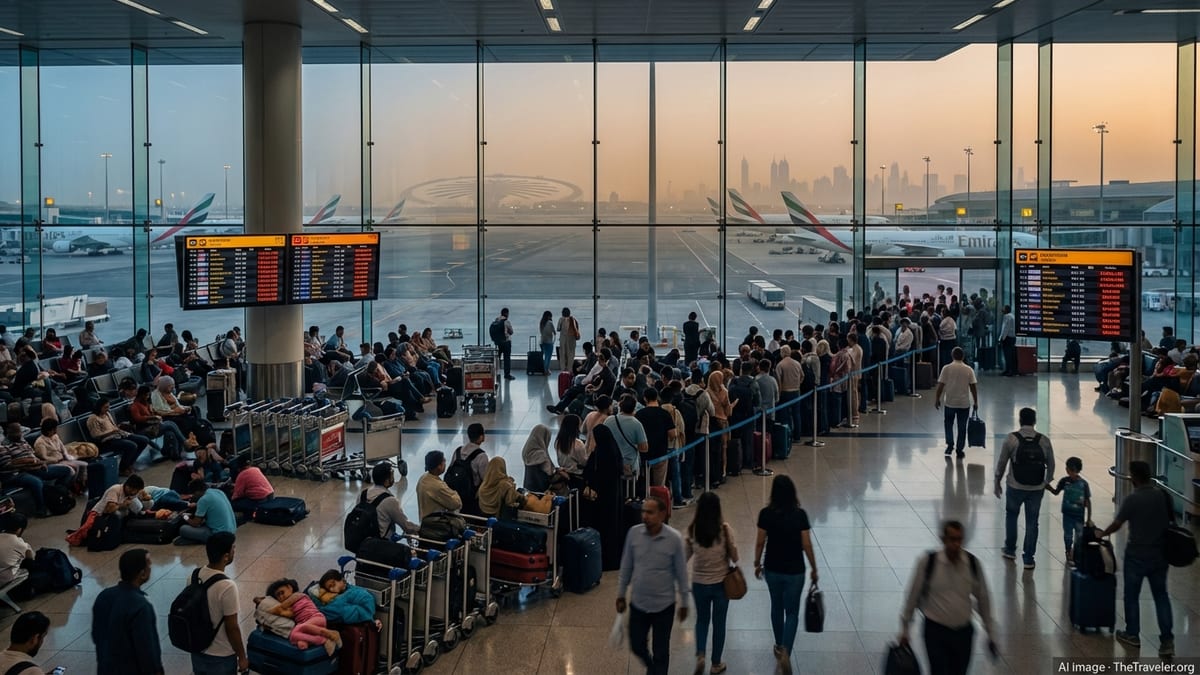
Inside Dubai International, one of the busiest airports on the planet, the usually choreographed flow of passengers dissolved into snaking queues, crowded seating areas and impromptu waiting zones near departure gates. Families on holiday, business travelers and transit passengers found themselves suddenly stranded, some with onward connections now impossible as airspace closures rippled across the region.
Airlines and airport staff scrambled to provide food vouchers, hotel rooms and rebooking options, but heavy demand quickly tested capacity. With many neighbouring countries also shuttering their skies or limiting operations, alternative routings were scarce and expensive, and rebooked itineraries stretched days into the future for some travelers.
Travel agents and online booking platforms reported a spike in calls from anxious customers seeking clarity on whether to proceed, reroute or cancel upcoming trips through Gulf hubs. Industry analysts warned that if current restrictions extend beyond a few days, the impact on airline schedules and global connectivity could rival previous major shocks to the aviation system.
Beyond immediate delays, airlines now face longer flight paths around closed airspaces, higher fuel burn and increased insurance and war-risk premiums. For travelers, that is likely to translate into fuller flights, more complex itineraries and potentially higher fares on some of the most popular Europe–Asia and Australasia routes in the weeks ahead.
Regional Security Jitters Hit Tourism and Business Travel
The attacks on Dubai and other Gulf locations mark a stark challenge to the image of the UAE and its neighbours as insulated commercial and tourism havens. Dubai in particular has marketed itself as a neutral, business-friendly crossroads, and the sight of interceptors over its skyscrapers and resort islands is likely to weigh on traveler confidence in the short term.
Tour operators reported guests asking to cut stays short or shift bookings to alternative destinations outside the immediate conflict region. Corporate travel managers said they were reviewing itineraries that routed staff through Dubai, Doha or Abu Dhabi, weighing company risk thresholds against the vital role these hubs play in global business networks.
Major hotel groups on Palm Jumeirah and along Dubai’s coastline stepped up visible security, coordinated closely with local authorities and reinforced messaging around emergency procedures. While bookings had been buoyant heading into the peak spring travel period, a wave of cancellations or postponements remains possible if missile alerts and airspace disruptions continue.
At the same time, industry observers cautioned against writing off Gulf tourism too quickly, noting the region’s track record of rapid recovery following previous episodes of geopolitical tension. Much will depend on whether Saturday’s strikes remain an isolated spike or the opening of a prolonged campaign targeting civilian infrastructure and transport nodes.
What Travelers Should Do Next
With the situation evolving by the hour, aviation and consular authorities around the world urged travelers to stay flexible and closely monitor official advisories. Several governments recommended deferring non-essential travel through the Gulf, while others advised citizens already in the UAE and neighbouring states to shelter indoors and avoid crowded public spaces until security updates indicate lower risk.
For those currently holding tickets via Dubai or other Gulf hubs in the coming days, experts advise regularly checking airline apps and email alerts, confirming that contact details are up to date, and considering travel insurance policies that cover conflict-related disruptions and extended delays. Some carriers are waiving change fees or offering free rerouting, but options remain constrained by the breadth of airspace closures.
Travelers already in the UAE are being encouraged to maintain communication with their embassies, register with consular services where available and keep identification documents easily accessible in case of sudden airport reopenings or evacuations. Local authorities continue to stress that the safety of residents and visitors is a top priority, even as the broader security picture remains uncertain.
For now, Dubai’s normally crowded skies and bustling terminals are a stark reminder of how quickly a regional conflict can redraw the global travel map. Whether this shock proves temporary or ushers in a longer era of rerouted corridors and heightened risk will shape not only Middle East tourism, but also how millions of travelers connect between continents.