

More news on this day
Dubai and Abu Dhabi are tightening their grip on global aviation as the Middle East’s air travel rebound gains pace, with Emirates signaling a return to full capacity by 2026 and fresh data showing record traffic through the United Arab Emirates’ twin hubs.
Get the latest news straight to your inbox!
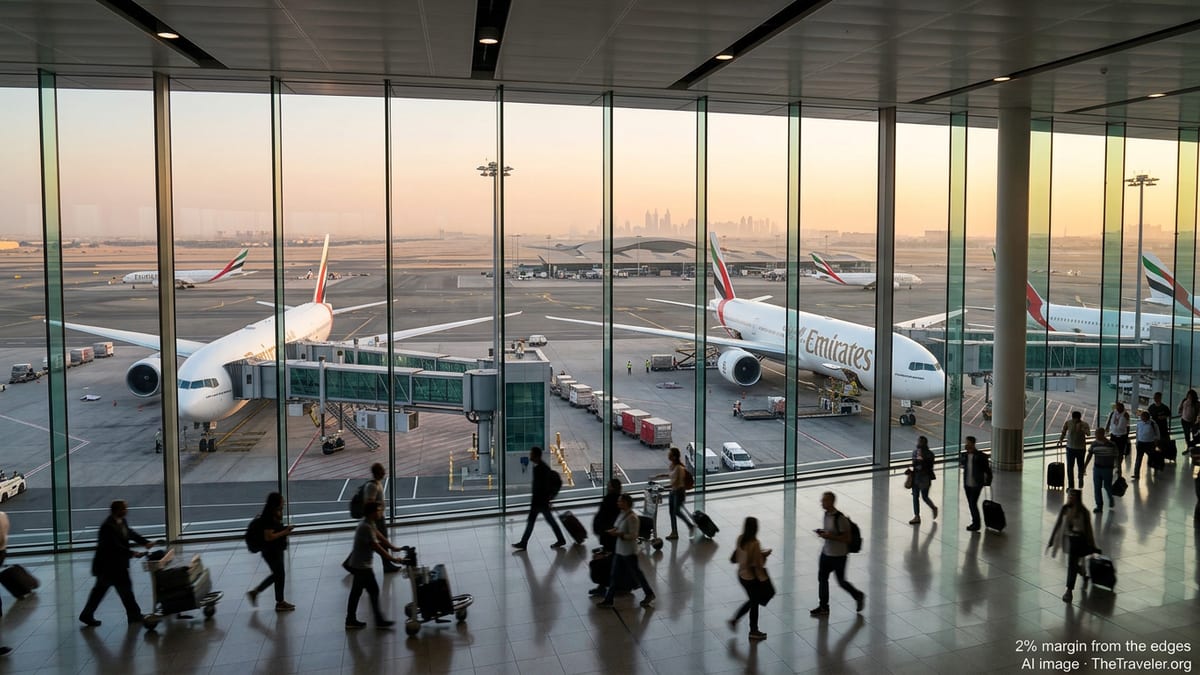
Middle East Recovery Outpaces Global Passenger Growth
The global aviation rebound that began in 2023 is entering a more mature phase in 2026, with the Middle East once again outpacing most regions on long-haul demand. Latest figures from industry bodies show global passenger traffic continuing to grow in early 2026, but with the strongest dynamics concentrated along major East–West trunk routes that converge over the Gulf.
Middle Eastern carriers entered this cycle with relatively lean cost structures and unconstrained hub airports, allowing them to add seats more quickly than many European or Asian rivals still grappling with staffing shortages and infrastructure bottlenecks. Capacity growth in the region is now running ahead of demand, yet load factors are holding near pre-pandemic highs, a sign that the appetite for connections through Dubai and Abu Dhabi remains robust.
For Emirates, the region’s largest long-haul airline and the anchor tenant at Dubai International Airport, that backdrop has provided room to restore frequencies, reopen secondary destinations and prepare for the arrival of new widebody aircraft that will push its network back toward, and likely beyond, pre-2020 levels by 2026.
Dubai International Targets 100 Million Passengers
Dubai International Airport has already moved beyond recovery into expansion. The hub handled a record 95.2 million passengers in 2025, cementing its status as the world’s busiest airport for international traffic and underscoring how fully demand has returned to the city’s tourism and business ecosystem.
Airport operator Dubai Airports now forecasts traffic approaching the symbolic 100 million passenger mark by the end of 2026, a milestone that had previously been penciled in for 2027. Recent quarters have seen successive upgrades to traffic guidance as flows from India, Saudi Arabia, the United Kingdom and the United States push well above earlier expectations.
The surge has accelerated investment in terminal throughput, biometrics and security technology to keep dwell times in check, even as record days and record months become a routine feature of operations. For travelers, that is translating into fuller flights and busier concourses, but also a broader choice of departure times and one-stop itineraries as Emirates rebuilds its pre-crisis network.
Emirates Rebuilds Fleet and Network for 2026 Peak
Emirates is using the current upswing to reshape its fleet for the second half of the decade. In late 2025 the airline placed a major order for Boeing 777-9 aircraft, adding to existing commitments and signaling confidence that demand for high-capacity, long-range jets will remain strong into the 2030s. Those aircraft, once delivered, are expected to underpin additional frequencies on key Europe–Asia and transpacific routes that route via Dubai.
While the carrier has not disclosed a detailed public timetable for each route, executives have repeatedly pointed to 2026 as the point at which Emirates expects to be operating at or above its pre-pandemic capacity in available seat kilometers. That trajectory is being supported by ongoing cabin refurbishments of the A380 fleet, the roll-out of premium economy on more routes and the reopening of destinations across Southeast Asia, Africa and secondary European markets.
Financial performance has given management substantial room to maneuver. Emirates has reported successive years of multibillion-dollar profits as travel demand roared back, allowing it to reinvest in fleet renewal, ground infrastructure and digital platforms while continuing to hire crew at scale. For Dubai, whose broader economy is tightly interwoven with aviation, the airline’s return to full capacity is central to maintaining growth in tourism, trade and high-end real estate.
Abu Dhabi’s Zayed International Emerges as a Challenger Hub
Just down the coast, Abu Dhabi is rapidly scaling up its own aviation ambitions. Zayed International Airport, which moved mainline operations into a new terminal in late 2023, handled more than 33 million passengers in 2025, the highest in its history and a powerful statement of intent from the UAE capital.
The airport’s growth is being driven in large part by Etihad Airways, which has embarked on a disciplined expansion plan after several years of restructuring. The carrier carried more than 22 million passengers in 2025 and has started 2026 with double-digit monthly traffic growth, even as it adds capacity and destinations across Europe, Asia and North America.
Abu Dhabi authorities are positioning Zayed International as a complementary, rather than directly competitive, hub to Dubai. By focusing on a mix of premium connecting traffic, fast-growing point-to-point demand into the capital and partnerships with low-cost operator Air Arabia Abu Dhabi, the emirate is seeking to capture a greater share of the Middle East’s projected passenger growth while supporting its own tourism and investment agenda.
Capacity Growth Brings Opportunities and Risks
The rapid return to full capacity across the UAE is not without challenges. The broader region has experienced episodes of geopolitical tension and temporary airspace closures over the past two years, periodically forcing airlines to reroute flights and adjust schedules at short notice. Both Dubai and Abu Dhabi have invested heavily in contingency planning and air traffic management to maintain reliability in a complex operating environment.
There are also questions about whether infrastructure can keep pace with demand beyond 2026. Dubai has begun long-term planning for a larger airport at Al Maktoum International, while continuing to fine-tune processes at its current hub. Abu Dhabi, for its part, is already exploring enhancements to surface transport links and terminal capacity to ensure its new facility can absorb the next wave of growth.
For travelers and the wider tourism sector, however, the near-term picture is largely positive. As Emirates moves toward full capacity and Etihad continues to add routes, passengers are likely to benefit from a denser web of one-stop connections, more competitive fares on key long-haul corridors and a wider spread of departure times that make complex itineraries easier to construct. With both Dubai and Abu Dhabi leaning into aviation as a cornerstone of their economic strategies, 2026 is shaping up as another defining year for the Gulf’s rise as the world’s preferred crossroads.