

More news on this day
Dubai and Doha, two of the world’s busiest aviation and tourism hubs, are facing their most serious crisis in years as the escalating conflict involving Iran, the United States and Israel triggers sweeping airspace closures, mass flight cancellations and a mounting battle over airline refunds.
Hub Airports Cut Off as War Shuts the Sky
In barely more than a week, the conflict has transformed the Gulf’s glittering megahubs into pressure cookers. Dubai International Airport, normally the world’s busiest international gateway, and Doha’s Hamad International, repeatedly ranked among the top global airports, have seen their schedules slashed after regional airspace over Iran, Iraq and parts of the Gulf was deemed unsafe.
Data from aviation analytics firms and industry bulletins indicate that more than 20,000 flights across the wider Middle East have been cancelled since February 28, with Dubai and Doha bearing a substantial share of the disruption. Emirates, Etihad and Qatar Airways, which together usually channel around 90,000 passengers a day through their hubs, have pivoted from growth mode to emergency repatriation, operating reduced schedules and longer, fuel-heavy routings.
While Emirates and Etihad have begun gradually restoring limited services, operations in Dubai remain well below normal, with priority given to stranded travelers and essential connections. Doha, which experienced direct disruption linked to strikes and debris around key infrastructure, is still largely cut off from regular traffic, with Qatar Airways relying on special repatriation corridors and charter-style movements instead of its usual global bank of connections.
Analysts say the situation represents the most severe collapse in regional connectivity since the height of the pandemic, but with additional complexity because safe airspace is constantly shifting as the conflict evolves.
Stranded Tourists, Rising Anxiety and Pressure on Consulates
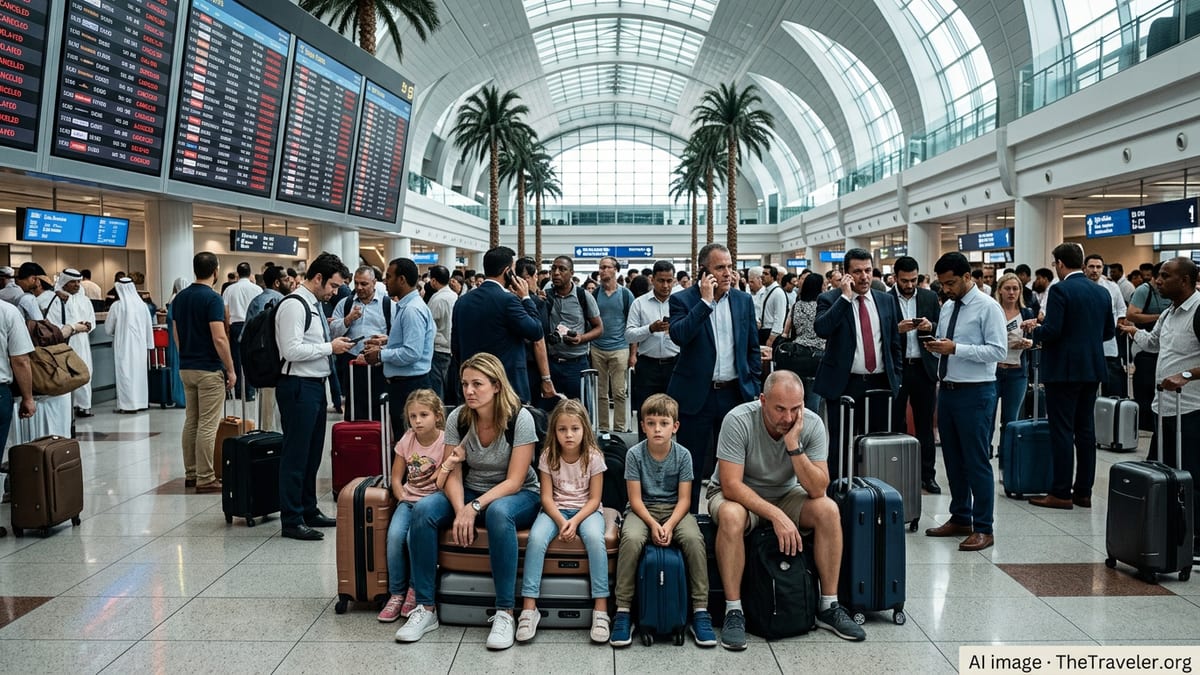
The abrupt shutdowns have left tourists marooned from the palm-fringed resorts of Dubai’s Jumeirah coastline to the museums and waterfront promenades of Doha’s West Bay. Airport hotels are overflowing, city properties report unusual one-night extensions, and social media feeds are full of images of families camped out on terminal floors as they await news of outbound flights.
Consulates in both cities have been inundated with appeals for help, particularly from package tourists and long-haul travelers who used Dubai and Doha as transit points between Europe, Asia and Africa. Several European governments have chartered their own aircraft or reserved blocks of seats on repatriation flights as commercial capacity remains constrained and highly volatile.
For local tourism operators, the crisis has shattered what had been a strong start to 2026. Dubai entered the year off the back of record visitor numbers and nearly full hotels during major events and shopping festivals. Now hoteliers report a sudden shift from high-yield leisure stays to cost-sensitive stranded passengers negotiating last-minute extensions or requesting refunds for missed onward segments and excursions.
In Doha, the still-young tourism push built around major sporting and cultural events is also under strain. Tour guides, desert safari operators and museum districts that had banked on rising arrivals in March describe a wave of cancellations and a sharp drop in forward bookings, even as authorities emphasize that key visitor areas away from strategic infrastructure remain calm.
Refunds, Vouchers and Legal Grey Areas
The turmoil in the sky has rapidly turned into a battle over who pays on the ground. With schedules in flux and governments advising against non-essential travel to parts of the region, passengers are pressing airlines, online travel agencies and tour operators for cash refunds rather than future credits.
Carriers based in the Gulf and beyond are invoking force majeure clauses, arguing that sudden airspace closures and security risks fall outside their control. That stance allows many airlines to offer travel vouchers or rebooking options instead of full refunds, particularly for non-refundable tickets. Passenger advocacy groups, however, say the patchwork of regulations spanning departure country, airline home base and booking channel is confusing travelers and leaving many unsure of their rights.
European and British regulators have reminded airlines that standard compensation rules for delays and cancellations often do not apply when security events are involved, but they have also urged carriers to show flexibility where possible. Consumer lawyers note that package holiday rules, which cover bundled flights and hotels, typically offer stronger protections than standalone air tickets, placing additional pressure on tour operators to shoulder the cost of rebooking clients out of Dubai and Doha.
On the ground, some travelers are choosing not to wait for formal processes. Reports are emerging of stranded passengers pooling funds for private charters to safe third-country hubs or accepting itineraries that route them through secondary airports and lengthy overland connections simply to get home, highlighting the depth of frustration with official refund and rebooking channels.
Regional Winners Emerge as Routes Shift
As Dubai and Doha struggle to restore their hub roles, other airports around the Gulf and wider region are stepping into the vacuum. Muscat in Oman, Riyadh and Jeddah in Saudi Arabia, and several major European and Asian gateways have seen a surge in last-minute demand as airlines stitch together improvised routings that avoid conflict zones.
Muscat, in particular, has become a pivotal diversion point, with Oman’s national carrier adding capacity and regional governments coordinating safe corridors to allow repatriation flights to cross fragmented airspace. Hoteliers and tourism boards in these emerging hubs are walking a delicate line, responding to the influx while avoiding the perception of profiting from crisis.
For Dubai and Doha, the immediate concern is restoring enough stability to keep them in global routing plans. Airline network planners warn that if the conflict and restrictions persist, some long-haul carriers may permanently rebalance their schedules away from the Gulf, strengthening point-to-point services or alternative hubs in Europe and Asia instead of relying on a single Middle Eastern stopover.
Any structural shift of that kind would have deep implications for tourism, conference business and investment flows in both cities, which have spent years positioning themselves as indispensable crossroads of global travel.
Tourism Authorities Race to Salvage Confidence
Tourism and civil aviation authorities in the United Arab Emirates and Qatar are responding with a mix of crisis communications and practical support. Official channels in both countries are publishing frequent operational updates, urging travelers not to proceed to airports without confirmed bookings and coordinating with airlines on repatriation priorities.
Industry insiders say that once the immediate safety risks and airspace closures ease, salvaging traveler confidence will be the next major task. That could involve aggressive fare promotions, flexible booking policies, and campaigns emphasizing security measures and the resilience of infrastructure after limited damage from falling debris at or near key sites.
Hotel associations in Dubai and Doha are already discussing coordinated offers for future stays targeted at guests whose trips were disrupted, hoping to turn a negative experience into a reason to return once conditions normalize. Large-scale events later in 2026 are being reassessed rather than cancelled outright, with organizers weighing whether shifting dates or formats could preserve economic benefits without exposing visitors to elevated risk.
For now, the images that define both cities are not of new attractions or record-breaking visitor numbers, but of departure boards full of cancellations, winding queues at airline service desks and tourists anxiously refreshing their phones for word that the skies over the Gulf are open again.