

More news on this day
Tens of thousands of passengers are struggling to leave Dubai and Doha this week as the escalating conflict involving Iran triggers sweeping airspace closures, mass flight cancellations and a mounting travel crisis across the Gulf’s busiest aviation hubs.
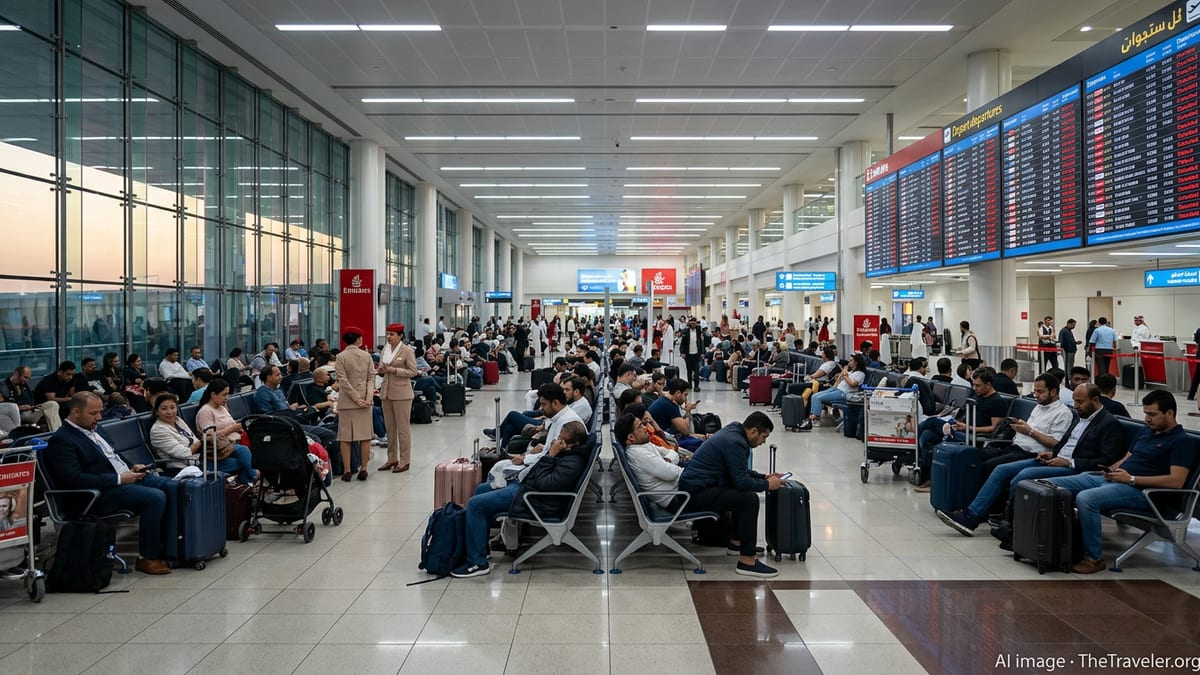
Gulf Megahubs Brought to a Standstill
Dubai International and Doha’s Hamad International, normally among the world’s busiest and most efficient connecting hubs, have been operating at a fraction of their usual capacity since a wave of US and Israeli strikes on Iran and Tehran’s retaliatory attacks over the weekend. Regional airspace restrictions in the United Arab Emirates, Qatar, Kuwait and Bahrain have forced airlines to ground or divert services, with departure boards in Dubai and Doha dominated by cancellations.
Emirates, flydubai, Qatar Airways and other carriers have suspended most regular schedules to and through the Gulf, focusing instead on a handful of relief and repositioning flights. Aviation analytics providers estimate that thousands of services touching the Middle East have been cancelled in recent days, with long-haul routes between Europe, Asia and Australasia particularly affected as airlines scramble to find safe and viable alternative corridors.
In Dubai, authorities have announced only a gradual and tightly controlled resumption of operations, urging passengers not to travel to the airport unless contacted directly by their airline. In Doha, aircraft movements remain heavily curtailed by the closure of Qatari airspace, effectively shutting down one of the most important transit gateways for traffic between Europe, South Asia and Oceania.
The sudden paralysis of these hubs comes at a time of high demand for leisure and business travel, magnifying the disruption far beyond the Middle East as aircraft and crews are left out of position and onward journeys collapse.
Stranded Passengers Face Uncertainty and Overcrowded Terminals
For travelers on the ground in Dubai and Doha, the crisis has translated into long queues, crowded terminals and considerable uncertainty about when they will be able to move on. Images from Dubai International show departure halls filled with passengers stretched along corridor walls, many perched on luggage trolleys or sleeping on the floor as they wait for new flight information.
Hotels near both airports have filled rapidly as airlines work to accommodate those whose itineraries have collapsed. Some carriers have arranged emergency block bookings, while others are asking passengers to source their own accommodation and seek reimbursement later, a prospect that is proving challenging in cities suddenly flooded with displaced travelers.
Transit passengers have been hit hardest. Many originated in Europe, India, Southeast Asia or Australia and were only scheduled to pass through the Gulf for a few hours. Instead, they have found themselves in protracted limbo, some without immediate visa clarity or access to their checked baggage. Families with small children, elderly travelers and those with medical needs are among the most vulnerable, prompting humanitarian concerns as the disruption stretches into multiple days.
Social media posts from stranded passengers describe confusion over rebooking options and rapidly changing information as airlines respond to evolving security guidance. While some have managed to secure seats on scarce alternative routes via Africa or southern Europe, others face waits of several days before a realistic onward option appears.
Airlines Reroute and Trim Networks as Safety Takes Priority
Airlines across Europe, Asia and the Middle East are racing to redesign networks in real time to keep aircraft away from active conflict zones and closed airspace. Flag carriers such as Air France, Lufthansa, British Airways and Turkish Airlines have canceled flights to Gulf cities or are detouring around Iran and Iraq, adding hours to flight times and substantially increasing fuel burn.
Gulf-based airlines are balancing pressure to repatriate tens of thousands of stranded passengers with strict safety directives from civil aviation authorities. Emirates and Etihad have begun operating a limited number of departures from the United Arab Emirates focused on evacuating travelers and repositioning aircraft, while Qatar Airways has signaled that it will restore services only after regulators confirm that air corridors are secure.
The complex geography of the crisis means there are few easy alternatives. With Iranian, Iraqi and Qatari airspace closed and parts of the Gulf under temporary restrictions, carriers are being pushed into narrow flight corridors over Saudi Arabia, the eastern Mediterranean or the Arabian Sea. That congestion heightens operational challenges and reduces capacity, even on routes that remain technically open.
Industry analysts warn that if the closures persist, airlines could be forced into deeper schedule cuts across their global networks, not just on Middle East routes, as aircraft and crews are tied up on longer detours or remain stuck at airports unable to dispatch normally.
Ripple Effects Felt From Europe to Asia-Pacific
The disruption at Dubai and Doha is radiating through global aviation systems, with knock-on delays and cancellations at airports far from the Gulf. Major European gateways such as London, Paris and Frankfurt are handling waves of passengers whose connecting flights via the Middle East have vanished, while airports in India and Southeast Asia are grappling with congested departure lounges and last-minute schedule changes.
Travelers bound for popular destinations in South Asia, East Africa and Australasia are among those most affected, as these flows rely heavily on Gulf transit hubs. With limited nonstop alternatives and many traditional overflight routes now unusable, carriers are struggling to accommodate rebooked passengers, and economy cabins on remaining services are selling out quickly.
The cargo sector is also under acute strain, as Gulf carriers play an outsized role in international air freight. The loss of belly-hold capacity on passenger flights, combined with restrictions on dedicated freighters operating through the region, has tightened supply chains for everything from electronics to pharmaceuticals. Logistics firms are warning of rising costs and longer delivery times, particularly on Europe–Asia lanes.
Tourism-dependent economies beyond the Middle East are bracing for a downturn in arrivals if the chaos persists. Destinations that rely on Gulf carriers to funnel visitors from long-haul markets could see cancellations and postponements in the critical weeks ahead.
Governments and Travelers Scramble for Contingency Plans
Governments with large numbers of citizens stranded in the Gulf are activating contingency plans, coordinating closely with airlines and regional authorities. European states, including the United Kingdom and Germany, are assessing options for organized repatriation flights and advising travelers to register their details with consular services while they await confirmed departures from Dubai, Doha and other affected airports.
Travel and security advisories have been sharply upgraded across the region, with many countries now urging against all but essential travel to Iran and neighboring states, and warning that transiting through Gulf hubs may remain risky or impractical in the short term. Travelers already en route are being told to monitor airline and government updates closely and to build in significant flexibility for delays and rerouting.
For individual passengers, the guidance from experts is to stay in close contact with airlines, use carrier apps and official channels for rebooking, and avoid heading to airports without confirmed new itineraries. Those with imminent travel plans involving Gulf connections are being encouraged to explore alternative routings via southern Europe, Africa or East Asia where available, although these options remain limited and often more expensive.
With no clear timeline for a full reopening of Gulf airspace, industry observers caution that the Dubai and Doha travel crisis could drag on, reshaping how airlines plan long-haul networks and underscoring once again how quickly geopolitical shocks can upend the global freedom of movement that modern travelers have come to take for granted.