

More news on this day
Dubai International Airport’s decision to cap foreign airlines at one daily flight is converging with widespread strike-related schedule cuts by carriers in the United Kingdom, Germany, India, Singapore, Hong Kong and elsewhere, fuelling a fresh wave of cancellations and severe disruptions at one of the world’s busiest aviation hubs.
Get the latest news straight to your inbox!
Foreign Flight Cap Adds New Constraint at World’s Busiest Hub
Publicly available notices and industry reports indicate that Dubai airport authorities have imposed a temporary limit of one daily rotation for most foreign carriers operating to Dubai International Airport, with measures broadly reported as running from late April through the end of May 2026. The move affects a wide range of international airlines that previously operated multiple daily services into the hub.
This cap is being introduced on top of an already fragile operational environment following Iranian strikes on the United Arab Emirates in late February, which damaged infrastructure and forced the suspension of regular flight schedules. Dubai International, consistently ranked among the world’s busiest airports by international passenger traffic, had only recently begun rebuilding capacity under limited, highly flexible timetables before the new restrictions were reported.
Airport coordination documents and airline briefings describe the one‑flight‑per‑day rule as a slot management tool intended to ease congestion, support safety measures and preserve runway and terminal capacity for home‑based carriers and essential services. For foreign airlines that rely on multiple daily frequencies to sustain connecting banks, however, the cap sharply reduces available capacity and undermines schedule integrity.
The cap does not apply in the same way to UAE‑based airlines, which continue to rebuild networks out of Dubai and other UAE airports using a mix of regular and repatriation services. This structural difference is contributing to a two‑speed recovery, with some carriers rapidly restoring links while many foreign operators face extended constraints.
UK and European Carriers Cut Dubai and Gulf Schedules
In the United Kingdom and continental Europe, several major airlines have already trimmed or suspended Dubai operations in response to the regional security situation, with the new cap adding further pressure. Travel trade outlets and European media report that some flag carriers, including those in Germany and the Netherlands, have extended suspensions of services to Dubai, Riyadh and other Gulf destinations well into May.
For UK travellers, publicly available information shows that some long‑haul carriers are planning to reduce their Dubai, Doha and Tel Aviv services to a single daily flight on selected routes from mid‑year, aligning with safety assessments and constrained airspace corridors. These moves coincide with the capacity cap at Dubai, limiting options for British travellers who typically rely on multiple daily departures across London and regional UK gateways.
German operators are confronting a similar squeeze. Coverage from European business and aviation outlets highlights that large German airlines have already cancelled extensive Middle East schedules during the crisis period, citing both security and operational complexity. With Dubai now restricting foreign frequencies, opportunities to reintroduce additional daily flights remain limited even as demand begins to recover.
Across Europe, analysts note that the combination of airspace closures, fuel routing challenges through the Strait of Hormuz and constrained slots at Dubai is forcing airlines to reroute or consolidate services, often funnelling passengers into a smaller number of flights and extending journey times.
Indian Airlines Face Sharp Capacity Loss to Dubai
Indian carriers are among the hardest hit by the one‑flight‑per‑day cap, given the dense network of services that previously linked multiple Indian cities with Dubai. Indian aviation coverage describes how airlines such as Air India, IndiGo and SpiceJet had built schedules with numerous daily rotations to Dubai International, which now must be compressed into a single round trip per day under the reported rules.
Industry associations in India have publicly urged intervention to ease the Dubai restrictions, arguing that the cap disproportionately constrains Indian carriers relative to local UAE airlines, which are not subject to the same one‑rotation limitation. With only one daily flight allowed on key city pairs, Indian airlines are facing underutilised aircraft, lost revenue opportunities and mounting complexity in reaccommodating passengers.
The impact on travellers is immediate. Ticket holders on heavily booked India–Dubai routes are encountering widespread rebookings, last‑minute cancellations and limited alternative options, particularly for those who planned to connect via Dubai to onward destinations in Europe or North America. Travel advisories from Indian and regional outlets consistently urge passengers to monitor their flight status closely and maintain flexible plans.
At the same time, UAE‑based carriers have been quicker to restore a broader set of India services from Dubai and Abu Dhabi, creating a divided landscape in which capacity is returning, but not evenly across all airlines or fare classes.
Asia-Pacific Suspensions From Singapore and Hong Kong Deepen the Disruption
Further east, carriers in Singapore and Hong Kong are extending suspensions on routes to Dubai and nearby Gulf cities, adding another layer of disruption. According to recent travel industry coverage, Singapore Airlines has prolonged its suspension of Singapore–Dubai flights until at least the end of May 2026, while Hong Kong‑based Cathay Pacific has cancelled all services to and from Dubai and Riyadh over a similar timeframe.
These suspensions effectively cut key Asia–Gulf corridors that previously fed significant traffic into Dubai’s global network. Without nonstop links from Singapore and Hong Kong, many passengers in Southeast Asia and Greater China must rely on alternative routings via other hubs in the Middle East or Europe, which themselves are operating on reduced or highly volatile schedules.
The combination of route suspensions and Dubai’s capacity cap is also constraining freight and belly‑hold cargo capacity on traditionally busy lanes. Logistics observers note that shippers are being forced to reroute goods, accept longer transit times, or pay premium rates for limited space on the flights that are still operating through the region.
For leisure travellers, particularly those connecting between Asia and Europe via Dubai, the lack of predictable schedules from Singapore and Hong Kong complicates forward planning. Travel commentators in those markets are advising would‑be passengers to postpone non‑essential trips, purchase fully flexible tickets where possible, and avoid tight connections through Dubai for the duration of the current measures.
Passengers Confront Rolling Cancellations and Complex Rebooking
Across all affected markets, the common denominator is uncertainty. With Dubai International operating under a foreign‑carrier cap and many airlines simultaneously responding to strikes, security assessments and changing airspace permissions, schedules are being adjusted with little notice, creating rolling waves of cancellations.
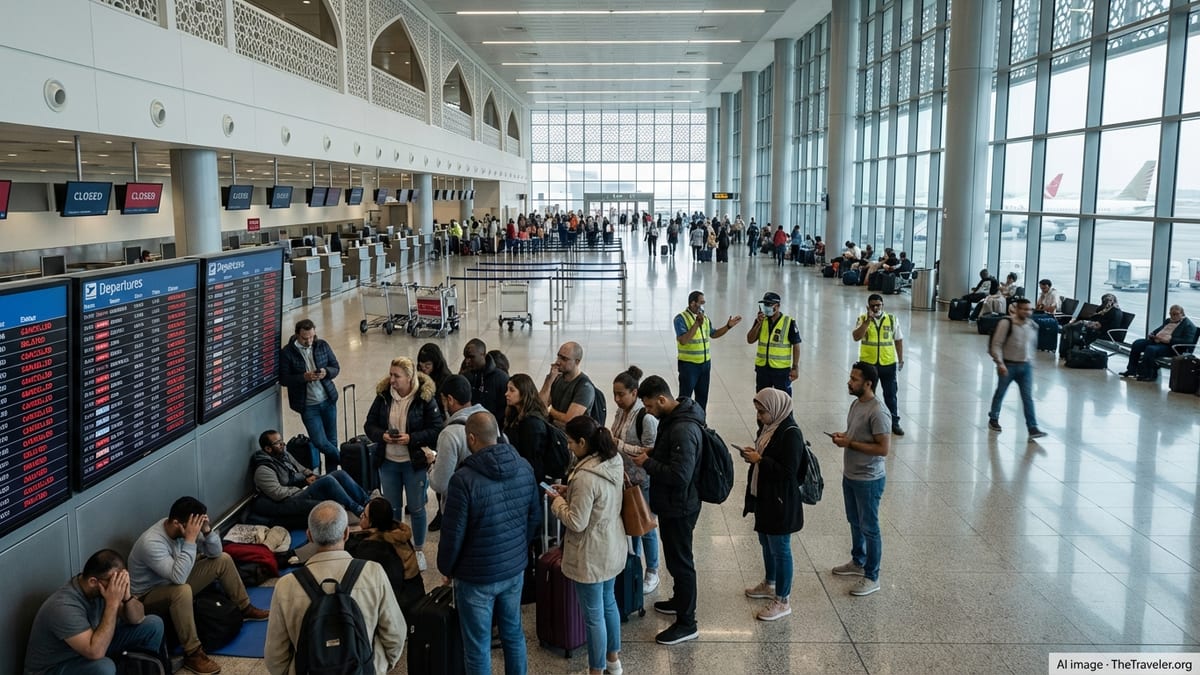
Travel industry reports describe scenes of crowded customer‑service lines, long wait times on airline call centres and rapidly shifting departure boards at airports linked to Dubai. Many carriers are prioritising previously cancelled passengers on the limited services that are still operating, leaving new bookings hard to secure and popular routes sold out days in advance.
Experts tracking the situation suggest that volatility is likely to persist at least through the end of the currently announced restriction period. They point out that even if security conditions stabilise and strikes ease, rebuilding full schedules at Dubai will require careful coordination across slot allocation, crew availability and aircraft positioning, as well as the unwinding of temporary one‑flight‑per‑day rules.
For now, publicly available guidance from airlines, airports and travel organisations consistently focuses on flexibility. Passengers with imminent travel plans involving Dubai are being encouraged to check flight status repeatedly, consider alternative routings or destinations, and allow extra time for connections, as the Middle East’s key transit hub continues to operate under unprecedented constraints.