

More news on this day
Air travel across the Middle East is facing its most severe disruption in years after a drone incident at Dubai International Airport forced widespread flight suspensions, leaving passengers in the UAE, Qatar, Saudi Arabia, and neighboring countries grappling with rolling cancellations and uncertain travel plans.
Get the latest news straight to your inbox!
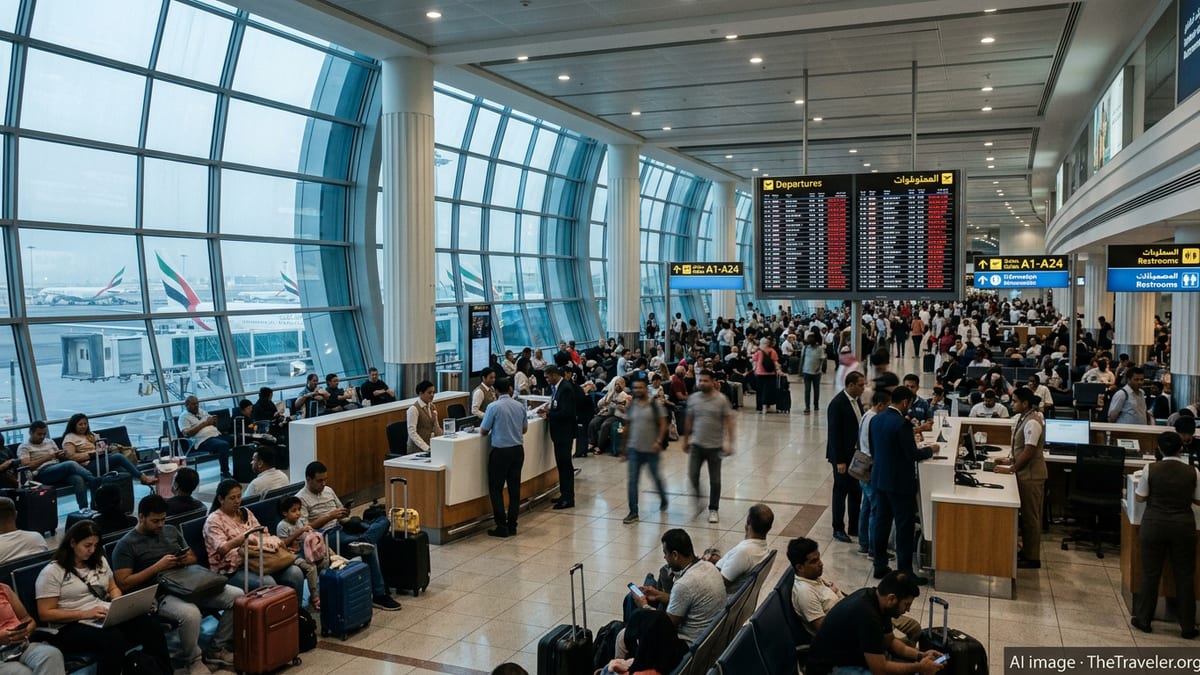
What Happened at Dubai Airport and Why Flights Are Still Disrupted
According to publicly available reporting, Dubai International Airport temporarily halted most operations after a drone strike near aviation fuel infrastructure triggered a fire and safety alarms. The incident, which occurred amid a broader campaign of missile and drone attacks linked to the 2026 Iran conflict, prompted an immediate suspension of departures and diversions of inbound aircraft to alternative airports in the UAE.
Information compiled from airport advisories and regional coverage shows that flight activity at Dubai resumed only gradually, with the hub operating on a reduced schedule and subject to sudden pauses whenever new aerial threats were detected. At several points in early and mid March, additional interceptions and debris near the airfield led to fresh stoppages, extending disruption far beyond the initial incident window.
These operational pauses at the world’s busiest international hub have had an outsized impact on global connectivity. With Dubai serving as a key transit point between Europe, Asia, Africa, and Oceania, even a partial shutdown has cascaded into missed connections, aircraft and crew out of position, and rolling delays that are still working their way through airline networks.
How the Shockwaves Reached Qatar, Saudi Arabia, and the Wider Region
Published travel advisories and airline statements show that Dubai’s problems are only one part of a larger regional airspace disruption affecting multiple Gulf states. In Qatar, closures and restrictions around Hamad International Airport have led to waves of cancellations and reroutings, especially on routes crossing or skirting conflict-affected air corridors.
Saudi Arabia has also seen reduced schedules and intermittent disruption at key gateways such as Riyadh’s King Khalid International Airport, where limited operations and delays have been reported. Travel risk bulletins describe airports across the Gulf operating under tight airspace management, with short-notice traffic holds and diversions when missile or drone activity is detected.
Corporate and government-focused briefings characterize the current situation as one of the most extensive aviation interruptions in the region since the pandemic era, citing thousands of cancelled services across the Middle East and North Africa during the initial escalation and ongoing instability on long-haul routes that typically rely on Gulf hubs for transit.
Current Status: Cancellations, Reroutings, and Which Flights Are Most Affected
Based on recent advisories, the overall pattern remains highly fluid. Some carriers are operating limited schedules into the UAE, Qatar, and Saudi Arabia, while others have suspended or sharply reduced services. Various long-haul airlines in Europe, Asia, and North America have either rerouted flights around affected airspace, added technical stops in secondary airports, or temporarily withdrawn from certain Gulf destinations.
Short-haul regional flights and popular South Asia connections via Dubai, Doha, and Riyadh appear particularly affected, with reports of same-day cancellations and last-minute schedule changes. Travelers have described situations where flights were cancelled, reinstated, and then delayed again within a short period as operators responded to evolving security assessments and airspace notices.
Transit passengers are feeling the impact most acutely. When a hub such as Dubai or Doha experiences a shutdown, even for several hours, aircraft rotations and crew duty limits can ripple across entire networks, leaving travelers stranded far from their final destination. Some advisories note that rebookings are complicated by high demand for remaining seats and limited alternative routings that avoid restricted air corridors.
What Travelers Need to Do Now if Flying Via the Gulf
Publicly available travel guidance from risk consultancies, airlines, and corporate mobility teams emphasizes that passengers should treat flight status as provisional until very close to departure time. Same-day checks on airline apps and departure boards are being described as essential, with some advisories recommending multiple checks in the 24 hours before travel.
Travel risk bulletins also highlight the importance of allowing significantly longer connection times when itineraries route through Dubai, Doha, Abu Dhabi, Riyadh, or other major regional hubs. In the current environment, tighter connections that previously would have been considered safe can easily be missed if departures are briefly suspended or if traffic is metered due to airspace restrictions.
Travelers are being encouraged to keep accommodation and ground transport plans flexible, particularly on itineraries involving overnight layovers or complex multi-leg journeys. Some corporate guidance suggests that nonessential trips to or through the region be postponed where possible until flight patterns stabilize, especially for travelers who must arrive by a fixed date or connect onward to cruises, tours, or time-sensitive events.
How Long Could the Disruptions Last and What to Watch
Regional analysts and aviation advisories indicate that the duration of the current disruption will depend largely on the trajectory of the wider conflict involving Iran and multiple Middle Eastern states. As long as missile and drone activity remains a credible risk, airspace authorities are expected to maintain a cautious approach, including temporary closures, altitude restrictions, and rerouting around sensitive areas.
Public information suggests that airports and airlines are gradually adapting operations, refining contingency plans, and coordinating schedules to reduce knock-on delays. However, intermittent suspensions at major hubs, such as the one triggered by the Dubai drone incident, may continue to occur at short notice, particularly if new attacks or interceptions take place close to aviation infrastructure.
Travelers planning to transit the Gulf in the coming days and weeks are being advised to monitor regional news and airline operational updates closely. While flights are operating in and out of the UAE, Qatar, Saudi Arabia, and neighboring states, the situation remains dynamic, and elevated levels of disruption are likely to persist as the airspace picture across the Middle East evolves.