

More news on this day
A drone strike near Dubai International Airport has unleashed a new wave of disruption across Middle East air travel, forcing Emirates and other carriers to cancel or reroute flights as governments, airlines, and stranded passengers grapple with yet another escalation in a fast-moving regional conflict.
Get the latest news straight to your inbox!
What Happened at Dubai International Airport
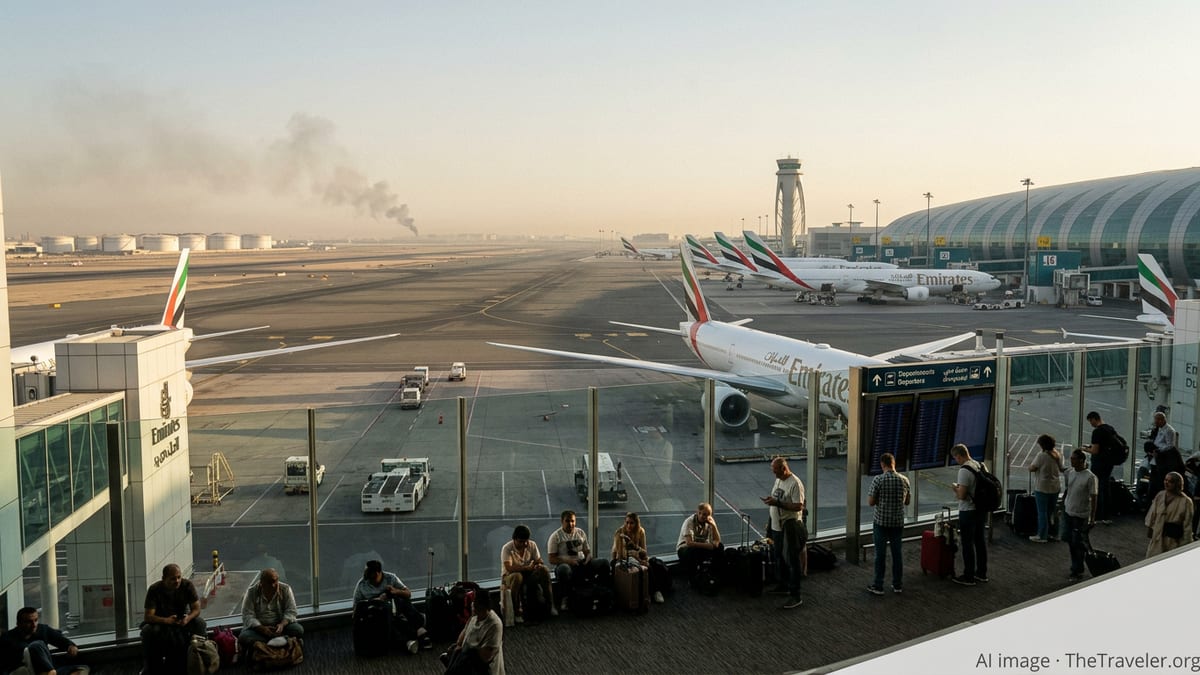
Publicly available information indicates that in the early hours of Monday, March 16, a drone struck fuel infrastructure close to Dubai International Airport, triggering a fire and prompting an immediate suspension of flights at one of the world’s busiest global hubs. The incident follows a series of drone and missile attacks linked to the wider conflict involving Iran, the United States, Israel, and Gulf states, which have already targeted ports, industrial sites, and airports across the region in recent weeks.
Earlier this month, drone activity and intercepts near Dubai prompted temporary closures and evacuations within the airport complex, with images and eyewitness accounts circulating on social media showing smoke rising close to runways and concourses. These latest strikes appear to be the most serious to date in terms of direct impact on aviation operations, striking at the heart of a hub that typically handles hundreds of thousands of passengers each day.
Reports from regional media and aviation trackers suggest that air defenses around Dubai engaged multiple incoming drones in the hours before and after the confirmed strike, resulting in debris falling across parts of the city and in the vicinity of the airport. While damage to core passenger facilities appears limited so far, even short-term closures at Dubai create a ripple effect for global connections, given its role as a primary transfer point between Europe, Asia, Africa, and Australasia.
Immediate Impact on Emirates and Other Airlines
Emirates, the largest carrier operating out of Dubai, has suspended many departures and arrivals while assessments of runways, fuel systems, and airspace safety continue. Public statements and schedule data show a patchwork of limited operations, with some long-haul flights canceled outright and others held on the ground or diverted to alternative airports around the Gulf.
Other Gulf-based airlines, including flydubai, Air Arabia, Qatar Airways, and carriers in neighboring Saudi Arabia and Bahrain, are adjusting schedules as airspace restrictions and security considerations evolve hour by hour. In some cases, flights headed for Dubai have been diverted mid-route to airports such as Abu Dhabi, Sharjah, Muscat, or Doha, creating bottlenecks at secondary hubs that are not designed to handle sustained surges of transit passengers.
European and Asian carriers are also reassessing their exposure. Some have temporarily suspended services to Dubai and other Gulf gateways or have opted to reroute around contested airspace, adding flight time and fuel costs. Industry analysts note that airlines have been operating with contingency plans since the first wave of strikes in late February, but the direct hit near Dubai has forced many to shift from selective adjustments to broader network overhauls.
Stranded Tourists and Disrupted Travel Plans
For travelers, the effects are being felt most sharply in the form of cancellations, long delays, and sudden changes to itineraries. Social media posts and traveler forums are filled with accounts of passengers held on aircraft for hours, moved into underground corridors and service tunnels at Dubai International Airport, or diverted unexpectedly to other Gulf cities with limited information about onward connections.
Repatriation flights that had been operating to move tourists and expatriate workers out of conflict-affected areas have been particularly disrupted. When Dubai’s runways briefly closed during earlier drone incidents this month, some travelers reported missed connections that pushed their onward journeys back by days, and similar patterns now appear to be reemerging as airlines attempt to rebuild schedules from an already fragile base.
Accommodation and visa complications are compounding the problem. Tourists diverted to airports in neighboring states are sometimes required to clear immigration and arrange temporary stays while awaiting replacement flights. Travel insurance policies vary widely in how they treat war-related disruption, and many travelers are only now discovering the limits of their coverage as they seek compensation for additional hotel nights and rebooked tickets.
How the Drone Attacks Are Redrawing Middle East Air Routes
The drone strike near Dubai is part of a broader series of attacks aimed at strategic infrastructure across the Gulf, including ports and industrial zones in the United Arab Emirates, Bahrain, and Kuwait. Aviation risk advisories issued over the past two weeks describe rolling airspace closures, altitude restrictions, and no-fly zones that have forced airlines to redraw traditional corridors connecting Europe and North America with South and Southeast Asia.
Prior to the current crisis, Dubai sat at the core of a dense web of routes that allowed carriers such as Emirates to funnel traffic from dozens of smaller cities into a single connecting hub. With heightened risk now concentrated around that hub, some airlines are shifting capacity to alternative gateways including Doha, Riyadh, Jeddah, Muscat, and even more distant points like Istanbul and Athens, transforming a once-stable map of Gulf aviation into a constantly shifting patchwork.
Long-haul flights that previously overflew sensitive areas of the Gulf and Iran are also being rerouted to more southerly or westerly tracks, adding flight time and increasing operational costs. Aviation experts note that while these detours can keep passengers away from the most volatile airspace, they also reduce the efficiency that made Middle Eastern hubs so competitive over the past two decades.
What Travelers Need to Know Right Now
Public advisories from governments and travel risk consultancies emphasize that the situation remains fluid and can change with little warning. Travelers booked on routes touching the Gulf in the coming days are being urged, through public guidance and airline updates, to monitor their flight status closely, keep contact details up to date with their carrier, and consider arriving earlier than usual at departure airports in case of additional screening or schedule changes.
Passengers connecting through Dubai or other Gulf hubs should be prepared for last-minute rerouting, overnight stops, or shifts to different airlines. Flexible tickets and direct bookings with carriers generally provide more options for rebooking than itineraries purchased through third-party platforms, and many airlines have introduced short-term waiver policies to allow date or routing changes without standard penalties.
Travelers are also being encouraged, according to published coverage, to review government travel advisories that assess security conditions at specific airports and along overflight corridors. While Dubai International Airport has historically been regarded as a secure and efficiently managed hub, the recent drone incidents underscore that proximity to an active conflict zone can introduce sudden and significant disruption, even when core passenger facilities remain largely intact.
For now, the overarching message from publicly available information is one of caution rather than panic. Airlines continue to operate a reduced but significant number of flights into and out of the United Arab Emirates and neighboring states, and there is a clear effort to maintain essential connectivity for residents, tourists, and transit passengers. Yet with drone threats evolving and diplomatic efforts still lagging behind events on the ground, travelers planning to pass through the region in the coming days and weeks should expect uncertainty to be part of the journey.