

More news on this day
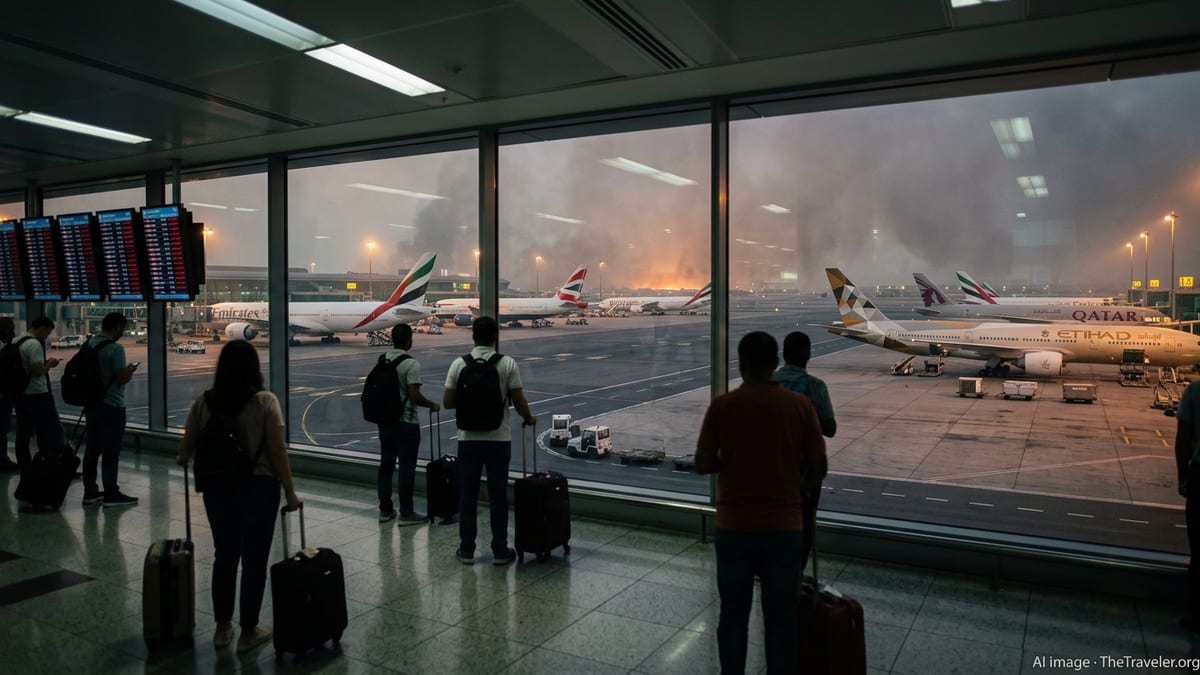
Major global and Gulf airlines have canceled or curtailed flights across the Middle East after a drone strike triggered a fire at Dubai International Airport, unleashing a new wave of global travel disruption centered on one of the world’s busiest aviation hubs.
Get the latest news straight to your inbox!
Dubai Drone Strike Shuts Key Hub and Rippled Across Region
The latest turbulence for global aviation began when a drone strike hit fuel infrastructure near Dubai International Airport, causing a fire and prompting an immediate halt to operations at the airport. Publicly available information indicates that flights were suspended as emergency crews tackled the blaze and authorities assessed damage to critical fuel and ground systems. The incident came amid a broader pattern of Iranian drone and missile attacks targeting the United Arab Emirates and other states since late February, sharply elevating operational risk across Gulf airspace.
Dubai International, which normally handles hundreds of thousands of passengers each day, has already endured several shutdowns and partial closures during the current crisis. The latest strike, however, hit directly at the airport’s ability to supply fuel, compounding earlier infrastructure damage and leaving carriers with little choice but to halt or divert traffic. Aviation data and media coverage show waves of cancellations and diversions fanning out quickly to neighboring hubs in Abu Dhabi and Doha as airlines recalculated routes and crew schedules around newly expanded no-fly zones.
Regional airspace closures in the United Arab Emirates, Qatar, Bahrain and other Gulf states are now intersecting with security restrictions over Iran, Iraq and parts of Israel, effectively squeezing the main east–west corridors that connect Europe, Asia, Africa and Australasia. Flight-tracking services and travel management advisories point to thousands of flights a day being canceled or rerouted since the latest escalation, with the Dubai strike intensifying an already severe disruption.
British Airways Halts Services to Key Gulf and Levant Destinations
British Airways has moved to suspend a broad swath of its Middle East network, including flights to Dubai, Abu Dhabi, Doha, Bahrain, Amman and Tel Aviv. According to recent aviation industry reporting and flight schedule data, the carrier has progressively expanded its cancellations as Gulf airspace restrictions hardened and war-risk insurance costs climbed. Routes into the United Arab Emirates and Qatar are particularly affected, with some services suspended well into the coming months.
Travelers report widespread last-minute cancellations, complex rebookings and limited options for rerouting around the conflict zone. While some passengers holding British Airways tickets issued by partner airlines such as Qatar Airways have been offered alternative routings, others say they are being steered toward refunds or future travel credits instead of immediate re-accommodation. Public comments from consumer forums and travel communities suggest that capacity on remaining indirect routes, particularly via southern Europe or Southeast Asia, is quickly filling as passengers try to bypass the Gulf entirely.
Operationally, British Airways is contending not only with closed or restricted airspace but also with heightened exposure to rapidly rising insurance premiums for any flight that might traverse contested corridors. Industry analysis indicates that war-risk surcharges for flights near the Strait of Hormuz and key Gulf energy infrastructure have surged since the Dubai incident, adding another disincentive for carriers to maintain services even where corridors technically remain open.
Emirates, Qatar Airways and Etihad Slash Schedules From Their Home Hubs
Flag carriers based in the Gulf have also been forced into dramatic schedule cuts. Emirates temporarily suspended virtually all operations to and from Dubai in the immediate aftermath of the drone strike, with only a limited number of services gradually resuming once fuel supplies and ground systems were stabilized. Travel management bulletins describe a phased restart plan under “strict operational and safety approvals,” with priority given to repositioning, cargo and select repatriation flights while normal passenger schedules remain largely on hold.
In Abu Dhabi, Etihad Airways has similarly kept most regular departures suspended, operating only ad hoc services cleared under UAE aviation directives. Passengers booked on Etihad are being advised through public updates and travel agency communications to check flight status frequently and to avoid traveling to the airport without confirmed departure times. Many itineraries involving connections through Abu Dhabi have been canceled outright, with travelers instructed to seek refunds or future-date rebookings once conditions improve.
Qatar Airways, whose main hub at Doha’s Hamad International Airport sits inside another heavily restricted airspace zone, has also curtailed much of its regional and long-haul schedule. Reports from aviation analytics providers show that a high percentage of flights into Qatar have been canceled on recent days, reflecting both the closure and subsequent limited reopening of Qatari air navigation under emergency conditions. While some evacuation and cargo services have operated, standard commercial traffic continues to be heavily constrained.
Global Carriers Reroute or Withdraw as Airspace Tightens
The cascading shutdowns at Dubai, Abu Dhabi and Doha are reverberating far beyond the Middle East. Data compiled by aviation analytics firms and referenced in international coverage show that thousands of flights connecting Europe and North America with Asia, Africa and Australasia have been scrapped or significantly rerouted. Carriers including British Airways, Lufthansa, Virgin Atlantic, Air India and others have scaled back or entirely suspended services into affected Gulf markets in response to both airspace closures and heightened security concerns.
For many airlines, the traditional Gulf routing has long been the most efficient path between western and eastern hemispheres. With key corridors now blocked, carriers are pushing flights along more southerly or northerly tracks that add time, fuel burn and crew costs. In some cases, the additional operational complexity and insurance overheads are rendering certain routes temporarily uneconomical, leading to network-wide timetable overhauls. Passengers booked on journeys that relied on fast connections through Dubai or Doha are among the hardest hit, with some itineraries now requiring overnight layovers or multi-stop detours.
Insurers and risk consultants cited in business coverage note that the Dubai fuel facility strike underscores the vulnerability of aviation infrastructure in a region already central to global energy flows. Even when runways and terminals remain intact, any credible threat to fuel farms, radar systems or navigation aids can prompt immediate standstills in air traffic. The result is a more fragile long-haul network in which a single high-impact incident can close or cripple a major hub for days at a time.
Stranded Passengers Face Uncertainty as Airlines Adjust Policies
For travelers on the ground, the crisis has translated into long queues, improvised overnight stays and uncertain timelines for return. Passenger accounts shared publicly describe extended waits inside terminals before eventual evacuation to hotels or temporary shelters, sometimes amid audible explosions in nearby areas. Others report being offered refunds that fall short of the cost of securing last-minute seats on still-operating carriers, creating difficult choices between waiting out the disruption or paying a premium to escape congested hubs.
Airlines are updating waiver policies in near real time, with some carriers allowing free changes or cancellations for travel to and through the Middle East within specific date ranges. However, publicly available guidance emphasizes that many of these options hinge on the original flight being canceled by the airline rather than voluntarily changed by the passenger, a distinction that can significantly affect eligibility for cash refunds. Travel agents and corporate travel managers are playing a key role in helping travelers navigate rapidly shifting rules and limited availability.
Industry observers suggest that as long as Gulf airspace remains constrained and drone and missile threats persist, airlines will be reluctant to restore full schedules through Dubai, Abu Dhabi and Doha. The immediate priority for many carriers appears to be repatriating stranded customers and stabilizing reduced but reliable operations on lower-risk routings. For passengers planning upcoming trips, the prevailing advice across public advisories is to monitor airline communications closely, consider flexible itineraries that avoid the most affected hubs, and be prepared for last-minute changes in a region where the aviation landscape is shifting day by day.