

More news on this day
A drone strike and related missile activity around Dubai International Airport has shaken the core of global aviation routes through the Middle East, forcing Emirates and other major carriers to cancel or reroute hundreds of flights and leaving travelers facing days of uncertainty.
Get the latest news straight to your inbox!
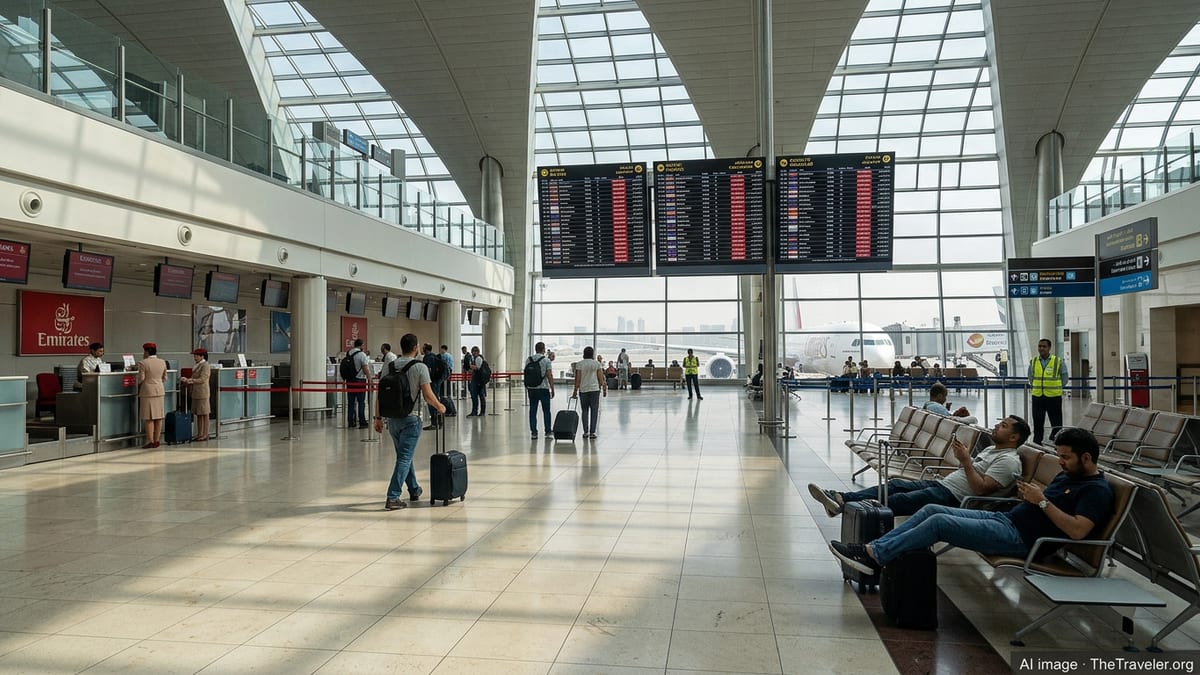
What Happened at Dubai International Airport
The latest disruption centers on a drone strike and debris incidents linked to an escalating regional conflict that began on February 28, 2026. Publicly available information indicates that Dubai International Airport, one of the world’s busiest long-haul hubs, sustained minor structural damage and a fuel-related fire after drones and suspected missile debris fell near operational areas.
Reports from regional and international media describe at least one impact near a fuel or service facility and another near passenger terminals, with fires quickly brought under control. Coverage referencing airport and government briefings notes that several staff members were injured, but large-scale casualties were avoided. Aviation tracking data shows that flight movements over the United Arab Emirates temporarily dropped to near zero at the peak of the attacks as air defenses responded.
The incident follows a broader pattern of Iranian missile and drone strikes across the Gulf, with infrastructure in Dubai, Abu Dhabi, Fujairah, Kuwait City and Doha all affected to varying degrees. Dubai’s role as a high-visibility financial and tourism hub has given the airport strike particular symbolic weight, magnifying concern among airlines, insurers and travelers.
While emergency checks and damage assessments at Dubai International were completed within hours and limited operations resumed within days, the initial shock to the system created a cascade of schedule disruptions that continues to ripple across airline networks.
How Emirates and Other Airlines Have Responded
Emirates, which relies on Dubai as its sole global hub, has been at the center of the turmoil. According to airline advisories and independent travel-industry analysis, the carrier suspended large portions of its schedule after the first wave of strikes and subsequently introduced rolling adjustments as more information on airport capacity and regional airspace restrictions became available.
Published guidance indicates that Emirates has offered affected passengers complimentary rebooking, extended ticket-validity windows and, in many cases, refunds for travel originally scheduled between late February and the end of March. Travelers are being advised through public channels to avoid heading to the airport without a confirmed, operating flight and to manage changes online where possible, as call centers and airport desks remain heavily congested.
Other Gulf carriers, including Qatar Airways, Etihad Airways, flydubai and Air Arabia, have also reshaped their schedules. Industry trackers report that on February 28 alone, more than 1,800 flights across the wider region were canceled after multiple states, including the United Arab Emirates and Qatar, closed or restricted their airspace. Since then, hundreds more flights have been delayed or rerouted as airlines balance safety concerns with the need to restore connectivity.
European and Asian carriers that use Dubai as a stopover point have temporarily suspended some services or diverted aircraft to alternative hubs such as Istanbul, Jeddah or European gateways. Low-cost airlines with thinner route networks have sometimes opted to cancel services outright rather than operate long detours around affected airspace.
Impact on Global Travel Routes and Middle East Hubs
The drone strike at Dubai has exposed how dependent modern aviation is on a small number of mega-hubs in the Gulf. Before the current crisis, Dubai, Abu Dhabi and Doha together handled tens of thousands of long-haul passengers each day, funnelling traffic between Europe, Africa, Asia and Australasia. When these hubs are disrupted simultaneously, options for rerouting become constrained very quickly.
Flight-tracking and aviation analytics platforms show that, in the days following the first attacks, large swathes of the Gulf’s airspace were effectively empty of civilian traffic. Long-haul flights between Europe and Asia were forced to adopt longer, more northerly or southerly trajectories to avoid closed corridors, adding flight time and fuel burn. Some services were forced to land short of their planned destinations for refuelling or crew changes, straining airport capacity at secondary hubs.
For travelers, this has translated into a mix of missed connections, unplanned overnight stops and last-minute itinerary changes. Passengers on multi-leg trips via Dubai have reported being rebooked through other Middle Eastern or European cities, often with travel times extended by many hours or more. Those relying on tightly timed business trips, cruise departures or onward regional flights have faced particularly acute disruption.
The situation has also highlighted vulnerabilities for cargo and logistics. Dubai and other Gulf hubs play an outsize role in global air freight flows, including e-commerce shipments. Temporary capacity reductions and detours are likely to slow some deliveries and increase costs, though freight operators have generally been quicker than passenger airlines to adopt alternative routings.
What Tourists and Transit Passengers Need to Know Right Now
For visitors already in the United Arab Emirates or due to transit through Dubai in the coming days, the immediate priority is to verify individual flight status. Public advisories from airports, airlines and travel-risk consultancies consistently urge passengers not to rely on earlier booking confirmations, as schedules continue to change on short notice in response to security assessments and airspace adjustments.
Most major carriers, including Emirates, Etihad and Qatar Airways, have published temporary flexibility policies. These typically allow one or more free changes of travel dates, the option to reroute through an alternative hub where capacity permits, or, in some cases, refunds or travel vouchers. Travel insurers are also beginning to publish guidance on claims related to missed connections, additional accommodation costs and other disruption-related expenses, although coverage conditions vary widely.
At the airport level, operations at Dubai International and Abu Dhabi appear to be moving gradually toward a more stable pattern, with a mix of cancellations, delays and on-time departures. Travelers should be prepared for longer security queues, occasional gate changes and limited availability of seats on popular routes as airlines work through backlogs of displaced passengers.
For those planning leisure travel to Dubai or neighboring destinations later in March and into April, current assessments suggest that bookings remain possible but should be made with caution. Flexible tickets, comprehensive travel insurance and a willingness to adjust itineraries on short notice are strongly recommended, given the fluid security environment.
Looking Ahead: Safety, Regulation and the Future of Gulf Aviation
Beyond the immediate wave of disruption, the drone attack at Dubai International is likely to fuel a broader debate over aviation risk and infrastructure resilience in the Gulf. The region has previously experienced brief flight suspensions linked to unauthorized drone activity, but the current crisis is on a different scale, tying airport safety directly to interstate conflict and large-scale missile and drone campaigns.
Publicly available reporting indicates that the United Arab Emirates already employs advanced air defense systems around key cities and airports. Even so, the fact that drones and debris were able to reach airport-adjacent areas underscores the challenges of fully protecting sprawling aviation infrastructure. Analysts expect renewed investment in early warning, counter-drone technologies and hardened fuel and communications facilities at major hubs.
Regulators in the region and internationally are also likely to revisit flight-path planning and contingency protocols. Airlines may face new requirements to demonstrate how quickly they can shift traffic away from suddenly closed hubs, and how they communicate with passengers when events evolve rapidly. The experience of late February and March 2026 is providing a real-time stress test of existing systems for passenger rights, crisis communications and cross-border coordination.
For now, the core message for global travelers is that the Middle East’s aviation network remains under unusual strain. Dubai is slowly resuming its role as a central crossroads, but the recent drone strike has made clear that the stability of Gulf hubs can no longer be taken for granted. How airlines, airports and governments respond in the coming weeks will help determine how quickly confidence, and normal travel patterns, can return.