

More news on this day
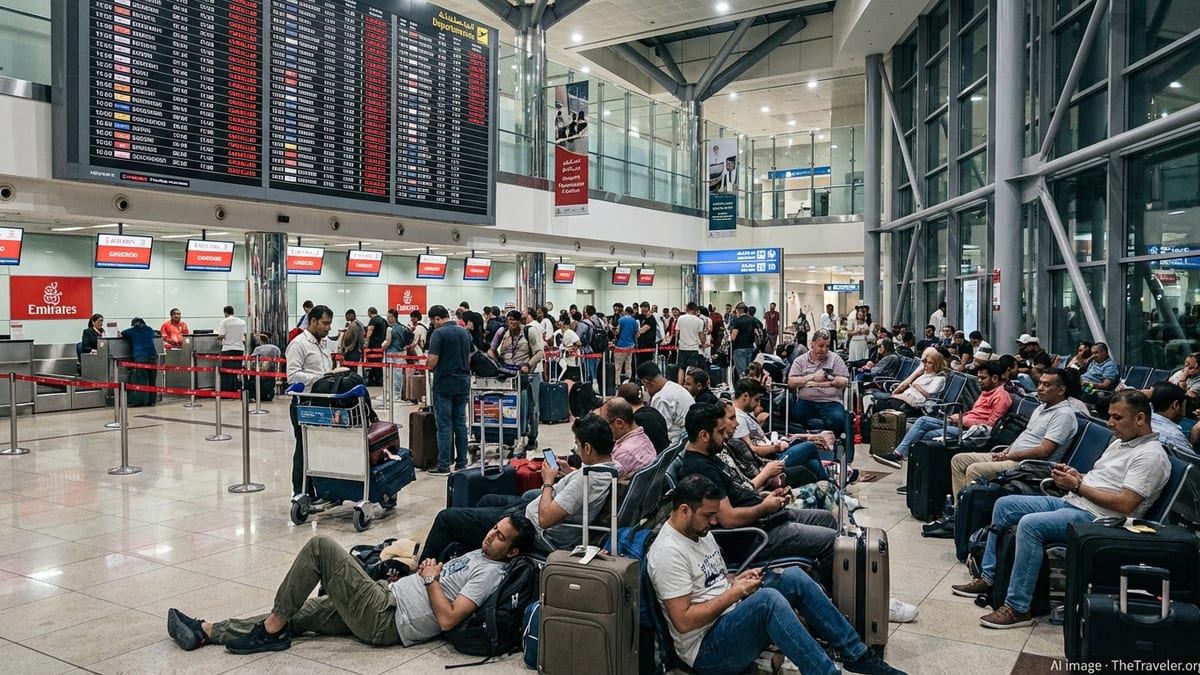
Thousands of passengers were left stranded at Dubai International Airport on Sunday as Iran’s retaliatory strikes and subsequent airspace closures across the Gulf sent flight cancellations soaring and plunged one of the world’s busiest hubs into unprecedented disruption.
Dubai’s Role as a Global Hub Suddenly Stalls
Dubai International Airport, normally the world’s busiest international hub by passenger volume, saw operations grind to a halt over the weekend after Iran launched missile and drone attacks in response to US and Israeli strikes. UAE aviation authorities moved quickly to partially close national airspace, prompting operators at Dubai International and Al Maktoum International to suspend flights and divert inbound traffic.
State-linked operator Dubai Airports confirmed that all flights were suspended for extended periods, with only limited emergency and repositioning movements allowed. Home carrier Emirates, along with low cost sister airline Flydubai, temporarily halted all services to and from Dubai, citing multiple regional airspace closures and the need to prioritize passenger and crew safety.
The shock to operations in Dubai rippled across the global aviation system. As a primary east west conduit linking Europe, the Americas and Africa with Asia and Australasia, Dubai’s sudden shutdown has forced airlines to delay, reroute or cancel services that do not even touch the Middle East directly, as carriers scramble to find alternative routings around newly restricted skies.
Thousands of Flights Delayed or Cancelled Across the Region
Industry data from aviation analytics firms show the scale of the disruption. Over the weekend, more than a thousand flights scheduled to land in Middle Eastern countries were cancelled, with Dubai, Abu Dhabi and Doha among the hardest hit. Global tracking services reported tens of thousands of delays and several thousand cancellations worldwide as the cascading impact of airspace closures became clear.
In the Gulf, the United Arab Emirates, Qatar, Bahrain, Kuwait and Oman imposed at least partial closures of their airspace following the strikes, while Iran, Iraq, Jordan and Israel also restricted or closed their skies. That left key regional and long haul carriers, including Emirates, Etihad Airways, Qatar Airways and Air Arabia, with little option but to suspend many services entirely until authorities signal it is safe to resume operations.
The National and other regional outlets reported that Emirates has suspended all flights to and from Dubai until at least Monday afternoon local time, offering affected passengers rebooking within a 20 day window or refunds. Etihad paused most departures from Abu Dhabi, while Air Arabia and Flydubai have likewise extended suspensions and warned that further adjustments are possible as the security picture evolves.
Scenes of Confusion and Long Waits for Stranded Travelers
Inside Dubai International Airport, passengers described long queues at airline desks, limited hotel availability and confusion over when flights might resume. Many travelers had arrived for overnight connections only to find departure boards suddenly filled with cancellations and diversions, forcing families with young children, elderly passengers and business travelers to bed down in terminals.
Stranded travelers interviewed by international broadcasters spoke of struggling to get through jammed customer service hotlines and receiving only rolling short term updates via airline apps and text messages. Some reported being bussed to hotels paid for by UAE authorities or airlines, while others said they were advised to return home or delay their journey indefinitely if they were originating in the Gulf.
The disruption has not been limited to Dubai. Passengers connecting through airports from Beirut and Amman to European gateways such as London and Frankfurt have found their flights rerouted, heavily delayed or cancelled outright as airlines avoid flying over conflict zones and congested detour corridors. With no clear timeline for a full reopening of regional airspace, many travelers remain in limbo.
Safety First: How Airlines Are Rerouting Around the Conflict
Airlines and regulators stress that the sweeping cancellations are a proactive safety measure, not a reflection of aviation system failure. Following the strikes, authorities issued new risk assessments for overflights of Iran, Iraq and neighboring areas, prompting carriers to redraw flight paths to avoid potential missile trajectories or debris and to prevent misidentification in a tense air defense environment.
For long haul routes between Europe and Asia that usually overfly the Middle East, detours now commonly run further north over Turkey and Central Asia or farther south over the Arabian Sea and parts of Africa. These alternative routings lengthen flight times, increase fuel burn and add operational costs, which analysts warn could eventually push ticket prices higher if the conflict drags on.
Aviation consultants note that airlines had already been navigating complex geopolitical risk maps due to the war in Ukraine and restrictions on Russian airspace. The new Middle East constraints erase more high altitude corridors and further squeeze capacity into remaining safe routes. That raises the risk of longer block times, tighter connection windows and heightened congestion at unaffected hubs as carriers try to keep global networks functioning.
What Travelers Flying Via Dubai Need to Do Now
For passengers with upcoming trips routed through Dubai, Abu Dhabi or Doha, the most important advice from airlines and travel agents is simple: do not go to the airport until your flight is explicitly confirmed as operating. With schedules still in flux, carriers are urging customers to rely on official channels, including airline apps, SMS alerts and direct emails, for the latest information.
Most major airlines serving Dubai are offering free rebooking or refunds for tickets scheduled during the period of disruption, typically allowing date changes within a defined window without change fees. Some have relaxed fare rules to permit itinerary changes to alternative gateways outside the Gulf, though such seats are limited as airlines deal with backlogs of displaced passengers.
Travel insurers say policyholders should keep all receipts for meals, accommodation and ground transport in case they are eligible to claim for additional expenses. However, coverage varies widely, and many standard policies treat war and related airspace closures as excluded events, making airline provided support especially critical in the short term.
With tensions still high and airspace restrictions subject to rapid change, travel experts recommend building extra flexibility into plans in the days ahead. That can mean allowing longer connection times, being prepared for last minute reroutes, and staying in close contact with airlines or agents. For now, the world is watching to see how quickly Dubai and its neighbors can safely reopen their skies and restore the region’s role as a central artery of global travel.