

More news on this day
Passengers connecting through Dubai International Airport faced mounting disruption this week as publicly available flight data showed FlyDubai, Emirates and Gulf Air among the hardest hit carriers, with a combined 116 delays and five cancellations on services linking Dubai with London, New Delhi, Cairo and Sydney.
Get the latest news straight to your inbox!
Delays Mount Across Flagship Routes
Fresh disruption at Dubai International is rippling across some of the airport’s most important long haul and regional corridors, with flights to and from London, New Delhi, Cairo and Sydney experiencing extended hold-ups. Reports indicate that a mix of operational constraints, congested airspace linked to wider regional tensions, and earlier schedule reductions have created a tightening bottleneck at the hub.
Aggregated movement statistics for the first week of April point to at least 116 delayed departures or arrivals involving FlyDubai, Emirates and Gulf Air on these four city pairs alone, alongside five outright cancellations. While such figures represent a fraction of Dubai’s daily traffic, the concentration on major trunk routes has heightened the impact, particularly for passengers relying on tight connections between Europe, the Middle East and Asia-Pacific.
According to published coverage tracking Middle East aviation, Dubai International has been operating on a constrained schedule in recent weeks following airspace restrictions and security alerts across parts of the Gulf. In practice, this has meant longer ground times, aircraft rotations out of sequence, and crews reaching duty-time limits more quickly, all of which have contributed to rolling delays on high-demand flights.
Operational data for services linking Dubai with London, New Delhi, Cairo and Sydney suggests knock-on disruption beyond the Gulf. Late-running departures out of Dubai have been feeding into evening and overnight waves in Europe and Asia, leaving onward passengers facing missed connections and unscheduled hotel stays at intermediate hubs.
FlyDubai, Emirates and Gulf Air Among the Worst Hit
Low-cost and full-service carriers based in the Gulf have borne the brunt of the latest disruption, largely because of their reliance on Dubai and other regional hubs as central transfer points. Travel-industry reports highlight FlyDubai, Emirates and Gulf Air as among the worst affected at Dubai International during the current spell of irregular operations, with the three airlines together linked to the 116 delays and five cancellations logged on the four key routes.
FlyDubai, which specialises in short and medium haul services feeding traffic into Dubai, has seen schedule pressure intensify as turnaround buffers shrink and aircraft spend longer on the ground awaiting departure slots. Publicly available statistics compiled by aviation trackers show the airline recording an elevated proportion of delayed departures on regional routes in recent days, including rotations that connect into longer-haul partner services.
Emirates, the largest operator at Dubai International, has also been navigating a fragile recovery phase after earlier large-scale suspensions connected to regional conflict and temporary airspace closures. Industry analysis notes that the carrier has been rebuilding capacity on core routes such as London, Cairo and Sydney, even as irregular operations continue to affect punctuality on certain departures and arrivals.
Gulf Air, which uses Dubai as part of its wider regional network anchored in Bahrain, has likewise been caught in the cross-currents. Disruption on its Dubai services has combined with delays at other Gulf airports, amplifying the effect on passengers relying on multi-leg itineraries that string together flights operated by several carriers.
Stranded Passengers Face Long Queues and Limited Options
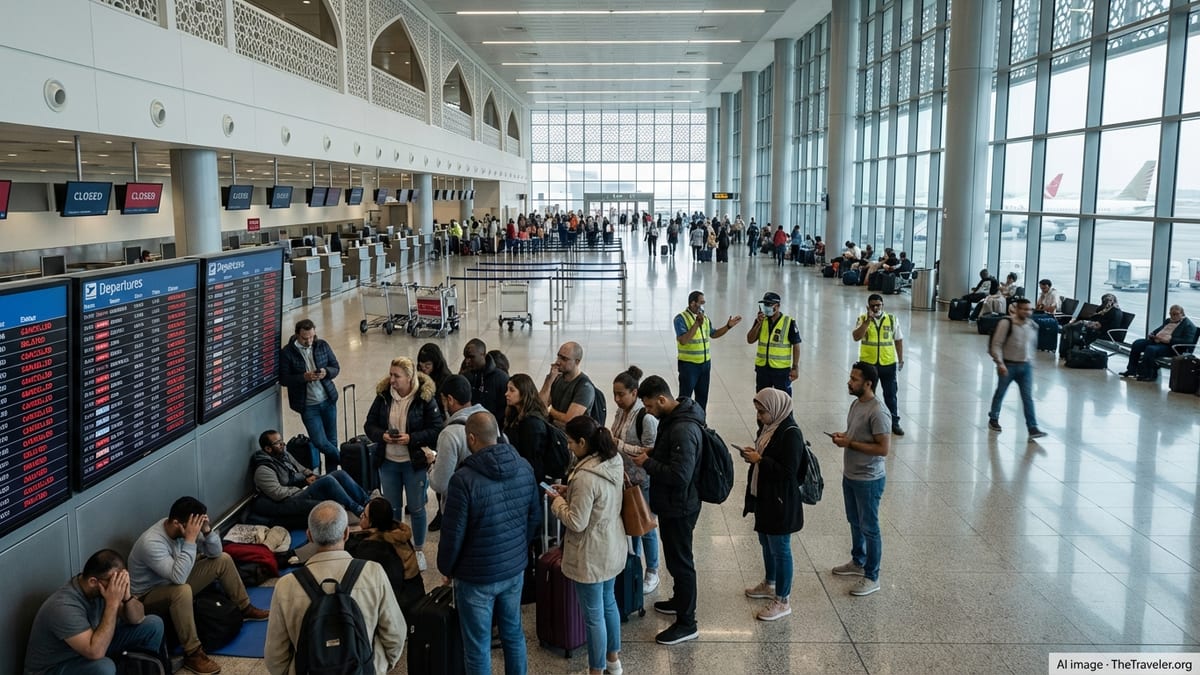
For travellers on the ground in Dubai, the statistics translate into crowded terminals, long queues at transfer desks and limited same-day rebooking options on popular routes. Reports from travel forums and passenger-focused outlets describe scenes of overnight stays in terminal seating areas, with some travellers waiting many hours for clarity on revised departure times.
London-bound flights have proved particularly sensitive, as they sit at the heart of premium business and leisure demand. With Dubai also functioning as a bridge between South Asia and Europe, delays on services to and from New Delhi have quickly cascaded into missed onward connections for travellers heading to the United Kingdom and beyond. Published updates from fare and route analysts indicate that pressure on westbound seats has already pushed up one-way prices between the Gulf and Europe where alternative routings remain available.
Cairo and Sydney services tell a similar story. Cairo, a major North African gateway, has itself been grappling with elevated delay levels linked to broader regional disruption, compounding the effect for passengers shuttling between the Egyptian capital and Dubai. Sydney flights, operating at intercontinental range with tight aircraft utilisation patterns, are especially exposed when schedules slip, since a late arrival can affect both the outbound and subsequent rotations of the same aircraft.
With thousands of customers using Dubai as a pure transit point, even a modest number of cancellations can leave large groups without immediate alternatives. Travel advisories compiled by consumer sites now recommend that passengers passing through Dubai build in generous connection times, avoid separate-ticket itineraries, and monitor their flight status frequently in the days before travel.
Regional Turmoil and Weather Leave Lasting Operational Scars
The current wave of disruption is unfolding against a backdrop of longer-running instability in Gulf aviation. Since late February, airspace closures and evolving security considerations across parts of the Middle East have forced airlines to reroute or suspend thousands of flights, with Dubai, Doha and Abu Dhabi among the hubs most exposed. Industry observers describe the situation as the most severe operational stress test for the region since the height of the pandemic.
This year’s problems follow on from earlier shocks that have left lingering structural vulnerabilities. In 2024, record-breaking rainfall and flooding in the United Arab Emirates led to temporary closures at Dubai International and the cancellation or diversion of more than a thousand flights over a short period. Aviation analysts point out that such extreme weather events have had a lasting impact on how airlines plan buffers into their schedules, reserving extra time for ground operations at airports known to be susceptible to sudden disruption.
Recent travel-industry commentary also points to a tightening labour market for key aviation roles, from ground handling and security staff to licensed engineers and long-haul pilots. When combined with conflict-related rerouting and lingering infrastructure repairs, this has created a fragile ecosystem in which relatively small disturbances can translate into outsized operational consequences.
In Dubai’s case, the hub’s very success has made such shocks more visible. With tens of millions of international passengers funnelled through a limited number of daily departure banks, any constraint on runway availability or airspace routing can resonate through the network for days, leaving seat maps full, standby lists long and affected travellers scattered across several continents.
What Passengers Can Expect in the Coming Days
Looking ahead, publicly available guidance from airlines and airport operators suggests that while conditions at Dubai International are improving compared with the peak of recent disruptions, passengers on certain routes should still expect elevated risk of delays. Services to and from London, New Delhi, Cairo and Sydney are likely to remain under close scrutiny as carriers adjust timetables and attempt to realign aircraft and crew.
Travel analysts indicate that further schedule fine-tuning is probable across April, including tactical aircraft swaps and occasional consolidation of lightly booked flights. For passengers, this may mean short-notice changes to departure times or flight numbers even when services are not formally cancelled. Consumer advocates recommend that travellers sign up for airline notifications, make use of mobile boarding passes and consider travel insurance policies that explicitly cover missed connections and extended delays.
There are tentative signs that the most acute phase of regional disruption may be easing as airspace restrictions are recalibrated and some carriers cautiously restore capacity. Nonetheless, observers caution that Dubai’s role as a major connecting hub between Europe, Asia and Africa ensures that shocks elsewhere in the network can still rebound quickly on operations at the airport.
For now, the experience of passengers left stranded or severely delayed as FlyDubai, Emirates and Gulf Air absorb 116 delays and five cancellations on a handful of marquee routes underlines how finely balanced global aviation remains. As schedules are rebuilt and contingency plans tested, travellers transiting Dubai are likely to face a period in which flexibility and patience remain essential parts of any long-haul itinerary.