

More news on this day
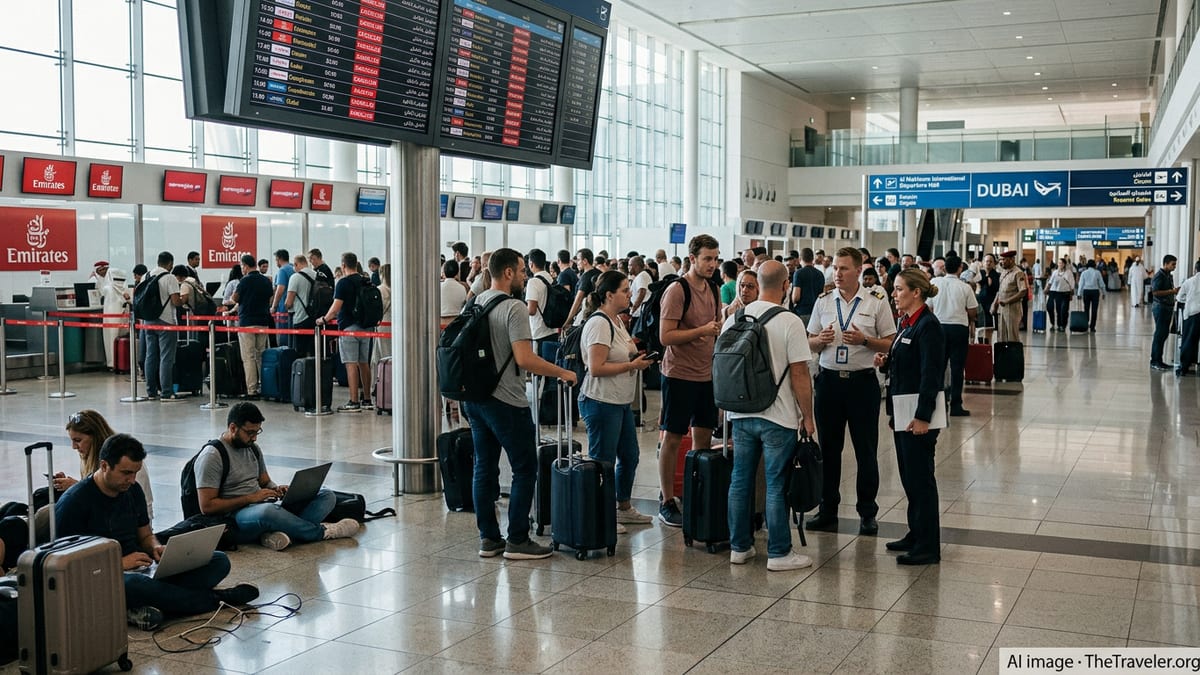
Dubai International Airport, the world’s busiest hub for international travel, is grappling with prolonged disruption that has left thousands of passengers stranded, as reduced flight schedules, airspace restrictions and rolling cancellations continue to cause scenes of chaos across its terminals.
Get the latest news straight to your inbox!
Regional Conflict Turns Global Hub Into Bottleneck
Dubai’s current travel chaos stems from a regional security crisis that has forced sweeping airspace restrictions across the Gulf. Publicly available information shows that strikes and missile incidents in early March triggered the grounding and rerouting of aircraft across the United Arab Emirates and neighboring states, abruptly throttling capacity at what is normally one of the world’s most reliable transit hubs.
Reports indicate that Dubai International Airport temporarily halted regular commercial services in the first days of March as authorities prioritized safety checks and emergency operations. Many carriers cancelled or diverted flights into alternative airports, while others held aircraft and crew on the ground as risk assessments were updated. The sudden reduction in arrivals and departures created an immediate backlog of passengers who were already en route or mid-itinerary when the closures took effect.
As limited services resumed, traffic did not return evenly. Airlines based in Dubai have been gradually rebuilding their schedules, but foreign carriers remain subject to tighter restrictions, leaving gaps on key regional and long haul routes. Industry data and travel advisories published in late March and early April show Dubai operating on a substantially reduced timetable, with a particular focus on repatriation and essential travel rather than normal commercial demand.
The result is a system still under intense pressure. Even as planes take off and land each day, capacity remains well below the record 95 million passengers Dubai handled in 2025, turning the airport from a high speed global connector into a chokepoint where travel plans can unravel with little warning.
Stranded Passengers Face Long Queues and Limited Options
For passengers caught in the disruption, the experience has been defined by long waits, rolling delays and limited information. Coverage from regional and international outlets describes packed departure halls, crowded seating areas and long lines at rebooking counters, as travelers compete for scarce seats on the reduced number of outbound flights.
Travel advisories issued by airlines and agencies in recent weeks repeatedly urge customers not to go to the airport unless they have a confirmed booking and have been instructed to travel. Despite this, large numbers of stranded passengers with cancelled or heavily delayed itineraries have continued to gather at Dubai International, hoping to secure earlier departures or stand-by seats. Many have already spent days in the city or within the airport complex, extending hotel stays where possible or resting in terminal seating when accommodation is unavailable or unaffordable.
Published accounts of the disruption highlight a familiar cycle for many travelers. Flights are scheduled, delayed by several hours as airspace and routing are reassessed, and then either depart on altered timings or are cancelled outright, forcing rebooking onto later services. This pattern has made it difficult for passengers to plan onward connections or ground arrangements, particularly for those with complex multi-leg journeys routed through Dubai.
Some carriers have put formal waiver policies in place, allowing free rebooking or itinerary changes for travel across specific dates, but these measures do not always guarantee quick escape from the backlog. With capacity constrained and priority often given to repatriating visitors and clearing the longest stranded cases, many travelers have been left with few viable alternatives beyond waiting out the disruption.
Airlines Trim Schedules as They Rebuild Networks
Major Gulf carriers are central to the unfolding picture at Dubai. According to recent operational updates, Emirates and flydubai have restored a significant share of their pre-crisis schedules but are still operating below normal capacity. Industry analysis indicates that, by the end of March, the two airlines together were back to roughly 60 percent of their typical combined flight program, with hundreds of services operating daily but many routes reduced in frequency.
This partial recovery has brought a measure of stability to certain long haul corridors, particularly those linking Dubai with Europe, North America and key Asian hubs. However, traffic to and from parts of the Middle East remains especially volatile, with some airlines extending suspensions on selected routes into April. Travel industry bulletins list continued cancellations from multiple regional and low cost carriers, with some not expecting to resume normal Dubai operations until later in the month.
For stranded passengers, these uneven patterns matter. Travelers whose tickets are held with airlines ramping up schedules are more likely to secure rebooking within days, while those booked on carriers maintaining outright suspensions can face longer waits or complicated rerouting via alternative hubs such as Muscat or Doha. In many cases, passengers are being advised to monitor airline apps or contact centers closely, as seat inventory on operating flights changes quickly when fresh waivers and schedule adjustments are released.
Despite the constraints, publicly available data on flight movements through Dubai indicates a slow upward trend in daily operations since mid March, suggesting that the worst of the immediate shutdown has passed. Even so, the residual backlog of disrupted itineraries continues to ripple through the system, with some passengers only now reaching their original destinations after unplanned stays of a week or more.
Airport Services Strain Under Congestion
Dubai International is accustomed to handling high passenger volumes, but the atypical mix of grounded travelers, last minute schedule changes and staffing challenges has tested its resilience. Reports from recent days describe terminals where food outlets and seating are under near constant demand, and where lines for security, immigration and customer service can fluctuate dramatically depending on the timing of newly added or rescheduled departures.
Publicly accessible operational updates emphasize that the airport remains open, but with limited services in some areas. Ground transport links have generally continued to function, allowing passengers to move between the city and the terminals, yet the uncertainty around departure times has prompted many travelers to stay close to the airport even between rebooked flights. For some, that has meant repeated trips through security and check in zones as bookings are updated or as they attempt to standby for earlier services.
Airlines and airport staff have also had to manage the practical challenges of aircraft and crew positioning. With earlier days of the crisis seeing planes and personnel stranded at outstations around the region, matching available aircraft with the greatest areas of passenger need has been a complex exercise. This has contributed to irregular departure banks in Dubai, with quiet stretches punctuated by bursts of activity when multiple delayed or relief flights depart in quick succession.
Service standards have inevitably come under pressure. While many travelers report professional and calm handling on the ground and onboard, others describe difficulties in accessing accurate, up to date information about their options. In an environment where conditions can change within hours, and where official websites and call centers are facing heavy traffic, communication has remained a critical pain point for those trying to make time sensitive decisions.
What Travelers Should Expect in the Coming Days
With the regional security situation still evolving, forecasts suggest that Dubai’s aviation network will remain fragile through at least mid April. Travel agencies and corporate mobility advisers are continuing to warn clients about the risk of last minute schedule changes, and recommend extra buffer time for critical journeys that rely on Dubai as a transit point.
Passengers booked to travel through the hub in the coming days are being encouraged, through public advisories, to check the status of their flights frequently, make use of airline apps and online rebooking tools where available, and avoid heading to the airport early in the hope of securing ad hoc changes. Many guidance notes also emphasize the importance of travel insurance that covers disruption related expenses such as unexpected hotel stays, reissued tickets or alternative routing.
For those already stranded at Dubai International, the outlook is gradually improving but remains highly dependent on airline capacity and route specific restrictions. As more flights are added back each day, backlogs on major trunk routes are likely to ease first, while services to conflict affected destinations may continue to face intermittent suspensions. Travelers without urgent commitments may find that accepting later confirmed flights, rather than chasing multiple standby options, provides a more predictable path home.
Dubai’s flight chaos has underscored how quickly a highly connected global hub can be thrown off balance by events beyond its borders. Even as planes continue to depart and arrive, the scenes at DXB are a reminder that modern air travel remains closely tied to geopolitical stability, and that when regional tensions flare, the ripple effects can strand passengers thousands of miles from home with little warning.