

More news on this day
A sweeping freeze on many foreign flights serving Dubai and wider UAE hubs has sent shockwaves through global travel networks, stranding tourists across continents and forcing a scramble for new, often circuitous routes around the Gulf.
Get the latest news straight to your inbox!
Airspace Closures Trigger a New Phase of Disruption
Publicly available flight data and travel advisories for March 2026 show that a series of Iranian drone and missile attacks on the United Arab Emirates triggered rolling airspace closures, culminating in a near-total halt of routine commercial traffic to and from Dubai at several points in recent weeks. Dubai International Airport, normally the world’s busiest gateway for international passengers, temporarily suspended all operations on multiple days as air defenses intercepted incoming fire and a fuel tank fire near airport infrastructure drew global attention.
Regional aviation notices indicate that the UAE’s General Civil Aviation Authority ordered binding suspensions on inbound and outbound services as a precautionary safety measure. The closures coincided with wider restrictions across neighboring airspaces, including Qatar and parts of Iran, sharply reducing available corridors over the Gulf and forcing airlines to reassess flight paths at short notice.
Industry trackers report that Gulf hubs such as Dubai, Abu Dhabi and Doha form a critical bridge between Europe, Asia, Africa and Australasia. When large portions of this airspace closed or became heavily constrained, the impact rippled far beyond the Middle East, instantly affecting travelers who had never planned to set foot in the region but relied on it as a connecting point.
Major Carriers Suspend, Trim or Reroute Dubai Services
Updated airline statements and route maps reviewed in mid March show that a long list of foreign carriers has scaled back or halted Dubai operations altogether. Reports from aviation news outlets and travel advisories highlight temporary suspensions by airlines across Europe, Asia and North America, including operators that usually funnel large volumes of long-haul traffic through Dubai.
Several European network carriers have paused Dubai rotations as part of a broader pullback from the conflict-affected corridor, grouping Dubai with other restricted destinations such as Tel Aviv and Beirut. Some Asian airlines, including those based in Hong Kong and Singapore, have extended earlier temporary suspensions deeper into March, citing ongoing security assessments and airspace constraints.
At the same time, Dubai-based Emirates and regional peers such as Etihad Airways, flydubai, Qatar Airways and Air Arabia have been operating highly reduced schedules under special temporary corridors approved by aviation regulators. These services prioritize a limited set of high-demand routes and are frequently subject to retiming or last-minute cancellation, leaving passengers to rely on near-constant schedule checks rather than traditional fixed timetables.
Tourists Face Airport Gridlock and Lengthy Alternative Journeys
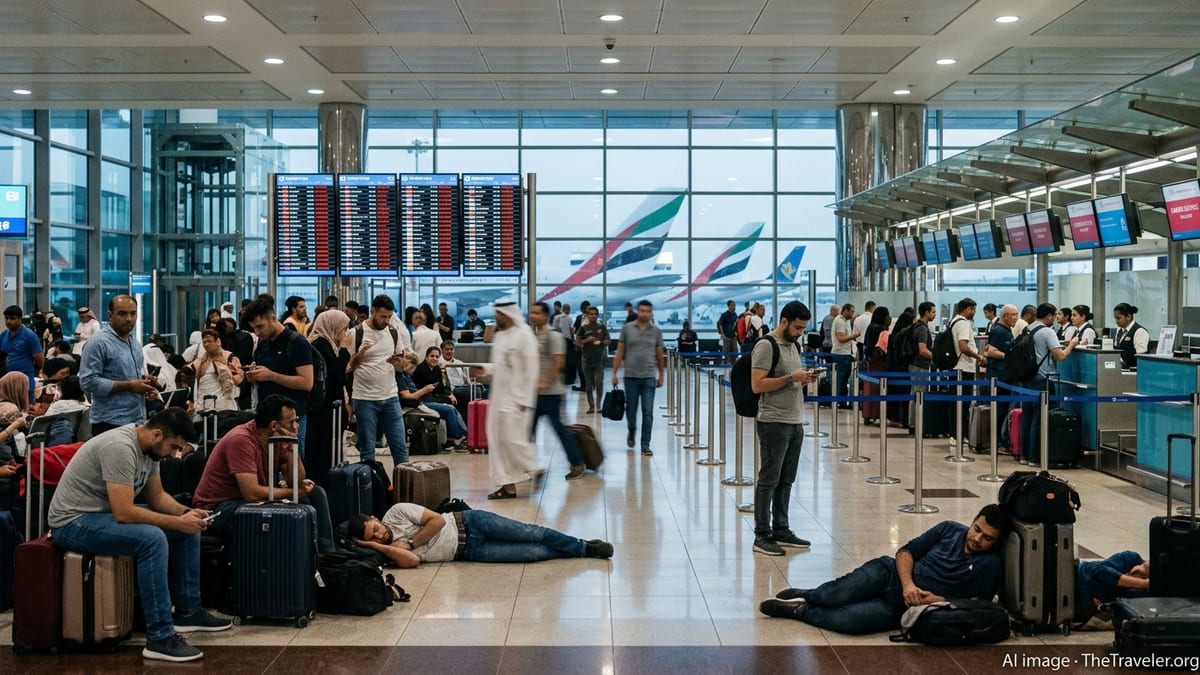
For tourists on the ground, the sudden freeze in foreign capacity has translated into overcrowded terminals, long queues at service desks and a scramble for scarce alternative seats. Social media posts, eyewitness accounts reported in regional outlets and airline guidance all describe travelers camping out in departure halls across the UAE, India, Europe and Southeast Asia as they wait for rebooking options to open.
With many direct and one-stop links via Dubai canceled, passengers are piecing together complex multi-stop itineraries that avoid the Gulf entirely. Popular workarounds include routings via Istanbul, Cairo or European hubs for travelers between Asia and Europe, and via Southeast Asian gateways such as Bangkok or Kuala Lumpur for those trying to bypass blocked links between South Asia and the Middle East.
Travelers report paying sharply higher fares for remaining seats on unaffected routes, a trend mirrored in independent fare analyses that show prices on select Asia Europe city pairs more than doubling or tripling compared with pre-crisis levels. Even those who manage to secure alternatives often face significant detours that add many hours in the air and extended layovers, reshaping what were once straightforward overnight transits into multi-day odysseys.
Patchy Resumptions Offer Limited Relief
By early to mid March, partial resumptions at Dubai International and Al Maktoum International were under way, but on a far smaller scale than normal. Airport advisories stress that only a limited number of airlines and departures are operating each day, and that schedules remain fluid as security conditions and airspace permissions evolve.
Flag carriers from the UAE and several partner airlines have begun reinstating select intercontinental routes, often with modified flight paths that curve well north or south of traditional Gulf corridors. These changes increase flight times, fuel burn and crew scheduling complexity, which in turn restricts how quickly full timetables can return.
Travel-industry briefings suggest that some foreign airlines view Dubai’s situation through a risk management lens that extends beyond the immediate attacks. For now, several have opted to maintain suspensions or operate at minimal frequencies until there is more clarity about regional security trends, insurance costs and the reliability of newly established diversion routes.
What Today’s Travelers Need to Know Before Flying to or Through Dubai
Public travel advisories issued in recent days emphasize that anyone planning to fly to, from or via Dubai should treat old assumptions about reliable, high-frequency connections with caution. Passengers are urged to verify the status of individual flight numbers repeatedly in the 24 to 48 hours before departure, as same-day schedule changes and rolling cancellations remain common.
Many carriers are offering limited fee waivers, date changes or refunds for affected tickets, but these are typically bounded by specific travel periods and booking classes. Tourists holding complex itineraries that involve multiple airlines or online travel agencies often face longer waits to secure reissues, as each segment must be confirmed as operating before new tickets can be validated.
Travel planners note that indirect routings that bypass the Gulf may continue to play an outsized role for weeks, even if Dubai and neighboring hubs gradually restore more of their capacity. For leisure travelers, that may mean building in additional time buffers at the start and end of trips, avoiding tight same day connections and considering travel insurance products that specifically address airspace closures and extended delays.