

More news on this day
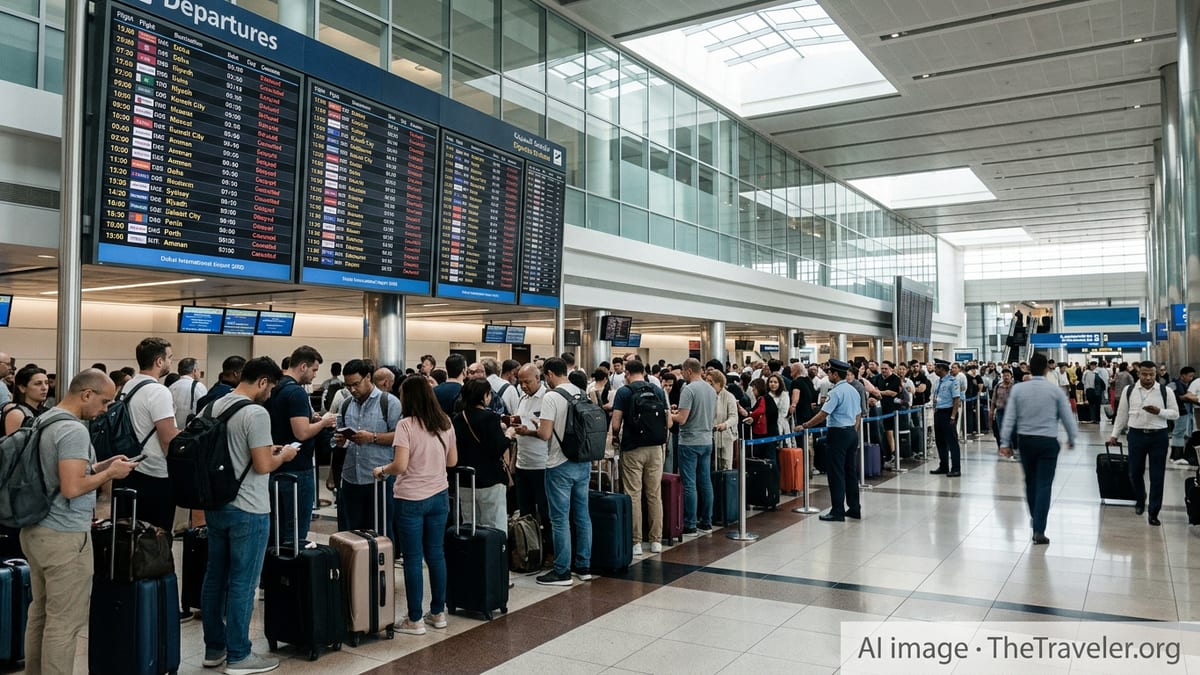
Passengers traveling through Dubai International Airport on April 9 faced another day of major disruption as more than 100 flights were delayed or canceled, stranding travelers on high-demand routes linking the United Arab Emirates with London, Paris, New York, Mumbai, Sydney and other global hubs.
Get the latest news straight to your inbox!
Fresh Wave of Disruptions at a Key Global Hub
Publicly available flight board data and regional coverage for Thursday, April 9, indicate that Dubai International Airport is still operating on a reduced and uneven schedule under ongoing regional airspace restrictions, with at least 103 flights delayed and six canceled in a single operating window. The rolling disruptions have left large numbers of passengers waiting at terminals or stuck overseas as they attempt to connect through what is normally the world’s busiest airport for international traffic.
The latest operational turbulence follows weeks of schedule upheaval triggered by late February airspace closures connected to tensions involving Iran and several Gulf states. Published summaries on recent operations describe a pattern of phased resumptions and intermittent interruptions, rather than a full return to pre-crisis normality.
Coverage of current airport conditions describes check-in halls and transfer areas still coping with backlogs of travelers whose flights were retimed, downgraded to reduced frequencies or consolidated into fewer daily services. While the majority of flights are now operating, the combination of delays and selective cancellations is still resulting in missed connections and extended layovers for many passengers.
Reports also note that Dubai’s secondary airport at Al Maktoum International, along with other airports in the UAE, continues to share some of the diverted traffic, adding complexity for travelers who must navigate last-minute changes of departure point or arrival time.
Emirates, FlyDubai and Air India Adjust Schedules
Emirates, Dubai’s largest carrier, has been gradually restoring its international network but is still running on trimmed schedules, according to recent airline guidance. Public information from the airline and regional business outlets shows that services on several long-haul routes, including London, Paris, New York, Mumbai and Sydney, are operating at reduced frequencies compared with typical peak levels, with tactical cancellations and retimings on short notice when airspace conditions tighten.
FlyDubai, the city’s low cost carrier, is also operating under disruption-management protocols. Its latest published guidance urges passengers not to travel to the airport unless their booking shows a confirmed departure time, and highlights rebooking options and status tools for those whose services are canceled or significantly delayed. The airline has already been juggling earlier schedule changes related to airport and runway works at certain destinations, compounding the challenge of reacting to regional security constraints.
Indian carrier Air India has introduced additional complexity for travelers connecting through Dubai. According to recent coverage focused on April 8 and 9, the airline has suspended or sharply reduced regular flights on several Gulf routes while operating a limited number of ad hoc services. These changes affect passengers flying between Indian cities and Dubai, including those booked on onward connections to Europe, North America and Australia.
Other regional and international airlines serving Dubai are making similar tactical adjustments, with some keeping particular rotations to the United Arab Emirates canceled while maintaining services to neighboring hubs such as Doha or Riyadh. The patchwork of airline-specific policies has left many travelers comparing options across carriers and airports in real time.
High-Profile Routes to London, Paris, New York, Mumbai and Sydney Hit
The disruption is particularly visible on marquee international routes that funnel business and leisure traffic through Dubai. Flight-tracking snapshots and airline bulletins for the current week show irregular patterns on services linking the emirate to key capitals such as London and Paris, as well as transcontinental routes to New York, Mumbai and Sydney.
On the Europe corridor, some flights between Dubai and major airports in London and Paris are operating close to schedule, while others are subject to rolling delays or have been removed from the day’s operations altogether. Travelers have reported being moved between departures, shifted to alternative days or rerouted via intermediate hubs when direct seats are no longer available.
Long haul routes to New York and Sydney are operating on reduced schedules that leave less slack in the system when a flight is delayed or canceled. Industry-focused coverage notes that certain services on these sectors were among the earliest to be restored following the February shutdowns, but they remain vulnerable to timing changes if airspace capacity is curtailed or if crews and aircraft are out of position.
On South Asian links, including the heavily traveled Dubai to Mumbai route, disruptions intersect with high seasonal demand and constrained capacity from Indian carriers. Recent reports highlight that Indian airlines have been limited in their Dubai operations by temporary caps and rotation rules, tightening seat availability and amplifying the impact of every delay or cancellation for passengers trying to connect onward.
Stranded Passengers Face Long Waits and Patchwork Support
For passengers already in the system on April 9, the mix of delayed departures, missed connections and selective cancellations has translated into long waits and uncertainty. International travel reports describe travelers forced to spend extended periods in Dubai’s terminals or in overseas airports while they wait for rebooked flights or clearance to transit via the UAE.
Some airlines are publishing flexible policies, including free date changes or refunds for affected bookings within a defined travel window, while others are concentrating on re-accommodating customers on their own reduced networks rather than placing them on partner carriers. The divergence in responses has created a patchwork of experiences, with some travelers rebooked quickly and others facing multi-day delays.
Consumer travel advisories emphasize that passengers should monitor their booking status, use airline apps and websites, and avoid heading to the airport without explicit confirmation that a flight is operating. Publicly available guidance from Dubai Airports and leading carriers stresses that terminal capacity and ground resources are still stretched, and that unconfirmed walk-up passengers risk adding to congestion without improving their chances of departure.
Travel-rights organizations and comparison platforms have also begun circulating reminders about entitlements to care, accommodation and refunds under various jurisdictions, although the mix of international carriers and connecting itineraries through Dubai means that rules can differ significantly from one ticket to the next.
What Travelers Should Expect in the Coming Days
Industry analysts following the situation suggest that disruptions at Dubai International Airport may remain fluid over the coming days as regional airspace and security conditions evolve. While the overall trend since early March has been a gradual restoration of flights, the events of April 9 underline that short-notice delays and cancellations remain a realistic possibility across multiple airlines and routes.
Airline advisories indicate that carriers are likely to continue prioritizing high demand trunk routes while trimming secondary services or consolidating frequencies when needed. This means that popular city pairs such as Dubai to London, Paris, New York, Mumbai and Sydney will likely keep operating, but not always at former frequencies or departure times.
Travel publications advise that passengers with imminent trips through Dubai should build in additional buffer time for connections, remain flexible about routing, and be prepared for itinerary changes, including possible diversions through other Gulf or European hubs. Many carriers are still allowing one-time free changes or credits on tickets issued for travel during the current disruption window, but policies are regularly updated.
For now, the picture from Dubai International Airport is one of partial recovery tempered by ongoing volatility. Flights are taking off and landing in greater numbers than in early March, yet the tally of 103 delays and six cancellations in a single operating period shows how sensitive this central hub remains to any renewed pressure on airspace and airline operations.