

More news on this day
Dubai International Airport, one of the world’s busiest global hubs, descended into turmoil this weekend as regional airspace closures following coordinated US and Israeli strikes on Iran forced Emirates and a raft of international carriers to cancel or divert hundreds of flights, stranding passengers from the Gulf to Europe and North America.
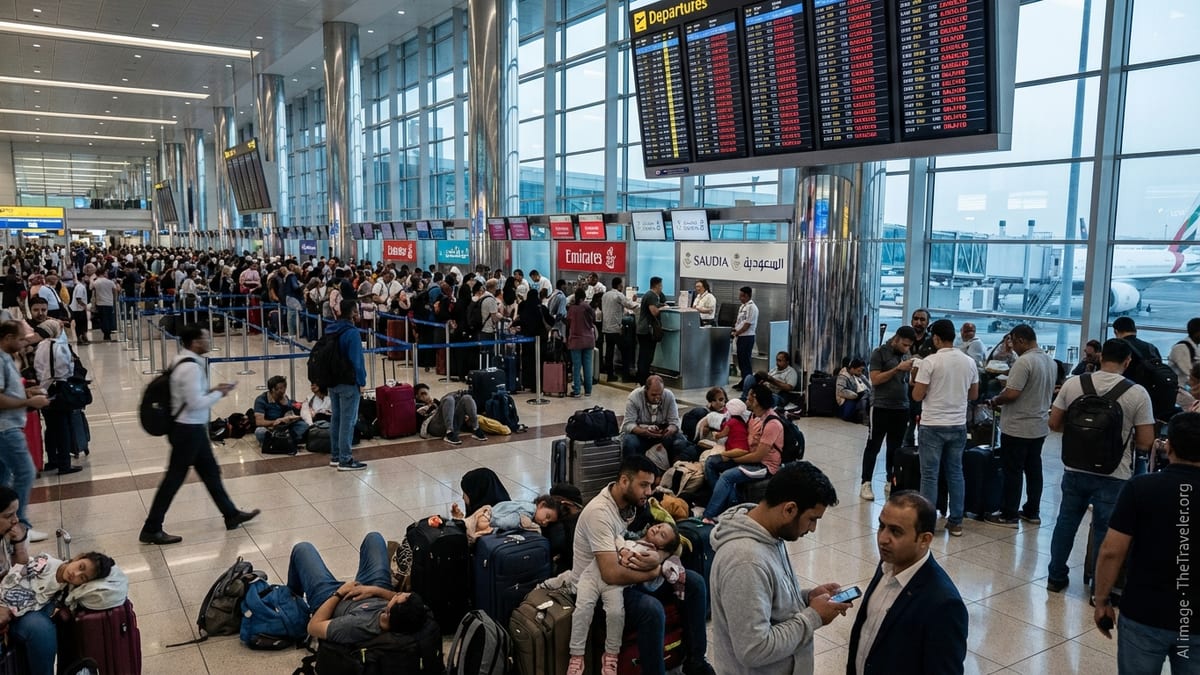
Airspace Closures Rip Through Global Flight Networks
The rapid escalation in the Middle East saw Iran, Israel, Iraq, Syria, Qatar, Kuwait, Bahrain and parts of the United Arab Emirates close their airspace, leaving flight tracking maps with vast empty corridors across the region. Authorities in the UAE announced a temporary and partial airspace shutdown for safety reasons, which immediately froze operations at Dubai International and Dubai World Central airports, two of the most important transit nodes for long haul travel between Europe, Asia and the Americas.
Dubai Airports confirmed that all flights at both hubs were suspended until further notice, while Emirates said it had halted all operations to and from Dubai on Saturday and into Sunday afternoon local time as the situation evolved. Flydubai and Air Arabia also suspended services, joining a growing list of regional carriers effectively cut off from their primary routes. Aviation data firm Cirium reported that nearly a thousand arrivals into affected Middle Eastern countries were cancelled in a single day, with total cancellations across inbound and outbound services surpassing 1,800 as schedules unraveled.
European and North American airlines quickly followed suit, rerouting or cancelling flights that would normally cross the Gulf and Iranian airspace. Authorities and safety regulators warned of a high risk to civil aviation across multiple flight information regions, urging operators to avoid conflict zones and adjacent areas hosting military assets that could be targeted in retaliatory strikes.
Emirates, Saudia, Air Canada and US Carriers Slash Schedules
Home carrier Emirates bore the brunt of the disruption at Dubai, cancelling a substantial portion of its long haul network after regional airspace closures made many of its trunk routes temporarily inoperable. Analysts said upwards of a third of the airline’s planned weekend operations were affected, as aircraft scheduled to cross Iran or the Gulf were either grounded or forced to return to origin airports. Sister airline flydubai, along with Abu Dhabi based Etihad Airways and Qatar Airways in Doha, saw similarly heavy disruption as their hubs went largely offline.
Saudi Arabia’s Saudia cancelled multiple services into and across the Gulf as corridors into the UAE, Qatar and Iraq became unusable or severely restricted. While Saudi airspace remained more flexible than that of its neighbors, knock on effects from diversions and airport congestion in Jeddah and Riyadh triggered a cascade of schedule changes, leaving connecting passengers unsure of onward travel options.
Long haul transcontinental links were hit particularly hard. Air Canada suspended flights to Israel until March 8 and to Dubai until March 3, citing the evolving military situation and the closure of key airspace. Major US carriers including United and Delta pulled their services to Tel Aviv and adjusted Middle East operations, while American Airlines temporarily suspended at least one long haul Gulf route. Budget operator Spirit Airlines, along with other US low cost carriers that rely on codeshare and interline partners for Middle East connectivity, saw itineraries disrupted as their partner networks in the region ground to a halt.
Stranded Passengers from London to New York and Miami
With Dubai, Abu Dhabi and Doha effectively closed as transit points, passengers who had planned seamless one stop journeys between Europe, Asia and North America found themselves abruptly stuck in cities far from home. At Dubai International, travelers described scenes of confusion as aircraft were ordered back to gates and long haul flights already airborne were forced to circle while crews searched for alternative routings before ultimately returning to origin airports.
Key long haul markets felt the impact quickly. Scheduled services between Dubai and major Western gateways such as London, New York, Miami, Los Angeles and Dallas were among those cancelled or heavily delayed, according to airport and airline updates. In Europe, passengers at London Heathrow and Gatwick reported last minute cancellations or significant delays on flights destined for the Gulf, while some services from continental hubs were terminated in Europe rather than continuing eastward.
Across North America, travelers in New York, Toronto, Miami, Chicago, Los Angeles and Dallas faced uncertainty as airlines halted departures to the Middle East or to onward destinations in Asia that would ordinarily route through Dubai or Doha. Call centers and airport customer service desks were quickly overwhelmed as passengers sought rebooking, hotel vouchers and refunds, often competing for limited seats on alternative routings through Europe, Africa or southern Asia that avoided closed airspace.
Ripple Effects Across Jeddah, Riyadh and Secondary Hubs
The shock wave from the airspace closures did not stop with the Gulf super hubs. In Saudi Arabia, airports in Jeddah and Riyadh became pressure points as Saudia and foreign carriers attempted to reconfigure networks on the fly. While Saudi airports remained operational, restricted access to neighboring airspaces reduced usable corridors for flights to Europe and South Asia, forcing carriers to opt for longer routings that increased fuel burn and reduced aircraft availability for subsequent rotations.
Secondary hubs across the wider region, including in Egypt, Jordan and Turkey, also faced operational challenges. Airlines such as Turkish Airlines, EgyptAir and regional low cost carriers instituted sweeping cancellations or multi day suspensions of services to Gulf destinations, Iraq, Iran and Israel. This in turn limited alternative options for stranded travelers hoping to patch together indirect journeys via Cairo, Amman or Istanbul to bypass the closed corridors over the Gulf and Iran.
Aviation analysts warned that even partial and temporary closures can have outsized effects on global connectivity when they affect a handful of highly central hubs. With Dubai, Abu Dhabi and Doha collectively handling tens of thousands of long haul transit passengers daily, the loss of those nodes ripples quickly through airline scheduling, aircraft positioning and crew planning, making a rapid return to normal timetables unlikely even after airspace gradually reopens.
Uncertain Timeline and Advice for Affected Travelers
As of Sunday, carriers were issuing rolling updates, with some Gulf based airlines targeting limited resumptions later in the day while cautioning that operational conditions could change at short notice. Others, including Air Canada and several European airlines, set multi day suspension windows for flights to Dubai, Tel Aviv and other regional destinations, reflecting expectations that security assessments and military flight plans would constrain civilian corridors for days.
Industry experts noted that while airlines have become more adept at rapid rerouting around conflict zones, the concentration of closures across such a wide swath of Middle Eastern airspace leaves few efficient alternatives for key long haul flows. Extended flight times on remaining corridors can strain crew duty limits and aircraft utilization, which may lead to additional short notice cancellations even outside the immediate conflict area.
Travelers currently affected are being urged by airlines, airports and travel agents to avoid heading to airports without confirmed rebookings, to monitor carrier apps and direct communications rather than relying on static timetable displays, and to consider accepting reroutes that bypass traditional Gulf hubs entirely. With hundreds of flights already cancelled and more schedule changes likely, aviation authorities and carriers are warning that the disruption could take days to unwind, even if the underlying geopolitical tensions begin to ease.