

More news on this day
Dubai’s normally packed skies fell eerily quiet on February 28 as authorities suspended all flights at both of the city’s airports and Emirates halted operations, after multiple Gulf states moved to close or restrict their airspace in response to escalating military strikes on Iran.
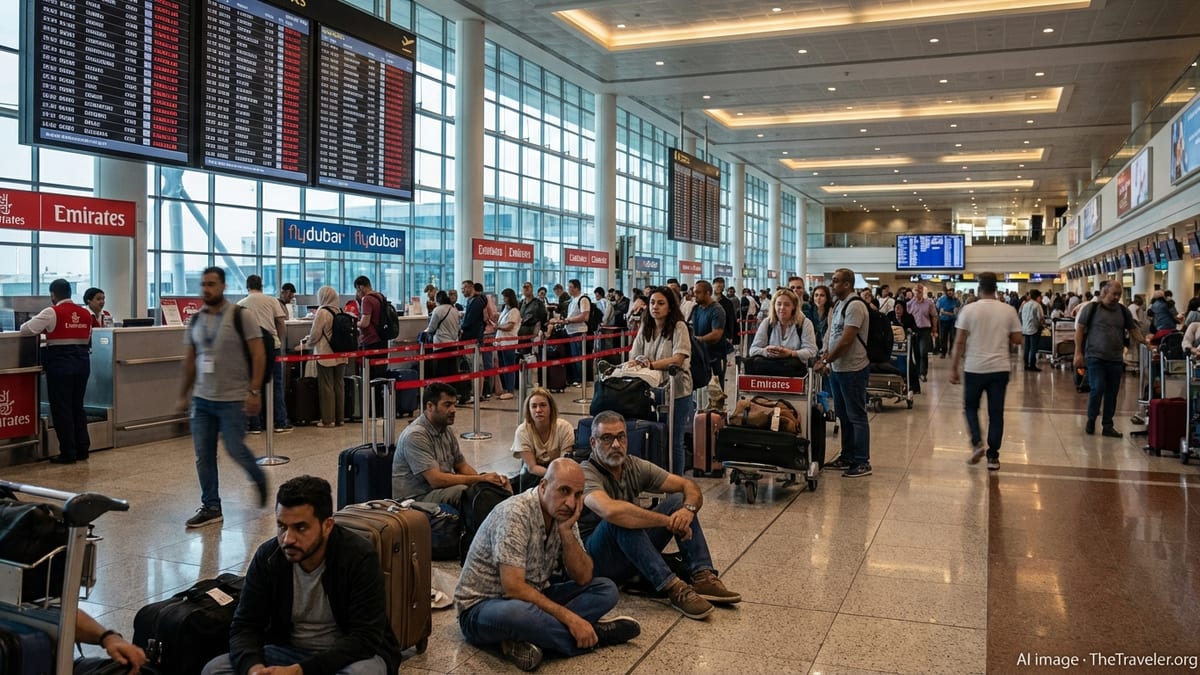
Dubai’s Airports Fall Silent as Airspace Tightens
Dubai Airports confirmed on Saturday that all flight operations at Dubai International (DXB) and Dubai World Central – Al Maktoum International (DWC) have been suspended until further notice, in one of the most significant disruptions to global aviation since the pandemic. Officials said the move followed a temporary, partial closure of United Arab Emirates airspace ordered by the country’s civil aviation regulator as a precaution amid rapidly escalating regional tensions.
Passengers have been urged not to travel to either airport and instead to contact their airlines directly for the latest information. With Dubai International long ranked among the world’s busiest hubs for international traffic, the sudden halt has left terminals crowded with stranded travelers and aircraft parked across aprons and taxiways awaiting clearance to depart.
Flight-tracking data on Saturday showed an almost empty corridor of airspace stretching across parts of the Gulf and wider Middle East, as routes that typically funnel tens of thousands of passengers between Europe, Asia and Africa each day were either canceled or forced far to the south to avoid closed skies.
Emirates and flydubai Suspend Operations
Dubai’s flagship carrier Emirates said it has temporarily suspended all operations to and from Dubai, citing multiple regional airspace closures and emphasizing that passenger and crew safety remains its highest priority. The airline, one of the world’s largest long-haul operators, added that it is actively monitoring the situation and coordinating with aviation authorities while adjusting its flight program in real time.
Budget carrier flydubai has also halted all flights on February 28, further tightening the squeeze on connectivity through the emirate. Other UAE-based airlines, including Etihad Airways and Air Arabia, have announced significant schedule disruptions, with departures from Abu Dhabi paused until at least Sunday afternoon and numerous services to and from the wider region canceled.
Industry analysts say the operational standstill effectively removes Dubai’s core hub function, at least temporarily, with aircraft and crews unable to position in or out of the city. For Emirates, whose business model depends on high-frequency connections across six continents, every hour of suspended operations translates into mounting logistical and financial pressure.
Regional Conflict Triggers Widespread Airspace Closures
The aviation shutdown follows coordinated strikes by the United States and Israel on targets in Iran, and subsequent Iranian retaliatory missile launches across parts of the Gulf. In response, several countries including Iran, Iraq, Qatar, Bahrain and Kuwait moved to close or heavily restrict their airspace, creating a patchwork of no-go zones for civilian flights over some of the world’s busiest long-haul corridors.
Authorities in the UAE described the partial airspace closure as a precautionary measure in light of evolving security risks, particularly the possibility of missile interceptions and falling debris. Earlier incidents in the region, including reported damage to infrastructure in Gulf cities, have heightened concerns about the vulnerability of aircraft flying near active conflict zones.
Regulators in Europe and elsewhere have issued advisories warning of a high risk to civil aviation in the affected skies and urging airlines to avoid them. With Russian airspace already largely off limits to many Western carriers since the invasion of Ukraine, the latest restrictions further squeeze routing options between Europe and Asia, compounding congestion, fuel burn and scheduling challenges.
Global Ripple Effect on Travelers and Airlines
The immediate fallout for passengers has been severe. Thousands of travelers who were due to transit through Dubai and neighboring hubs on Saturday found their journeys abruptly canceled or diverted, with some long-haul services forced to turn back mid-flight after airspace closures were announced. Aviation data firms estimate that hundreds of flights across the broader Middle East have been scrapped in a single day, with many more facing long detours and delays.
Major international airlines in Europe and Asia have rushed to rework schedules, suspending certain routes outright while plotting alternative paths that skirt the most affected areas. Longer flight times mean higher fuel costs and tighter crew duty limits, while aircraft stranded out of position will likely cause knock-on disruptions well into the coming days.
For travelers, the advice from airlines and airports is to stay away from terminals unless specifically instructed to come, to keep contact details updated in booking systems, and to monitor official airline channels for rebooking options. Many carriers are offering fee-free date changes or refunds, but the sheer scale of the disruption means re-accommodation on alternative services may be limited in the near term.
What Passengers Need to Know Right Now
As of Saturday evening local time, there is no confirmed timeline for when Dubai’s airports will fully reopen or when Emirates and other carriers will resume normal operations. Authorities stress that the suspension is temporary and tied directly to security assessments of regional airspace, which remain under continuous review.
Travelers scheduled to fly into or out of Dubai in the coming 24 to 48 hours should assume significant disruption is likely. Those already in the emirate are being advised by several foreign ministries to stay indoors, follow local news and official guidance, and avoid nonessential movement around key infrastructure. Tourists with imminent departures are urged to liaise with their airlines or travel agents before making any journey to the airport.
Industry experts note that while Middle East aviation has proven resilient through past crises, the convergence of regional conflict, overlapping airspace bans and existing global route constraints leaves little margin for error. How quickly operators can restart safely, reposition aircraft and clear passenger backlogs will determine whether this becomes a short, sharp shock to global travel or the start of a longer period of disruption on some of the world’s most important air corridors.