

More news on this day
A suspected drone strike near the U.S. Consulate in Dubai has pushed the Middle East’s air travel system into deeper turmoil, as key hubs from Doha to Kuwait City and beyond grapple with closures, diversions and rolling cancellations that are now rippling as far as Europe and India.
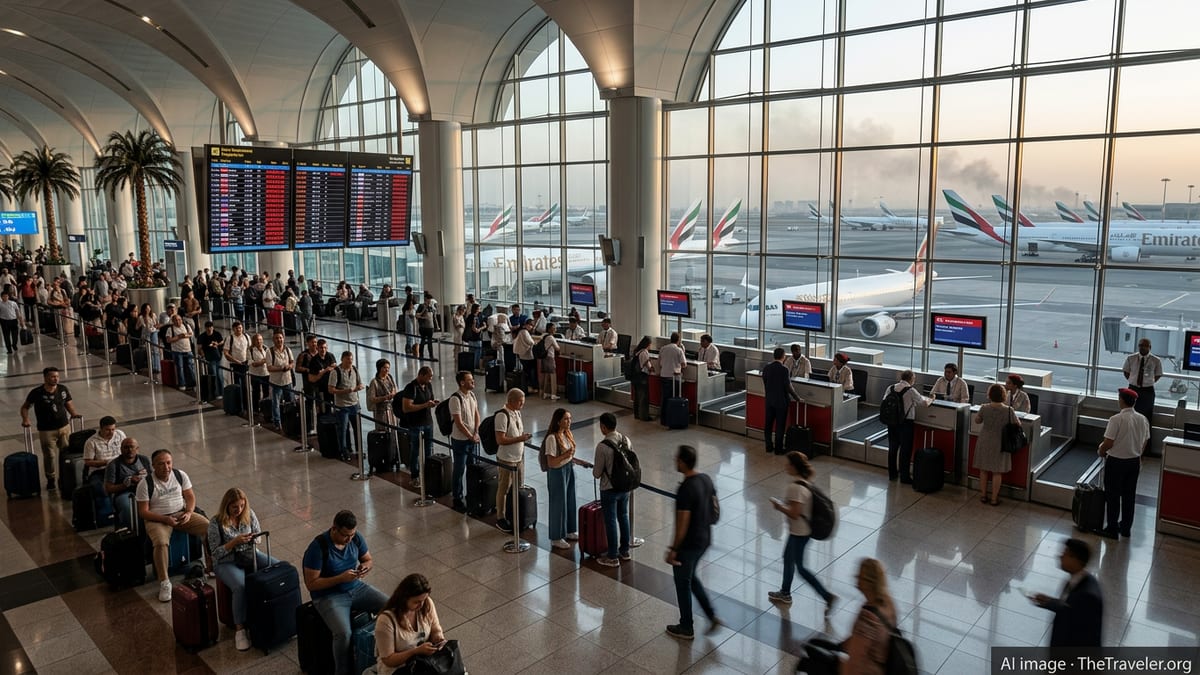
Dubai’s Role as a Hub Undermined by Targeted Strike
Dubai, long marketed as the safest and most reliable gateway between East and West, is now at the center of the disruption. Following an earlier barrage of Iranian missiles and drones against the United Arab Emirates, a suspected strike near the U.S. Consulate in Dubai this week triggered fresh evacuations and a halt to normal operations at Dubai International, the world’s busiest airport for international passengers.
Authorities have confirmed damage to airport infrastructure and nearby hotels along the city’s coastline, with flight boards dominated by cancellations and delays. While Emirates and other carriers have begun operating a reduced schedule of outbound services, these remain a fraction of normal capacity and are focused on moving stranded travelers to major long-haul destinations.
Officials in Dubai continue to urge passengers not to travel to the airport unless their airline has explicitly confirmed that their flight is operating. Even then, departure times are shifting by the hour as carriers navigate intermittent security alerts, inspections and changing overflight permissions across the region.
From Doha to Kuwait City, a Patchwork of Closures and Limited Reopenings
Dubai’s woes are part of a wider airspace crisis that has engulfed the Gulf and Levant since the outbreak of the U.S.-Israel war with Iran. Qatar’s Doha hub, usually one of the most reliable transit points in global aviation, initially shut down all regular services after missile and drone attacks near Hamad International Airport and key gas facilities. Authorities have since allowed a small number of relief and repatriation flights, but regular commercial traffic remains heavily restricted.
In Kuwait City, drone strikes at Kuwait International Airport caused structural damage and minor injuries among airport workers, forcing a full closure of the airfield for commercial traffic. National carrier Kuwait Airways has been rerouting citizens via Jeddah and other Saudi airports where possible, but the number of available seats is limited and subject to rapid change.
Similar patterns are playing out in Abu Dhabi, Riyadh, Muscat, Jeddah and Bahrain, where airspace is technically open at times but constrained by active missile defense operations and intermittent security incidents. Schedules that appear viable on airline apps are frequently scrubbed or rerouted at short notice, leaving travelers scrambling for alternatives or stuck in transit hotels.
Levant and Eastern Mediterranean Hubs Buckle Under Pressure
Beyond the Gulf, air travel in the Levant has been severely curtailed as Iranian and Israeli strikes crisscross the region. Beirut’s Rafic Hariri International Airport, already under strain from Lebanon’s broader economic crisis, has seen waves of cancellations as foreign airlines suspend operations due to security concerns and airspace closures over neighboring Syria and Israel.
Baghdad and other Iraqi airports are similarly affected, with overflights banned or heavily restricted as drones and ballistic missiles target military and strategic sites. Tel Aviv’s Ben Gurion Airport has oscillated between limited operations and full shutdowns, depending on the intensity of incoming fire and the capacity of air defenses to keep routes open.
The fallout has spread into the wider Eastern Mediterranean. Istanbul and Athens, while not directly under fire, are absorbing diverted long-haul flights that would normally transit via the Gulf. This has filled hotels, congested terminals and stretched airline crews and aircraft allocations, particularly on routes connecting Europe to South and Southeast Asia.
Network Shockwaves Reach Cairo, Amman, Mumbai and Beyond
To the west and south, Cairo and Amman have become critical pressure valves for rerouted traffic, hosting emergency connections for travelers who suddenly find themselves unable to fly through the usual Gulf or Levantine hubs. Both cities are seeing sharp spikes in demand and rising fares, along with crowded transfer zones and longer queues for immigration and security.
Further east, the ripple effects are being felt as far as Mumbai, Delhi and other Indian metros. With overflight corridors across Iran and large portions of the Gulf closed or severely restricted, airlines are lengthening routes, adding refueling stops, or temporarily suspending services altogether. Carriers in Europe, Asia and Australia have canceled or rerouted thousands of flights, turning what would normally be straightforward overnight journeys into multi-leg odysseys.
These network adjustments have also affected cargo flows, with key sea-air intermodal routes via Dubai, Doha and Abu Dhabi disrupted. Freight operators are seeking alternatives via Istanbul, Cairo and even sub-Saharan African hubs, which could lead to higher costs and longer delivery times for goods moving between Asia, Europe and North America.
What Travelers Need to Know Right Now
For anyone currently in the Middle East or holding tickets that involve Dubai, Doha, Abu Dhabi, Riyadh, Kuwait City, Muscat, Beirut, Baghdad, Tel Aviv, Tehran, Istanbul, Cairo, Amman, Jeddah, Athens or Mumbai, the situation remains highly fluid. Governments have issued strong advisories urging citizens to leave affected countries while commercial options still exist, yet capacity is limited and conditions can change rapidly.
Travel and aviation authorities are consistent on one point: do not assume any booked flight will operate as scheduled. Passengers are advised to monitor airline communications closely, use official apps or customer service channels to confirm specific flight numbers, and avoid heading to the airport without written or digital confirmation that their service is operating.
Where flights are available, travelers should expect longer routings, potential unscheduled stops, and last-minute gate or timing changes. Those with flexible itineraries may wish to explore alternative routings through relatively less affected hubs such as Istanbul, Cairo or certain European capitals, keeping in mind that these airports are also experiencing crowding and frequent timetable revisions.
With missile and drone attacks still ongoing and governments reviewing airspace restrictions day by day, the only certainty for now is continued volatility. Anyone planning to transit the broader Middle East in the coming days should be prepared for disruption, stay attuned to official advisories, and build substantial buffers into their travel plans.