

More news on this day
Dubai authorities have issued an urgent travel advisory for the wider Middle East as the escalating war between Iran and Israel forces airspace closures, widespread flight cancellations and emergency rerouting that are rippling through global tourism networks.
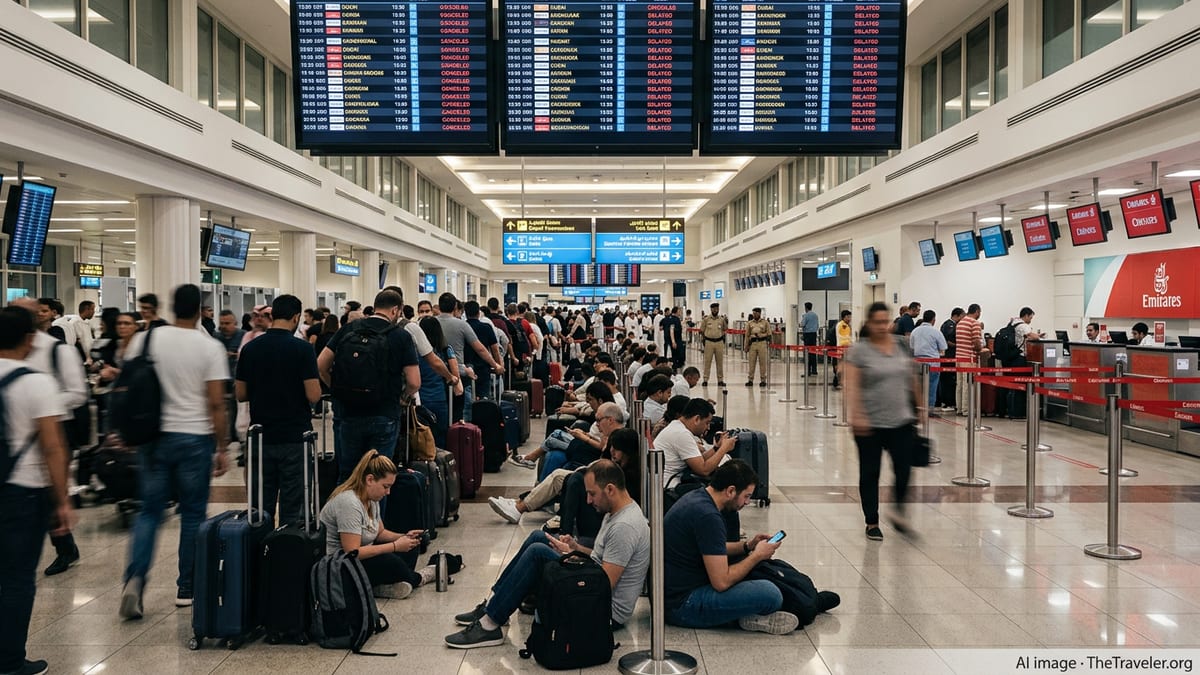
Airspace Closures Paralyze Key Middle East Hubs
The advisory follows days of unprecedented disruption across the region, with Iran, Israel, Iraq, Qatar, Bahrain and the United Arab Emirates imposing partial or full restrictions on civilian airspace since late February. Commercial operations at major gateways including Dubai International, Abu Dhabi, Doha and Tel Aviv have been curtailed or temporarily suspended, forcing airlines to cancel thousands of flights and divert others over longer routes via Central Asia and the Arabian Sea.
Dubai International, the world’s busiest hub for international travel, has been operating on a sharply reduced schedule after sustaining indirect damage and repeated security alerts linked to Iranian missile and drone barrages on Gulf targets. Authorities say flight movements remain well below normal, with only a limited number of departures cleared each hour and priority given to evacuation services and long haul connections that cannot easily be re-routed through alternative hubs.
Regional governments and aviation regulators have warned that airspace restrictions could remain in place or be tightened further if hostilities intensify. The European Union Aviation Safety Agency continues to advise carriers to avoid large swathes of Middle Eastern airspace, including over Bahrain, Iran, Iraq, Israel, Jordan, Kuwait, Lebanon, Oman, Qatar, Saudi Arabia and the UAE, compounding the complexity of route planning for global airlines.
Analysts say the closures have turned the Middle East’s position as a strategic crossroads into a liability for the moment, as aircraft from Europe, Africa, Asia and Oceania are forced into lengthy detours that add hours to flight times, strain crews and push up fuel costs, while dramatically reducing the number of passengers who can realistically transit through Dubai and other Gulf hubs.
Thousands Stranded As Airlines Slash Schedules
The immediate human impact is visible in crowded terminals from Dubai to Bangkok, where stranded passengers have been sleeping on airport floors or in makeshift waiting areas after their flights were canceled with little notice. Data providers estimate that more than twenty thousand flights have been canceled in just over a week since the conflict escalated on February 28, triggering a cascade of missed connections and lost holidays across the world.
Emirates, Etihad, flydubai and Air Arabia have all significantly reduced schedules to and from conflict-affected countries, while resuming only limited operations on selected corridors judged safe enough to operate with enhanced risk assessments. International carriers including major European and Asian airlines have temporarily suspended direct services to the region or are operating sporadic rescue flights to pick up stranded nationals and residents.
Dubai Airports is urging travelers not to come to either Dubai International or Al Maktoum International unless they have received explicit confirmation from their airline that their flight is operating. Officials say the priority is to avoid terminal overcrowding and allow room for security checks and processing for those passengers who do have confirmed departures, including evacuees booked on government-coordinated flights.
Travel industry executives warn that even once airspace begins to reopen, it could take weeks for airlines to fully restore normal schedules. Aircraft and crews are out of position, maintenance windows have been disrupted and many travelers are seeking refunds or postponements rather than accepting indirect routings that may now involve multiple stops and long layovers.
Dubai’s Advisory: Destinations, Risk Levels And Insurance Gaps
Dubai’s travel advisory, issued through federal crisis authorities and tourism officials, urges residents and visitors to avoid all nonessential travel to a broad list of countries across the Levant and Gulf, including Iran, Iraq, Israel, the Palestinian territories, Lebanon, Syria and Yemen. It further recommends that travelers reconsider or defer trips to other nearby states where airspace and transit routes remain volatile, even if local conditions on the ground appear calm.
Authorities are emphasizing that risk levels may change quickly as the conflict evolves and that travelers should not assume traditional business or pilgrimage routes will remain viable over the coming days. Even journeys that do not involve overnight stays in the region can be affected, as popular one stop itineraries between Europe, Asia, Africa and Australasia typically rely on connections through Dubai, Abu Dhabi or Doha, all of which are operating under tight capacity constraints.
Insurance specialists in the emirate are warning that many standard travel insurance policies contain exclusions for war, civil unrest and government ordered airspace closures. Dubai’s advisory encourages travelers to check policy wording carefully before departure and to ask brokers or insurers to confirm in writing whether trip cancellation, curtailment and medical coverage would apply in the event of further escalation or renewed shutdowns.
The advisory also reminds corporate travelers and tour operators to update their internal risk assessments and crisis plans, including verifying the security of local partners, confirming evacuation options and ensuring that staff traveling in or through the region are registered with their consular authorities. Companies are being told to avoid routing essential personnel through conflict affected hubs where practical alternatives exist, even if this increases costs.
Global Tourism Faces Shock To Confidence
The war’s timing and scale pose a serious challenge to a global tourism industry that had only recently returned to pre pandemic growth, with the Gulf at the center of that rebound. Dubai welcomed more than twenty four million international visitors in 2025, cementing its status as both a destination in its own right and a vital connecting point between continents. The current crisis threatens to undermine that momentum just as high season travel builds towards the Northern Hemisphere spring and summer.
Analysts say the conflict has delivered a psychological blow beyond the immediate travel bans and flight cancellations. Images of missile interceptions over Gulf skylines, damaged airport infrastructure and cruise ships idling offshore while ports assess security risks are likely to linger in the minds of travelers who may now question the reliability of itineraries that pass anywhere near the Middle East.
Tour operators report a spike in cancellations and rebookings away from the region, with some customers opting for routes that avoid the Gulf entirely, even when those alternatives involve longer flying times and higher fares. Cruise lines are quietly revising itineraries to sidestep Gulf ports, while long haul carriers are promoting connections through hubs in Europe and East Asia as safer options for the time being.
Despite the shock, Dubai’s tourism authorities insist that the city remains committed to hosting visitors safely, highlighting the emirate’s extensive security infrastructure, diversified hospitality sector and experience managing major international events amid regional instability. However, they acknowledge that sustained growth now depends on a swift de escalation of hostilities and the gradual restoration of confidence in Middle Eastern airspace.
Safety Guidelines For Travelers In Or Transiting Through Dubai
In conjunction with the advisory, Dubai and federal UAE agencies have published detailed safety guidance for residents, expatriates and visitors currently in the country or holding onward tickets through its airports. Travelers are urged to monitor official government and airport channels rather than relying on social media rumors, and to verify flight status repeatedly in the 24 hours before departure as last minute schedule changes remain common.
Authorities recommend that passengers keep travel documents, mobile phones, chargers, essential medications and at least one change of clothing in their carry on baggage in case of sudden diversions or extended waits in transit hubs. Those staying in hotels are encouraged to familiarize themselves with property emergency procedures, including shelter in place locations away from exterior windows and rooftop venues during periods of heightened alert.
Visitors are also being asked to register their presence with their home country embassies or consulates, enabling rapid contact in case evacuation flights are arranged. Residents and long term expatriates have been told to review personal contingency plans, including identifying safe meeting points for family members, maintaining basic supplies at home and ensuring that local contact details are up to date with employers and schools.
For travelers planning future trips, Dubai’s guidance is to build flexibility into itineraries wherever possible by choosing tickets that allow changes, allowing extra time for connections and considering alternative routing that does not rely solely on a single Middle Eastern hub. Officials stress that while the emirate remains open on a limited basis, the situation across the wider region is fluid, and prudent planning is now essential for anyone considering air travel touching the Middle East.