

More news on this day
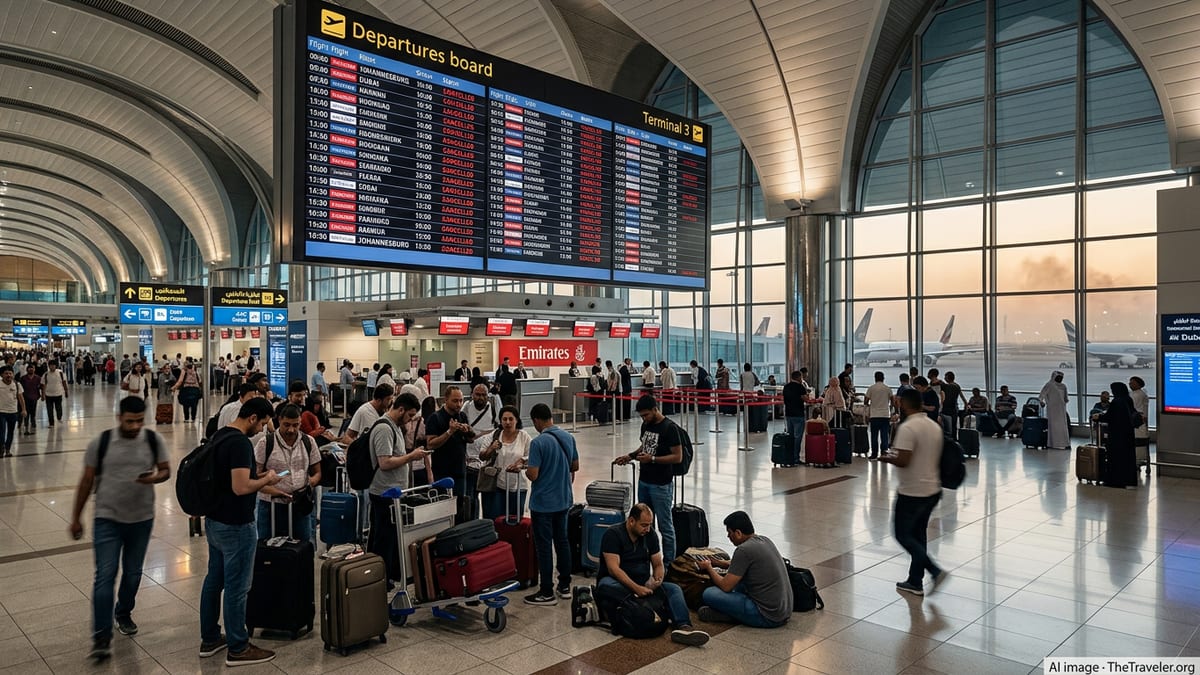
Fresh turbulence in the Middle East is rippling across global aviation, with Dubai–Johannesburg services among the routes facing sudden disruption, costly detours and mounting uncertainty for travelers and tourism businesses.
Get the latest news straight to your inbox!
Airspace Closures Turn a Key Corridor Into a Bottleneck
The latest phase of the Iran war, which escalated from late February 2026, has quickly transformed the Gulf’s skies from one of the world’s busiest transit corridors into a patchwork of closures and high-risk zones. Publicly available notices and travel advisories describe airspace restrictions or outright closures affecting Iran, Iraq, Israel, Syria, Kuwait and Yemen, with partial limitations across several Gulf states including the United Arab Emirates.
In the UAE, reports indicate that authorities briefly closed national airspace after missile and drone activity linked to Iranian forces, leading to smoke and debris near Dubai International Airport and a temporary halt in normal operations. Aviation risk analyses issued in early March highlight the possibility of sudden airspace shutdowns with little warning, forcing flight planners to redraw routes in real time and stretching already congested alternative corridors over the Arabian Sea, the Red Sea and East Africa.
Dubai’s position as a global super-hub has amplified the shock. With much of the region’s overflight capacity constrained, long-haul itineraries that once depended on seamless transfers through Dubai are being rerouted, delayed or suspended. Africa-bound traffic is among the most exposed, as traditional Middle East connections serve as a lifeline linking southern Africa with Europe, Asia and North America.
Industry assessments suggest that thousands of flights across the Middle East were canceled or heavily delayed in the days after the first major strikes, with international carriers and Gulf-based airlines alike cutting services to and over the conflict zone. For passengers, that has translated into rolling disruption on routes that seldom previously featured on global risk maps.
Dubai–Johannesburg: From Reliable Trunk Route to Risk Barometer
For years, Dubai–Johannesburg has been one of the flagship links between the Gulf and southern Africa, with multiple daily services funneling tourists, business travelers and migrant workers in both directions. The current conflict has turned that familiar trunk route into a barometer of wider aviation volatility, as schedules are reshaped day by day in response to risk assessments and airspace availability.
According to publicly shared airline updates and passenger notices, regular commercial flights between Dubai and Johannesburg were caught up in the broad suspension of services to and from Dubai in early March, when airspace closures across the region forced carriers to ground most operations. Subsequent days have seen a patchwork restart, including designated repatriation flights on the Dubai–Johannesburg sector while normal frequencies remain below pre-crisis levels.
Travel forums and airline advisories describe a situation in which certain Johannesburg flights appear on departure boards as scheduled, yet remain vulnerable to late operational changes if regional tensions spike or missile activity resumes. Passengers have been urged to verify flight status immediately before heading to the airport, underscoring how fragile these long-haul links have become while the war continues.
Even when services operate, routings may be longer and more circuitous as aircraft skirt no-fly zones and high-risk airspace. The result is extended flight times, higher fuel burn and compressed turnaround windows in Johannesburg and Dubai, all of which increase the risk of knock-on delays and missed onward connections.
Tourism and Business Travel Face Mounting Headwinds
The Gulf–Africa aviation bridge is central to tourism flows into South Africa, Botswana, Zimbabwe and the broader region, and analysts warn that prolonged instability could tip what was a strong post-pandemic recovery into a renewed downturn. Dubai-based connections enable visitors from Europe, the Middle East, India and East Asia to reach Johannesburg with a single stop, feeding safari circuits, wine tourism and conference travel across southern Africa.
Industry commentary and early booking data indicate a sharp uptick in cancellations and rebookings for itineraries relying on Middle East hubs, as travelers opt for routings via Europe or Southeast Asia to avoid perceived conflict risk. Some consumers report buying backup tickets on alternative corridors in case Gulf flights are abruptly canceled, a behavior that both reflects and reinforces concerns about reliability.
The tourism sector now faces a multi-layered challenge: not only reduced capacity and higher fares on core routes such as Dubai–Johannesburg, but also a psychological drag as headlines about missile strikes, airspace closures and repatriation flights dominate news cycles. Destination marketers in southern Africa are watching closely for signs that long-haul demand may soften, particularly from markets that depend heavily on convenient Gulf connections.
Business travel is also under strain. Corporate travel policies in sectors such as mining, energy and financial services are being reassessed, with some companies directing staff away from itineraries that involve extended time over or near conflict zones. That shift could further dent premium-cabin demand on the Dubai–Johannesburg route, eroding a key revenue pillar for long-haul carriers serving southern Africa.
Global Aviation and Insurance Markets Feel the Pressure
The disruption extends far beyond a single city pair. Logistics advisories issued in early March describe Gulf carriers as nearly fully grounded at the height of the crisis, temporarily removing a significant share of global airfreight capacity. With Dubai and other regional hubs constrained, critical cargo flows between Asia, Europe and Africa have been forced onto longer, more expensive paths, adding to supply chain stress that has built up over several years of geopolitical shocks.
War-risk insurance is emerging as another decisive factor shaping route maps. Specialist risk briefings note that underwriters are reassessing coverage terms for flights traversing parts of the Middle East, with premiums for certain corridors rising sharply. As insurers recalibrate, airlines must weigh the profitability of maintaining particular services, including long-haul sectors linking Dubai with African gateways such as Johannesburg.
Longer routings around closed airspace feed directly into operating costs. With fuel already volatile in response to the regional oil shock, each additional hour in the air can erode margins on price-sensitive leisure routes. Carriers face difficult choices between passing those costs on to passengers, trimming frequencies, or temporarily suspending services until conditions stabilize.
These headwinds intersect with lingering capacity constraints in the global fleet, as aircraft grounded during the pandemic and subsequent downturns are only gradually returning to service. The net effect is a tighter market in which every lost rotation on a high-demand route such as Dubai–Johannesburg is harder to replace elsewhere in the network.
Travelers Pivot to Detours and Delay-Tolerant Plans
For individual travelers, the turbulence has immediate, practical consequences. Publicly shared passenger experiences describe a scramble to secure alternative routings that bypass the Gulf entirely, often at significant extra cost and with much longer journey times. Options include detours via European hubs, East African gateways such as Nairobi and Addis Ababa, or Asian hubs like Singapore for those connecting onward from Johannesburg.
Risk consultants and travel-management firms are advising clients to build greater flexibility into itineraries touching the region. Recommendations include allowing extended layovers to absorb delays, booking fully changeable tickets where possible, and closely monitoring airline and airport communications in the days leading up to departure. For nonessential trips, some organizations are delaying travel altogether until more stable patterns emerge.
At the same time, there are early signs of gradual normalization as certain Gulf hubs move from total suspension to limited, carefully managed operations. Airline updates suggest that networks are being rebuilt in stages as airspace restrictions ease and risk assessments allow, with a focus on key trunk routes including those to major African cities.
The outlook for Dubai–Johannesburg remains closely tied to the trajectory of the wider conflict. If missile and drone activity subsides and airspace corridors reopen more fully, the route could recover relatively quickly, given underlying demand. If hostilities escalate or new restrictions are imposed, however, this once-stable link between the Gulf and southern Africa may continue to epitomize the fragility of global tourism in a highly volatile era.