

More news on this day
Escalating conflict across the Middle East has thrown the busy Dubai–Johannesburg corridor into turmoil, with widespread flight cancellations, emergency rerouting and mounting fears of a broader tourism slump across southern Africa.
Get the latest news straight to your inbox!
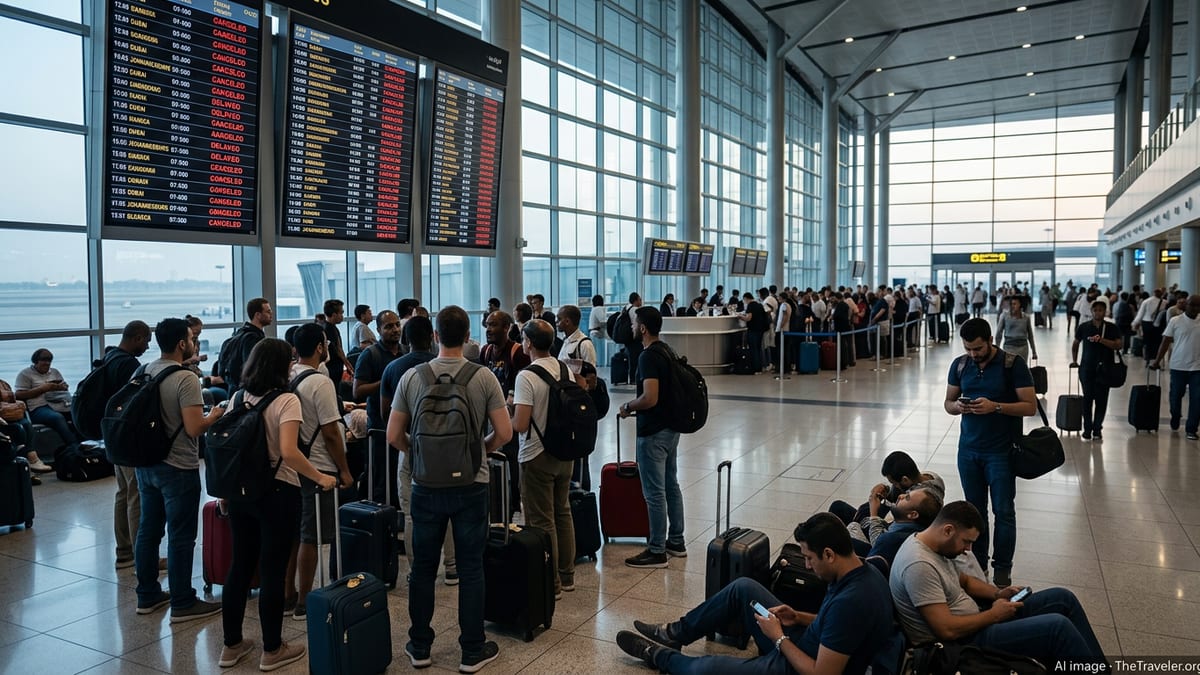
Key Gulf Airspace Closures Ripple Into Southern Africa
Recent military escalation involving Iran, Israel and U.S. forces has triggered partial and full airspace closures across the Middle East and North Africa, including Iran, Iraq, Israel, Jordan, Kuwait, Qatar, Bahrain, Syria and the United Arab Emirates. Publicly available aviation and government notices indicate that major hubs such as Dubai, Abu Dhabi and Doha are operating on heavily curtailed schedules, with waves of cancellations and delays affecting long-haul networks well beyond the region.
Industry advisories describe a patchwork of temporary shutdowns and restricted corridors, forcing airlines to divert or suspend services that traditionally funnel passengers from Europe and Asia into Africa via Gulf hubs. Reports from corporate and travel risk consultancies note that some Middle East airspace corridors remain subject to sudden closure, creating operational uncertainty for carriers and undermining schedule reliability.
Travel and tourism bodies in southern Africa warn that these disruptions are hitting one of the region’s most important aviation bridges. South Africa has long relied on Gulf carriers for connectivity to key long-haul markets, with Dubai–Johannesburg regarded as a backbone route for both leisure and business travel.
Dubai–Johannesburg Route Sees Cancellations and Stranded Passengers
Johannesburg’s O. R. Tambo International Airport has reported clusters of cancellations on services to Dubai and the wider Middle East since the latest phase of the conflict began in late February. Local travel media in South Africa highlight that the Johannesburg–Dubai route, normally among the country’s strongest international performers, has seen some of the sharpest disruption, prompting airport authorities to warn prospective passengers to avoid unnecessary trips to the terminal.
Coverage from Dubai and Abu Dhabi describes thousands of travelers left in limbo as Gulf-based carriers scaled back operations in response to airspace closures and missile and drone threats. In some cases, flights attempting to resume limited schedules have been forced to divert or turn back due to renewed security incidents near key aviation corridors, further compounding backlogs at already stretched hubs.
Advisories aimed at tour operators and corporate travel managers in southern Africa stress the importance of contingency planning for journeys involving Gulf connections. Recommendations include extended minimum connection times, flexible ticketing, and alternative routings that bypass the most sensitive airspace, even at the cost of longer flight times and higher fares.
Global Re-Routing Pushes More Traffic Around Africa
The aviation upheaval is unfolding alongside a broader realignment in global transport patterns. Maritime and logistics analyses show that the closure or partial closure of Gulf and Red Sea corridors has already redirected significant shipping traffic around the Cape of Good Hope, boosting vessel movements along South Africa’s coasts. This shift mirrors the emerging trend in passenger aviation, where carriers are increasingly looking to southern or western detours to avoid conflict-affected skies.
Business aviation specialists report that operators linking Europe and South Asia are now relying more heavily on southern routes that skirt the most volatile parts of the Middle East. Similar patterns are beginning to appear in commercial networks, with airlines exploring links via Oman, Saudi Arabia or direct Africa–Europe and Africa–Asia services that do not rely on the traditional Gulf triangle of Dubai, Doha and Abu Dhabi.
While these workarounds preserve some connectivity, they typically add hours to flight times and substantially increase fuel burn. Rising oil prices driven by disruptions in the Strait of Hormuz and wider Gulf energy infrastructure are further inflating operating costs, raising concerns that long-haul fares to and from southern Africa will climb as the crisis continues.
Tourism and Business Travel Face Mounting Uncertainty
Tourism analysts warn that the timing of the aviation shock is particularly damaging for South Africa and its neighbors, which have spent the past few years rebuilding long-haul demand after the pandemic. Travel trade publications note that Gulf carriers have become critical feeders of visitors from Europe, North America and Asia into Johannesburg, Cape Town and regional safari destinations, making any prolonged disruption a direct threat to forward bookings.
Published coverage from travel and trade associations points to a sharp increase in cancellations and rebookings on itineraries involving Dubai and Doha, as travellers seek more predictable routings or postpone trips altogether. Tour operators report heightened nervousness among clients, even for itineraries that do not transit the Middle East, reflecting a broader perception risk that could weigh on the region’s image as a long-haul destination.
Business travel is also feeling the strain. Corporate itineraries that previously relied on tight connections via Gulf hubs are being restructured, often at short notice, to route via Europe or direct African gateways. This adds complexity and cost to regional trade missions and investment visits at a time when South Africa is actively courting international capital and trying to stabilize its own economic outlook.
Worldwide Caution as Industry Braces for a Longer Crisis
Airlines, tourism boards and travel advisers are openly preparing for the possibility that the conflict and associated airspace restrictions will persist for weeks or months. Aviation analytics firms have already counted many thousands of cancelled flights touching the Middle East since the latest escalation began, and industry commentators caution that the backlog of stranded passengers could take considerable time to clear even if conditions improve.
Global coverage notes that the Middle East conflict is unfolding against a backdrop of other long-running airspace restrictions, including bans over Ukraine and parts of Russia, as well as closures in sections of Africa and along the India–Pakistan frontier. The cumulative effect is to funnel international traffic through a shrinking set of safe corridors, limiting the industry’s ability to absorb fresh shocks.
For southern Africa, and for the high-traffic Dubai–Johannesburg corridor in particular, the next phase of the crisis will hinge on whether Gulf hubs can safely restore stable schedules. Until then, travellers face continuing uncertainty, longer journeys and rising costs, while tourism and trade players in both regions weigh the risk that today’s flight chaos could harden into a more enduring loss of confidence.