

More news on this day
Dubai has issued an emergency instruction to hotels prohibiting the eviction of stranded guests, a move that is providing critical reassurance to hundreds of Edinburgh passengers marooned in the emirate after widespread flight cancellations across the Middle East.
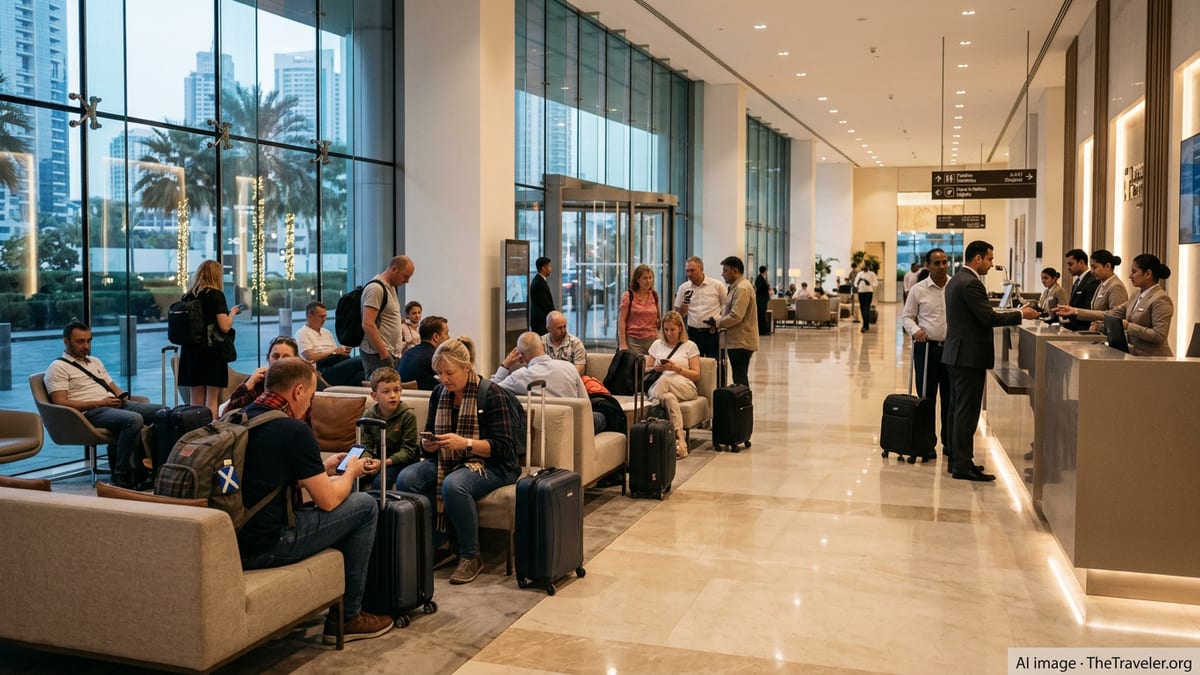
Emergency Order Shields Stranded Edinburgh Passengers
Dubai’s Department of Economy and Tourism has told hotels they must not evict guests who are unable to leave the city because flights have been grounded, following the sudden closure of large sections of Middle East airspace. The directive, circulated by email to hotel operators, instructs properties to extend stays for affected visitors on the same terms as their original bookings and to work closely with authorities in cases where guests cannot immediately cover additional costs.
The order is particularly significant for UK travelers, including large numbers of passengers who had departed from or were due to connect to flights from Edinburgh. With services through Dubai International Airport suspended and onward routes to Europe unavailable, many Scottish holidaymakers and business travelers have found themselves unexpectedly stuck in the city as their original hotel check-out dates approached.
Officials have stressed that no guest whose travel plans have been disrupted by the crisis should be forced to leave their accommodation solely because they have reached their scheduled departure date. Hotels have been asked to flag complex cases directly to the tourism department so alternative financial support or placement can be arranged where needed.
While the order applies to all nationalities, travel agents in Scotland say it has been especially welcomed by Edinburgh families traveling with children and older relatives, many of whom had been facing the prospect of trying to secure last-minute, potentially costly rooms in an already stretched hotel market.
Regional Airspace Shutdown Triggers Mass Flight Cancellations
The hotel directive follows one of the most disruptive aviation shutdowns the Gulf has seen in years. A wave of airspace restrictions linked to escalating tensions in the wider region prompted the temporary closure of key hubs, including Dubai International and Abu Dhabi’s Zayed International Airport, forcing airlines to suspend or severely curtail operations.
Carriers such as Emirates and Etihad have cancelled or diverted hundreds of flights, with ripple effects across European gateways that are heavily dependent on connections via the United Arab Emirates. Edinburgh, along with London and Manchester, counts Dubai as a vital long-haul link, leaving UK-bound travelers with few immediate alternatives once airspace closures took effect.
Industry estimates suggest more than 20,000 passengers are currently being housed in hotels across Dubai and Abu Dhabi after being moved off airport floors and terminal waiting areas. Many had already checked out of their original accommodation on the assumption they would be flying home, only to find themselves stuck landside when departures were suddenly halted.
With no clear timeline yet for the full restoration of normal flight schedules, authorities have shifted focus to ensuring that visitors are not left without shelter or basic support as the disruption continues into a third day.
UAE Steps In to Underwrite Accommodation and Meals
Dubai’s “no eviction” instruction is part of a broader package of emergency measures rolled out by the United Arab Emirates to protect stranded travelers. The country’s General Civil Aviation Authority has said the state will bear accommodation and sustenance costs for affected passengers while operational adjustments remain in place, working with national carriers and airport operators to coordinate care.
In Abu Dhabi, the Department of Culture and Tourism has gone further by formally committing to cover the full cost of extended hotel stays for guests who cannot depart, with hotels instructed to invoice the authority directly. Travel industry reports indicate that similar arrangements are being made in Dubai in cases where visitors are unable to pay for additional nights, though individual hotels have also introduced their own flexible policies and discounted crisis rates.
For many Edinburgh travelers, the practical impact is that room charges, meals and basic transport are increasingly being handled either by their airline or by local authorities, rather than through personal credit cards or travel insurance alone. Scottish consular officials in the UAE are liaising with hotel partners and carriers to ensure that vulnerable passengers, including unaccompanied minors and those with medical needs, are prioritized for support and early rebooking once flights resume.
Travel advisers are nonetheless urging stranded visitors to keep receipts and written confirmations of hotel arrangements, as these may later be required for insurance claims or for any reimbursement schemes established once the full scale of the disruption is assessed.
Human Stories From Edinburgh Travelers Stuck in Dubai
Behind the emergency orders and aviation statistics are thousands of individual travel stories. Passenger advocates report that several Edinburgh-origin school holiday groups were among those caught up in the disruption, with some families returning from long-planned trips to Southeast Asia or Australia via Dubai when their onward flights to Scotland were cancelled.
Many of these travelers had booked short stopovers, expecting to spend only a few hours in the emirate before flying on to Edinburgh. Instead, they have been transferred to city hotels for an open-ended stay, with some parents sharing accounts of explaining to children why they cannot yet go home despite bags being packed and goodbyes already said.
Others, including business travelers and solo backpackers, describe a mix of anxiety and relief: frustration at the uncertainty over when they will be able to leave, tempered by the knowledge that they have a guaranteed roof over their heads and access to meals without extra out-of-pocket costs. Several Edinburgh passengers have credited hotel staff with easing the strain, citing late-night check-ins, flexible meal hours and relaxed rules on late check-outs as key to coping with the situation.
Social media posts from stranded Britons in Dubai show lobby floors turned into informal information hubs, as guests from different countries share updates from airlines and embassies. Some Scottish visitors have reported receiving direct messages from consular teams advising them to register contact details and to avoid spending additional money on changing flights until new schedules are confirmed.
What Stranded Edinburgh Travelers Should Do Next
Travel specialists advising Edinburgh passengers in Dubai say the first step is to stay in close contact with airlines, either through official apps, customer service lines or airport help desks when safe to access them. Airlines remain responsible for rebooking and will have the most accurate information on when specific services to Scotland and the wider UK are likely to restart.
Stranded guests are being encouraged to confirm in writing with their hotel that their stay is covered under the emergency arrangements, including any meals or transfers that are being provided. Where possible, travelers should also register with the nearest UK consulate or embassy, which can offer tailored guidance and, in some cases, coordinate with local authorities on accommodation and welfare issues.
Agents in Edinburgh caution against making expensive independent arrangements to reroute via third countries until there is more clarity over the regional airspace picture, warning that onward connections could also be affected if restrictions shift. Instead, they advise focusing on maintaining communication, preserving funds where possible and taking advantage of the protections now being put in place by Dubai’s tourism authorities and the wider UAE government.
While the immediate priority remains passenger safety and shelter, the handling of stranded guests, particularly those from key markets such as the UK, will also play a role in shaping future perceptions of the region as a transit hub. For now, Dubai’s “no eviction” stance is being seen by many Edinburgh travelers as a vital assurance at an uncertain moment far from home.