

More news on this day
As conflict-driven airspace closures ripple across the Gulf, Dubai and Riyadh remain partially connected to the world by a fragile web of limited commercial flights, special services and emergency reroutes that can change by the hour.
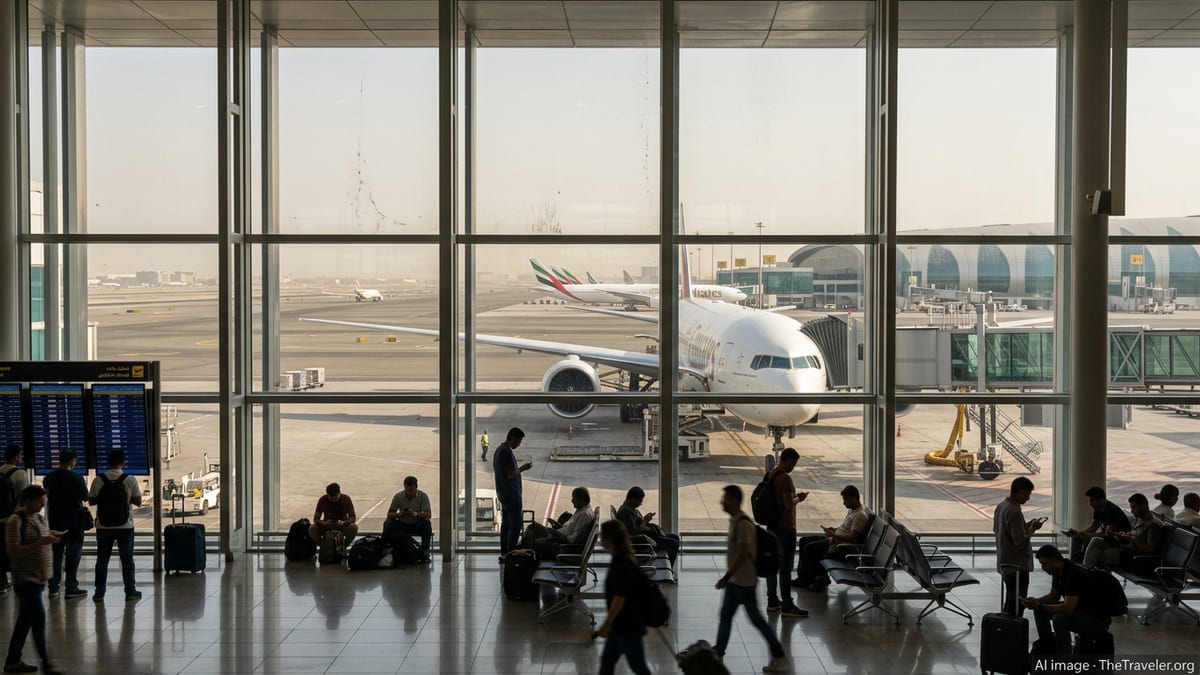
Patchwork Flight Network Amid Gulf Airspace Closures
Days of missile strikes and airspace shutdowns centered on the Strait of Hormuz have upended what were once some of the world’s busiest hubs, with Dubai International and Riyadh’s King Khalid International Airport operating far below normal capacity. Authorities in the United Arab Emirates and Saudi Arabia have allowed only a gradual, highly controlled restart of flights after full or partial closures that began on February 28.
Dubai Airports has confirmed a limited resumption of operations following a 48 hour shutdown, with departure boards still showing rows of cancellations and ad hoc services slotted between them. Aviation data providers estimate hundreds of thousands of passengers remain stranded or severely disrupted across Europe, South Asia and East Africa as the shock pulses through long haul networks that rely on Gulf connections.
In Riyadh, the picture is slightly more stable but still constrained. Saudi officials have kept key domestic corridors open to maintain internal connectivity while permitting a small number of international departures judged safe under current military and regulatory assessments. The result is an uneven map of availability where airline, route and even time of day can determine whether a flight operates at all.
Travelers heading to or from either city are being urged by local authorities and foreign embassies not to go to the airport without confirmed flight status, as same day schedule changes remain widespread. Many carriers are publishing rolling operational bulletins, often only a few hours before departure, reflecting the fluid security situation and the complex process of securing alternative routings.
Gulf Carriers: Limited Lifelines From Dubai and Riyadh
The region’s homegrown airlines remain the primary lifelines for those trying to reach or leave Dubai and Riyadh, though even these giants are running a fraction of their normal schedules. Emirates, based in Dubai, suspended regular scheduled services during the height of the airspace shutdown and has been operating only a small number of special or repatriation flights out of its hub, many routed along longer tracks over Africa or the polar regions to avoid conflict zones.
Etihad Airways in nearby Abu Dhabi has taken a similar approach, temporarily suspending most scheduled flights while gradually restoring select long haul services via southern and polar detours. These flights often operate with extended block times of four to six additional hours because they must skirt closed airspace over Iran, Iraq and parts of the Levant. Capacity on the few services still running is tight, with some departures reportedly selling out within minutes of being loaded into reservation systems.
Low cost carrier flydubai has announced a limited slate of outbound flights from Dubai International as part of a carefully controlled restart. The airline is focusing on returning stranded passengers on previously booked itineraries, directly contacting eligible travelers rather than opening broad public sales. Sharjah based Air Arabia has also begun to edge back into the skies after a period of total suspension on UAE routes, but its network remains sharply curtailed.
From Riyadh, flag carrier Saudia continues to operate a constrained schedule of domestic and select regional flights, while monitoring the situation on longer international routes. Saudi low cost airline flynas has gone in the other direction, extending a suspension of flights to and from the UAE, Bahrain, Kuwait, Qatar and several other neighbors due to ongoing airspace restrictions. For travelers in Riyadh, that leaves Saudia and a shrinking list of foreign partners as the main options.
International Airlines: Who Is Still Serving Dubai and Riyadh
Among non Gulf airlines, service to Dubai and Riyadh is a patchwork of partial resumptions, outright cancellations and short term suspensions announced in rapid succession. European and Asian carriers are weighing war risk assessments, insurance costs and regulatory advisories before dispatching aircraft into the region, leading to a constantly shifting operating map.
Virgin Atlantic has emerged as one of the first major European carriers to cautiously restore a limited number of flights into both Dubai and Riyadh, emphasizing that schedules remain subject to change as security conditions evolve. Turkish Airlines is allowing itinerary changes without fees for passengers booked to or from the UAE and Saudi Arabia, but continues to restrict or suspend certain services as it adapts its broader Middle East network to the new airspace realities.
On the other side of the ledger, several flagship brands have pulled back entirely, at least in the short term. Air France has canceled flights to and from Dubai and Riyadh through March 5 inclusive, citing the security situation at those destinations. A number of Asian and European airlines have similarly paused operations or sharply reduced frequencies, often extending blanket change fee waivers and refunds for affected passengers while they reassess risk beyond the end of this week.
For travelers, the implication is clear: seat availability into and out of Dubai and Riyadh is heavily concentrated on a handful of carriers still willing and able to operate, and even those flights may be retimed, rerouted or canceled on short notice. Booking flexible, fully changeable tickets and monitoring airline alerts closely has shifted from a convenience to a necessity.
What Travelers Can Expect at the Airport and in the Air
Those who do secure a seat on a flight to or from Dubai or Riyadh should be prepared for an experience that looks very different from the Gulf’s usual smooth, high capacity operations. At Dubai International, terminals that normally move tens of millions of passengers each quarter are instead seeing sporadic banking of departures, long customer service lines and ad hoc check in procedures as airlines scramble to rebook disrupted travelers.
Security measures have been tightened across both airports, with some carriers advising passengers to arrive earlier than usual while others stress the importance of not arriving at all until a flight is definitively confirmed. Inside the terminals, information screens are being updated frequently as operations staff match new airspace permissions to aircraft rotations and crew duty limits, creating an environment where departure gates and times can shift even after check in.
In the air, detour heavy routings are the new norm on many long haul services touching the region. Flights that once transited the Gulf via direct east west corridors now arc far south over the Arabian Sea, Red Sea and East Africa or north via the Caucasus, increasing scheduled times and fuel burn. Some long haul services have added technical stops for refueling, introducing the possibility of unplanned intermediate landings and additional border controls for passengers.
Cabin crews are also managing heightened anxiety among travelers, many of whom have already endured days of uncertainty and repeated cancellations. Airlines are encouraging passengers to build in generous buffers for connections at onward hubs, warning that missed links caused by extended flight times may not be easily reaccommodated given the limited spare capacity in the system.
Practical Guidance for Travelers in Dubai and Riyadh Now
For travelers currently in Dubai or Riyadh, the most important step is to anchor any decisions in real time, airline specific information rather than generalized assumptions about regional travel. Even within the same country, one carrier may be operating a limited schedule while another has suspended all services, and that gap can widen or narrow quickly as advisories change.
Passengers should use official airline communication channels to confirm whether their flight number is running on the day of travel and, if so, which routing and timing will apply. Many carriers have expanded rebooking and refund policies for tickets issued before the latest escalation, allowing changes without fees or the option of full refunds if flights are canceled. Given the constrained capacity, accepting alternative routings or dates may be the only way to secure a confirmed seat out of the region in the short term.
Travelers with flexible plans are being advised by multiple governments to defer non essential trips into the Gulf, particularly if itineraries rely on transiting Dubai or Riyadh en route to third country destinations. Those whose presence in the region is not optional, including residents and critical workers, should maintain close contact with consular services, which are tracking which airlines still have reliable links in and out of specific cities and may be coordinating charter or evacuation options if conditions deteriorate.
With the security situation still evolving, the list of airlines serving Dubai and Riyadh is best understood as provisional. For now, a skeleton network of Gulf carriers and a handful of foreign airlines is keeping these hubs on the global map, but travelers should plan as if any given option could disappear overnight and build redundancy, flexibility and patience into every journey.