

More news on this day
Dubai has joined a fast-expanding list of Gulf and Levant hubs witnessing an unprecedented spike in private jet bookings, as affluent tourists and business travellers scramble to escape a widening West Asia travel crisis triggered by the Iran war and cascading airspace closures.
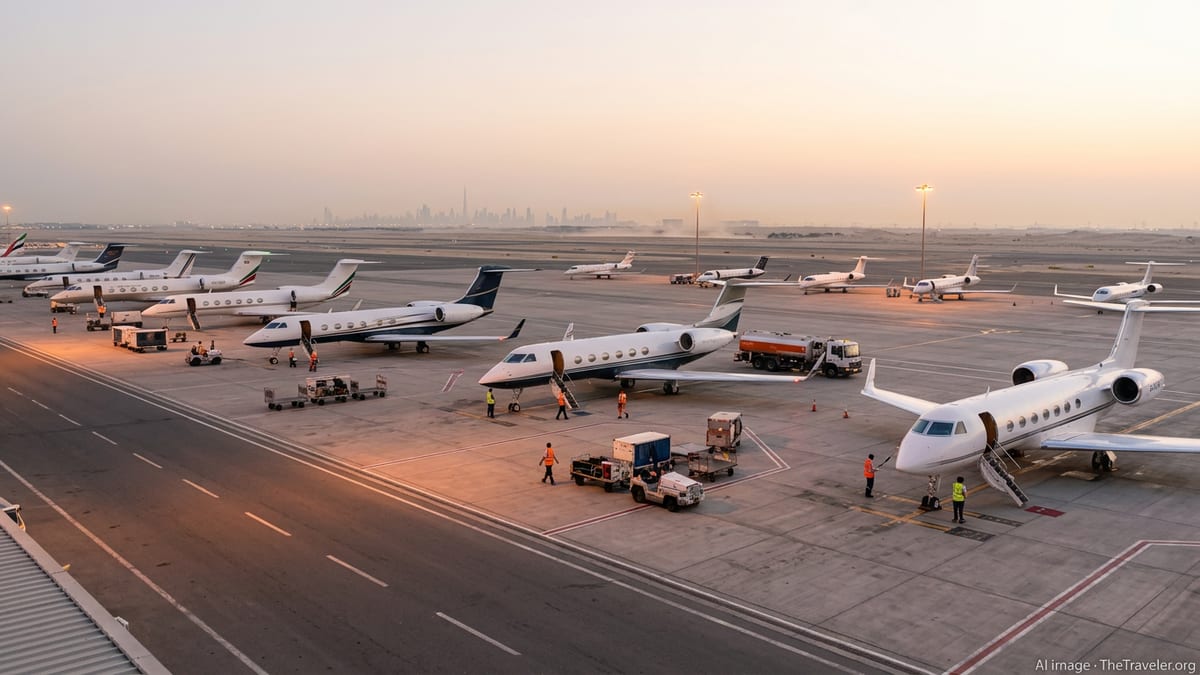
Emergency Charters Soar As Gulf Hubs Fall Silent
The closure of major airports in Dubai, Abu Dhabi and Doha after Iranian missile and drone strikes at the end of February 2026 has thrown global air traffic into disarray, severing vital links between Europe, Africa and Asia. With commercial schedules gutted and governments advising citizens to shelter in place, a small but deep-pocketed slice of travellers is turning to private aviation to secure a way out.
Private charter brokers report that Dubai, usually a byword for seamless connectivity, is now a launchpad for improvised evacuations as passengers endure hours-long drives across the desert before boarding chartered jets. Many are routing via secondary gateways such as Muscat, Riyadh and Kuwait City, where airspace restrictions are lighter and runway slots remain available, albeit at a premium.
According to industry executives, the squeeze between surging demand and operators unwilling to fly into perceived war zones has created a perfect storm for prices. Brokers cite cases of families, corporate groups and high-net-worth individuals paying well into six figures in dollars or euros for one-way flights to European and Asian cities that, just days earlier, were accessible on routine scheduled services.
Dubai, Abu Dhabi and Sharjah Extend Private Jet Boom
The scramble for charters is unfolding on top of a multiyear boom in business aviation across the United Arab Emirates. In 2024 Dubai’s dedicated business aviation hub at Al Maktoum International Airport logged a record 17,891 private jet movements, a 7 percent increase on the previous year and the highest figure in the emirate’s history. That growth has continued into 2025 and early 2026 as Dubai consolidates its role as the region’s primary long-haul transfer point.
Sharjah, long overshadowed by its larger neighbour, has quietly emerged as a significant player of its own. Sharjah Airport reported a more than 26 percent jump in private aircraft movements in the first quarter of 2025, even before the current conflict, reflecting rising interest from regional business travellers and leisure visitors looking for alternatives to Dubai’s congested airspace and premium pricing.
Abu Dhabi has also been in the midst of an aggressive expansion. Zayed International Airport, the emirate’s new primary hub, helped push total Abu Dhabi passenger traffic to more than 33 million in 2025, with aircraft movements climbing in tandem. The same infrastructure that has underpinned this commercial growth is now being pressed into service for emergency charters and diversions as airlines and private operators seek safe, well-equipped airfields on the edge of the conflict zone.
Doha, Riyadh, Jeddah, Kuwait City and Amman Absorb Diversions
Across the wider Gulf and Levant, other major airports are seeing a parallel surge in private jet demand. In Saudi Arabia, Riyadh and Jeddah have become key staging posts for travellers funnelling out of the region after first reaching the kingdom by road from the United Arab Emirates or Bahrain. Private security firms and concierge companies report booking fleets of vehicles to shuttle clients across multiple borders before they board outbound jets.
In Qatar, Doha’s Hamad International Airport, typically one of the world’s busiest transit hubs, has confronted rolling schedule disruptions as airspace restrictions bite. While large parts of its commercial operation remain constrained, its advanced infrastructure and experience handling high volumes of premium travellers have made it a natural node for business jet operators willing to navigate complex routing and insurance requirements.
Kuwait City, Amman and Muscat have also emerged as crucial pressure valves. Kuwait’s national carrier has curtailed some services in response to security assessments, but the country’s position on the northern Gulf makes it a useful jumping-off point for private flights into Europe. In Jordan, Queen Alia International Airport outside Amman is seeing heightened charter enquiries from travellers seeking a route northward without transiting the most volatile corridors. Muscat, meanwhile, has become a favoured alternative for those departing the United Arab Emirates by road, thanks to relatively relaxed visa policies for many nationalities and robust handling capacity for mid-size business jets.
Charter Prices Spike 200–300 Percent As Capacity Tightens
The shock to scheduled aviation has translated directly into soaring charter prices. One Dubai-based charter provider told industry outlet Skift that requests for private jets across the United Arab Emirates have risen between 200 and 300 percent since the latest round of hostilities began. With many operators repositioning aircraft out of the most heavily targeted areas, the number of available jets has failed to keep pace, driving up costs for every remaining seat.
Concierge firms and aviation brokers describe an environment where speed has trumped comfort, aircraft type and even destination. Some travellers are accepting routings that require multiple fuel stops, circuitous flight paths around closed airspace and arrival into smaller European or Asian airports far from their original plans. For many, simply reaching any functioning international gateway outside the region is now the priority.
The financial toll is steep. Brokers and travel advisors report quotes reaching 140,000 to 200,000 dollars or euros for one-way wide-cabin charters from safe Gulf or Levant gateways to Western Europe, particularly on short notice. Even light and mid-size jets that might typically be deployed on regional hops are commanding a premium, as demand spills over into every segment of the market.
Tourism Reputations At Stake As Crisis Drags On
The pivot to private aviation underscores the vulnerability of Gulf and West Asian tourism economies to geopolitical shocks, even after years of investment in resilience and diversification. Before the latest conflict, the United Arab Emirates alone handled roughly 148 million passengers in 2024, with Dubai accounting for close to two-thirds of all civil aircraft movements nationwide and positioning itself as a model of reliability and connectivity.
Those strengths are now being tested. While the vast majority of tourists stranded by the war lack the means to hire a private jet and must wait for commercial services to resume, images of convoys of luxury cars crossing borders and private jets queued on secondary aprons risk reshaping perceptions of the region’s flagship destinations. For destinations like Dubai, Abu Dhabi, Doha and Riyadh, which have spent billions courting a broad middle-income visitor base, the optics of an elite escape could prove problematic if disruptions persist.
At the same time, industry analysts note that the rapid redeployment of aircraft and crews into safer neighbouring markets suggests the broader Gulf aviation ecosystem retains significant flexibility. Secondary hubs such as Sharjah, Muscat and Kuwait City, along with established capitals like Amman and Jeddah, are demonstrating that they can absorb sudden swings in demand, at least for those able to pay for the privilege. How quickly commercial networks can be restored, and whether travellers continue to rely on private charters once they are, will help determine whether this surge in business aviation proves a short-lived spike or a structural shift in how the world flies across West Asia.