

More news on this day
Flights between Dubai and the United Kingdom are tentatively resuming this weekend, as Emirates and other Gulf carriers restore limited services following days of airspace closures triggered by escalating conflict across the Middle East.
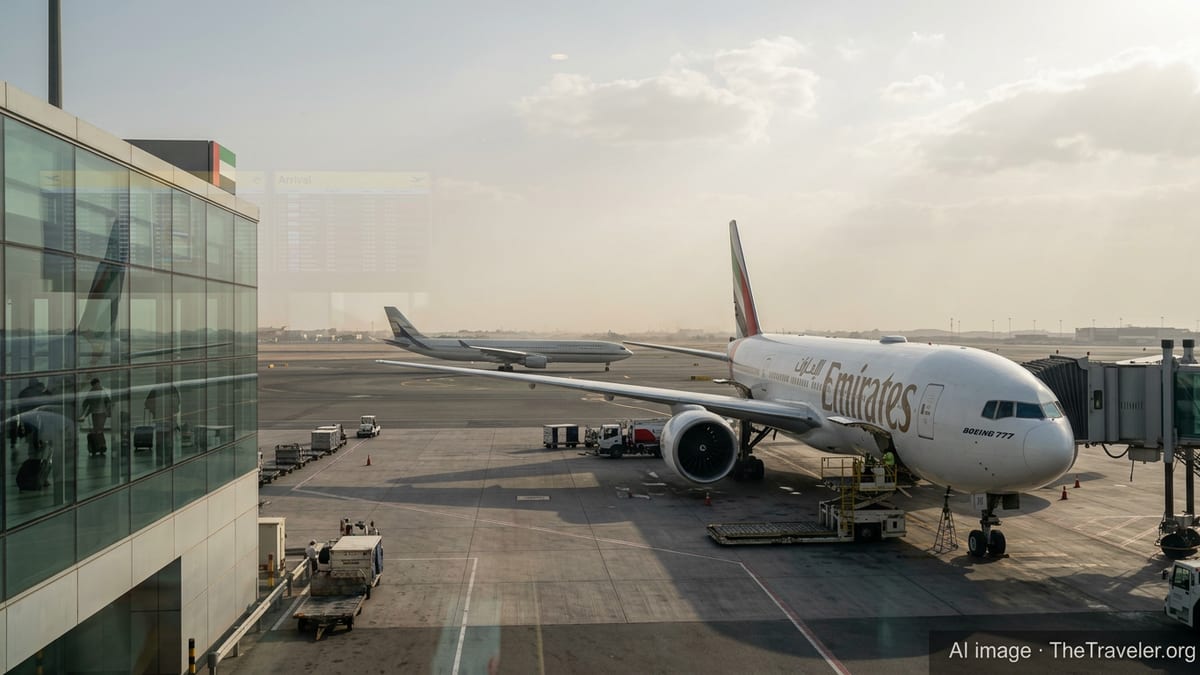
Gradual Reopening After Regional Shutdown
Dubai International Airport, one of the world’s busiest hubs for international traffic, is emerging from an unprecedented disruption that saw most commercial flights grounded after missile and drone attacks and subsequent airspace closures across the region. Authorities in the United Arab Emirates confirmed that operations at Dubai International and Dubai World Central have partially resumed, with a carefully controlled number of departures and arrivals.
Emirates, Dubai’s flagship carrier, temporarily suspended all scheduled passenger flights earlier in the week as airspace restrictions rippled out from targeted strikes on Iran and retaliatory attacks affecting Gulf states. In recent days, the airline has progressively added flights back into its schedule, focusing first on repatriation services and core long-haul routes that link the UAE to Europe and Asia.
Airport operators continue to warn that the system is far from normal. Flight-tracking data shows that a majority of scheduled services to and from Dubai remain grounded, even as a growing number of aircraft return to the skies. Officials are urging passengers not to travel to the airport unless they have received direct confirmation from their airline that their flight is operating.
The staggered restart comes as governments and aviation authorities weigh security assessments, route diversions and staffing constraints. Airlines must secure new overflight permissions and rework flight plans around closed or tightly controlled corridors, leaving schedules subject to late changes.
Emirates Restores Key UK Connections
The most significant development for European travellers is the reactivation of the Dubai–UK corridor. Emirates has confirmed that it is now operating a limited but expanding schedule between Dubai and five British airports, including London Heathrow and Gatwick, Manchester, Birmingham and Glasgow. The carrier is targeting around 11 daily services to the UK as capacity ramps up.
These flights are being restored in phases, with priority given to passengers whose journeys were disrupted during the shutdown. Travellers holding previously cancelled or postponed tickets are being rebooked where possible, and last-minute seat availability remains tight as the airline clears a backlog of stranded customers in both directions.
While headline frequencies suggest a rapid return, the pattern is not yet consistent. Some rotations are operating as one-off services or on modified timings while airspace congestion and re-routed traffic are absorbed. Industry analysts note that this kind of patchwork recovery is typical after major regional disruptions, and warn that it may be several days before the Dubai–UK market settles into a more predictable rhythm.
Other Gulf-based carriers are also rebuilding their UK networks. Etihad Airways is operating a reduced schedule from Abu Dhabi to London and other European hubs, while regional and European airlines cautiously add back flights that were suspended at the height of the closures.
Gulf Airlines Operate Under Tight Constraints
Across the Gulf, major carriers are juggling an operational balancing act: restoring connectivity for tens of thousands of stranded travellers while navigating ongoing security risks and restricted airspace. Emirates, Etihad, flydubai and Air Arabia have all moved to resume limited commercial services, publishing provisional timetables that remain subject to change at short notice.
Etihad has outlined a pared-back network from Abu Dhabi to around 70 destinations, including London, Frankfurt and key Asian cities, using altered routings to skirt closed airspace. Budget carrier flydubai has relaunched selective regional and medium-haul flights, while Sharjah-based Air Arabia is operating under a defined, scaled-down schedule and has extended some suspensions into next week.
For many flights, travel times are longer as airlines detour around conflict zones and overflight bans. These reroutings increase fuel burn and operating costs, forcing carriers to weigh the economics of each service, particularly on thinner routes. Aviation consultants note that large, well-capitalised Gulf airlines are better positioned to absorb these shocks than smaller competitors, but warn that a prolonged crisis could still erode margins.
Despite the constraints, carriers stress that safety remains the overriding factor in any decision to fly. Operations are being coordinated closely with national regulators, air navigation providers and military authorities, with risk assessments updated hour by hour.
Stranded Travellers Face Patchy Options
For passengers caught in the disruption, the resumption of Dubai–UK flights offers some relief but not an instant solution. Travel agents and consular officials in London, Dubai and other major cities report that seats on the first wave of restored services have been snapped up quickly, leaving some travellers still waiting for confirmed departures.
British authorities have arranged a small number of charter flights from regional hubs, supplementing the limited commercial capacity now returning to the market. Similar evacuation and repatriation efforts are under way for citizens of other European and Asian countries, relying heavily on the Gulf’s long-haul carriers as corridors reopen.
Tourists, business travellers and migrant workers remain scattered across hotels, temporary accommodation and secondary airports, many facing rapidly changing itineraries. With some neighbouring countries’ airspace still partially closed or restricted, routings via alternative hubs in Europe and Asia are in high demand, often at higher fares and with longer connection times.
Travel advisers say passengers should expect continued disruption in the coming days, and recommend building in flexibility on dates, accepting alternative routings, and keeping contact details up to date with airlines to receive rebooking notices.
What Passengers Should Do Now
With the situation evolving daily, airlines and airports are urging travellers to check the status of their flight immediately before leaving for the airport, using official channels such as carrier apps, email notifications and call centres. Many Gulf airports are controlling access to terminals, allowing in only passengers with confirmed same-day departures.
Emirates and other carriers have introduced flexible policies for affected customers, including fee-free rebooking options, travel vouchers and, in some cases, refunds for unused portions of tickets. However, processing times are stretched as customer service teams handle an unusually high volume of requests.
Industry experts advise passengers to avoid making speculative new bookings on routes that remain unstable, and instead to work with their existing airline or travel agent on re-accommodation. Those with urgent travel needs to or from the UK may find more immediate options by combining limited Gulf services with flights via continental European or Asian hubs that have been less directly affected by the closures.
For now, the resumption of Dubai–UK flights marks an important step toward restoring one of the world’s busiest long-haul corridors. Yet with tensions in the Middle East still high and airspace controls only partially lifted, travellers and airlines alike are bracing for a recovery that will be measured in days and weeks, not hours.