

More news on this day
Dubai is doubling down on its ambition to become one of the world’s most walkable cities by 2040, with a sweeping overhaul of streets, public spaces and transport links that is expected to reshape how both residents and visitors move around the emirate.
Get the latest news straight to your inbox!
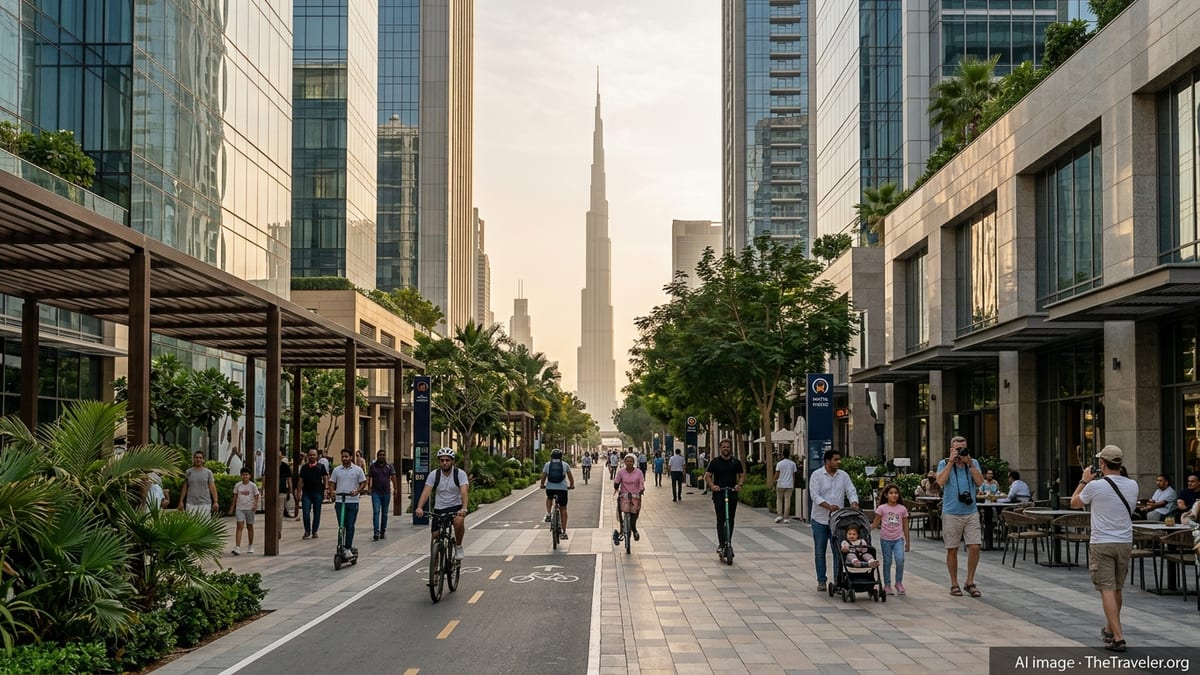
A 2040 Vision Built Around Walking, Not Driving
Publicly available planning documents and recent coverage show that Dubai’s Walk Master Plan sits at the heart of the wider Dubai 2040 Urban Master Plan and the Quality of Life Strategy 2033. The long-term goal is to rebalance a city long known for highways and air-conditioned malls toward shaded sidewalks, cycling paths and compact, mixed-use districts that are easier to navigate on foot.
The Walk Master Plan envisions a connected network of around 6,500 kilometers of pedestrian routes by 2040, combining new infrastructure with upgraded existing paths. This network is intended to link residential districts, business centers, coastal promenades and tourism zones in a way that reduces reliance on private cars and makes short journeys realistically walkable in Dubai’s climate.
According to recent reporting on the plan, the emirate is targeting a significant shift in “soft mobility” so that walking and cycling account for about a quarter of daily trips, up from low double digits today. The 2040 vision echoes global concepts such as the “20-minute city,” where everyday needs and services can be reached on foot or by bike within a short travel time.
For visitors, this means that areas which today feel fragmented or only comfortably accessible by car could, over the next decade and a half, become more continuous urban environments where strolling between attractions is increasingly feasible.
How Tourist Hotspots Are Expected to Change
Tourism-focused districts such as Downtown Dubai, Dubai Marina, Jumeirah Beach and the historic quarters along Dubai Creek are already among the emirate’s more walkable areas, with promenades, plazas and traffic-calmed streets. The Walk Master Plan and related initiatives aim to extend this pedestrian-friendly fabric both within and between these districts.
Published information on the plan indicates that new bridges, underpasses and continuous sidewalks will connect neighborhoods currently separated by wide arterials. For tourists, that could mean an easier walk between beach areas and inland retail or dining clusters, or safer crossings between hotels and waterfronts that today require circuitous routes or short taxi rides.
Authorities are also prioritizing so-called “super blocks” in selected districts, converting sections of street grids into people-first zones with limited vehicle access. Early examples in creative and cultural areas are designed to support outdoor cafes, galleries and pop-up events. Visitors can expect these pilots to expand into more leisure and entertainment districts if current timelines proceed as planned.
In heritage neighborhoods, urban mobility strategies emphasize traffic calming, narrower carriageways and improved wayfinding. That could make self-guided walking tours through souqs, museums and traditional architecture easier and more comfortable, with clearer pedestrian routes linking metro stations, abra docks and cultural sites.
Staying Cool: Shade, Microclimates and Year-Round Walkability
Making Dubai genuinely walkable involves more than building sidewalks. Planning documents and official strategy summaries highlight shade, greenery and microclimate control as core design priorities. The Quality of Life Strategy 2033 calls for a substantial expansion of green areas, while the Walk Master Plan references shaded paths, tree-lined corridors and cooling technologies.
For visitors, this is likely to translate into more arcades, pergolas, pocket parks and landscaped boulevards that offer respite from summer heat. In some new projects, designers are experimenting with materials and layouts that reflect heat and channel breezes, alongside misting systems or water features that modestly reduce perceived temperature along key walking routes.
Waterfronts and canal-side promenades are expected to benefit in particular, with extended boardwalks, better lighting and additional seating. These enhancements could make evening and shoulder-season walks more pleasant, turning areas that are already popular with tourists into genuinely all-day, all-year pedestrian environments.
Indoor-outdoor connections are also part of the walkability push. Plans for future malls, transit hubs and mixed-use complexes increasingly emphasize direct, sheltered links to the street network and nearby public transport, giving tourists more options to walk part of the way while still escaping peak-period heat when necessary.
Integrating Public Transport, Cycling and First‑Mile/Last‑Mile Links
Dubai’s expanding public transport system is being reshaped alongside its pedestrian network. Updates to the Dubai Metro, including the planned Blue Line, and the broader roads and transport strategy highlight “first and last mile” connectivity as a priority, with better walking and cycling access to stations and major bus interchanges.
Recent official publications outline rapid growth in cycling infrastructure, from just a handful of kilometers a decade ago to hundreds of kilometers of dedicated tracks and shared paths today, with long-term targets approaching 1,000 kilometers or more. Concepts such as citywide active-mobility corridors and looping routes are positioned as both commuter and leisure amenities, potentially appealing to visitors interested in cycling tours or joggers looking for safe, continuous tracks.
For tourists, the practical impact should include clearer pedestrian signage around metro stops, more visible crossings and traffic signals favoring people on foot, and increasingly seamless transfers between trains, trams, buses, taxis and micromobility options. Rental bikes and e-scooters are likely to be more tightly integrated into this network over time, particularly in coastal and central business districts.
As these projects advance toward their 2033 and 2040 milestones, visitors may find it progressively easier to plan itineraries that combine short walks with public transport, replacing some of the point-to-point taxi or ride-hail trips that today dominate tourist movement.
What Visitors Should Expect Over the Next Decade
In the short term, through the late 2020s, many of Dubai’s most walkable experiences will still be concentrated in established districts such as Downtown, Dubai Marina, JBR, City Walk and the historic creekside quarters. However, travelers are likely to notice an uptick in construction of bridges, shaded sidewalks and cycling lanes, particularly near new metro extensions and in designated creative or cultural zones.
By the early to mid‑2030s, if current plans stay on track, more neighborhoods are expected to adopt 20‑minute city principles, with clusters of hotels, residential buildings, workplaces and retail sharing a continuous pedestrian environment. For tourists, that could mean choosing accommodation based less on parking access and more on walking access to attractions, restaurants and transit nodes.
Visitors should also be prepared for occasional diversions or temporary works as streets are reconfigured for wider sidewalks, new crossings or traffic-calming measures. In many destinations, similar transitions have produced short-term inconvenience but long-term gains in comfort and safety for people on foot and on bikes.
For now, travelers planning a trip to Dubai can look at the city as a hybrid destination: still reliant on cars and taxis for many journeys, but increasingly threaded with corridors where walking is not only possible, but encouraged. If Dubai achieves even a portion of its stated 2040 targets, future visitors could experience a city that feels markedly different from the car-dominated metropolis it was just a generation ago.