

More news on this day
Dubai is positioning the United Arab Emirates at the forefront of the next revolution in air-traffic management, with the 25th Airport Show in May 2026 set to unveil a new generation of digital, data-driven and autonomous technologies that could redefine how aircraft, drones and future air taxis share the skies.
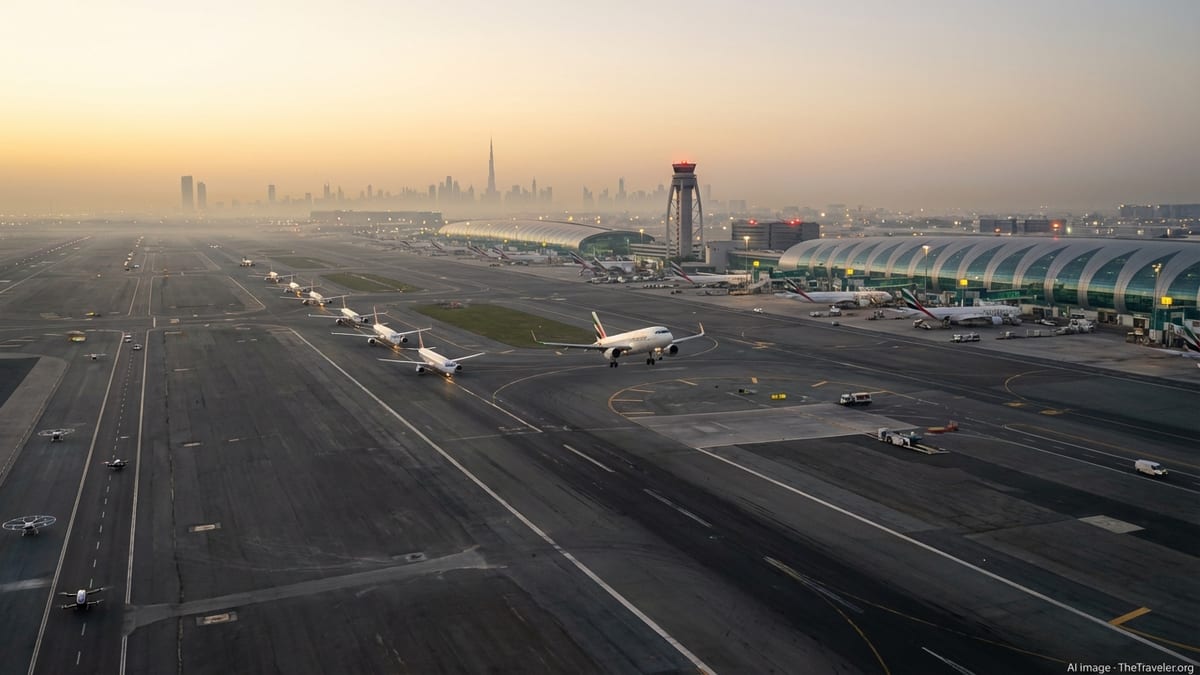
Silver-Jubilee Airport Show Sets Ambitious Agenda
The 25th edition of Airport Show will take place from 12 to 14 May 2026 at Dubai World Trade Centre, marking a milestone year for an event that has grown from a regional trade fair into one of the aviation industry’s most closely watched technology showcases. Organisers say this silver-jubilee edition will bring together more than 150 exhibitors and thousands of buyers and delegates focused heavily on air-traffic management solutions and operational innovation.
Framed under the banner of leading collaborative and sustainable airport growth, the 2026 show is expected to spotlight how airports and air navigation service providers can handle rapidly rising traffic while also preparing for the integration of new airspace users, from unmanned cargo drones to piloted and autonomous air taxis. The focus reflects the UAE’s broader strategy to harness artificial intelligence, automation and advanced data analytics across critical infrastructure.
Co-located events including the Global Airport Leaders’ Forum and the Women in Aviation Middle East Conference and Awards are set to add policy depth and human-capital discussion to a show floor dominated by hardware and software demonstrations. Together, they will offer regulators, operators and technology vendors a platform to debate how fast new systems can be deployed while preserving the region’s strong safety record.
Industry executives say the timing is no accident. With Dubai International Airport handling a record 95.2 million passengers in 2025 and the emirate committing tens of billions of dollars to expand its second hub at Al Maktoum International, the pressure is rising for smarter, more flexible ways of managing airspace and airport capacity.
UAE Bets on Digital and AI-Enabled Skies
Central to the 2026 narrative is the UAE’s bid to move from traditional radar-based air-traffic control toward a digitally fused, AI-augmented system capable of orchestrating far greater volumes of activity in increasingly complex skies. Aviation officials in Abu Dhabi and Dubai have already signalled plans for advanced air mobility corridors and AI-supported control systems, which are expected to move from pilot projects to more concrete deployment plans around the time of the show.
Across the UAE, civil aviation authorities are working with research institutions on air-corridor mapping for both piloted and autonomous air taxis and drones, a foundational step for integrating new classes of aircraft alongside conventional commercial traffic. That work includes designing procedures to ensure safe separation, real-time conflict detection and dynamic rerouting in busy urban environments, all of which rely on sophisticated sensors and responsive digital platforms.
Exhibitors in Dubai are expected to showcase AI-driven decision-support tools for controllers, predictive traffic-flow management software, and digital towers that allow remote supervision of smaller airports. These systems promise to improve runway throughput, reduce holding patterns, and optimise departure and arrival sequencing, measures that can deliver significant fuel and emissions savings even before alternative propulsion enters widespread service.
For the UAE, which has identified artificial intelligence as a national strategic priority, air-traffic management offers a high-impact testbed. Advances unveiled in Dubai in 2026 are likely to feed into parallel initiatives, including an AI in Aviation summit planned in the emirate and ongoing investments in AI research centres focused on robotics, autonomy and data science.
Next-Generation ATM on Display in Dubai
The show floor at Dubai World Trade Centre is expected to feature a broad spectrum of next-generation air-traffic management technologies, reflecting both incremental improvements and more disruptive concepts. Established ATM vendors are preparing to demonstrate integrated platforms that combine surveillance data, flight information and weather intelligence into unified, cloud-ready environments designed to support cross-border collaboration.
Among the anticipated highlights are virtual and augmented-reality interfaces that allow controllers to visualise traffic across three dimensions, supporting faster recognition of potential conflicts and bottlenecks. Some suppliers are also expected to unveil new human-machine interface designs that reduce cognitive load, an issue gaining prominence as controller workloads increase in parallel with traffic recovery and growth.
Digital remote towers, which use high-definition cameras, sensors and data links to control airports from centralised facilities, are likely to feature prominently, particularly from European and Asian providers already operating such systems at scale. For regional airports across the Middle East and Africa, remote and virtual towers offer a pathway to enhanced services without the cost of building traditional tower infrastructure.
Cybersecurity will also be a core theme. As more elements of air-traffic management move into connected, software-defined architectures, protecting systems from interference or attack has become a critical regulatory concern. Several exhibitors are preparing to showcase intrusion detection tools, secure communication solutions and resilience-focused architectures tailored to ATM networks.
Urban Air Mobility and Drones Enter the Mainstream
The 2026 Airport Show is set to be the first edition where urban air mobility and drone traffic management command nearly as much attention as conventional airspace operations. The UAE has been one of the earliest movers on air taxis, with authorities in Dubai and Abu Dhabi working with international manufacturers on piloted and electric vertical take-off and landing services planned for commercial launch over the next several years.
As those projects advance, the challenge is shifting from aircraft certification to integration with existing airspace. In Dubai, planners are mapping aerial corridors that will link key airports and landmark districts to a network of vertiports, creating a layered airspace where low-level urban traffic and high-altitude airline routes operate in harmony. That vision requires advanced unmanned traffic management systems able to track, sequence and, where necessary, automatically de-conflict dozens or hundreds of small vehicles.
At the show, visitors are expected to see demonstrations of drone-traffic platforms capable of interfacing with national ATM systems, enabling regulators to maintain oversight of both manned and unmanned operations. These platforms depend heavily on automation and data exchanges between operators, service providers and authorities, an area where the UAE is positioning itself as a regional standard-setter.
Cargo drones are also moving closer to commercial reality, particularly for middle-mile and last-mile logistics in the Gulf’s rapidly expanding e-commerce sector. Technologies on display in 2026 are likely to include route-optimisation engines, detect-and-avoid systems and AI algorithms that blend weather, traffic and demand forecasts to schedule unmanned flights in near real time.
Capacity Pressures Drive Need for Smarter Airspace
Behind the technological showcase lies a clear operational imperative. Dubai International Airport has reasserted itself as the world’s busiest airport for international passengers, handling more than 95 million travellers in 2025 and continuing to broaden its network across over 100 countries. At the same time, work is accelerating on a major expansion of Al Maktoum International Airport, envisioned as Dubai’s primary hub in the next decade.
Simply building more runways and terminals will not be enough to absorb anticipated growth, especially as the region’s airlines place record orders for new-generation widebody and narrowbody aircraft. Air-traffic management is emerging as the critical enabler, with regulators and operators seeking tools that allow them to increase movements within existing airspace constraints while maintaining strict separation standards.
Regional air navigation service providers are exploring cross-border collaboration to manage traffic flows across the Gulf and neighbouring regions more efficiently, reducing duplication and improving route efficiency. Enhanced coordination, supported by data-sharing agreements and interoperable platforms, could cut fuel burn and delays, with environmental and economic benefits that extend far beyond any single airport.
The 2026 Airport Show will provide a high-profile venue for these discussions, with sessions expected to delve into concepts such as trajectory-based operations, space-based surveillance and performance-based navigation procedures tailored to the complex mix of commercial, cargo and private operations typical of Gulf airspace.
Regulators Balance Innovation and Safety
As the UAE accelerates its adoption of advanced airspace technologies, regulators face the delicate task of enabling innovation while preserving safety margins that have underpinned global confidence in the country’s aviation sector. Authorities are drafting regulatory frameworks for advanced air mobility, updating rules for unmanned aircraft and reviewing certification pathways for AI-assisted decision-support tools in control centres.
Industry insiders expect the 2026 show to feature detailed briefings from UAE regulators on how new air-corridor designs, automation tools and remote operations will be approved and phased in. Topics such as liability in mixed human- and machine-driven decision environments, responsibility for automated de-confliction and data governance in shared platforms are likely to draw significant interest from international visitors.
Training and human factors will be another focal point, as air navigation service providers assess how to prepare controllers and support staff for more data-intensive, AI-augmented roles. Technology vendors are already promoting simulation environments that blend traditional radar and voice interfaces with augmented reality and advanced analytics, allowing trainees to experience future concepts of operations before they are fully deployed.
For the UAE, which has invested heavily in aviation academies and scholarship programmes, the regulatory conversation is intertwined with a push to build local expertise. Show organisers expect a strong presence from universities and research centres, reflecting the need to cultivate the next generation of engineers, data scientists and controllers who will manage the region’s increasingly digital skies.
Regional and Global Ripple Effects
While Dubai’s Airport Show primarily serves the Middle East, Africa and South Asia, the 2026 edition is expected to resonate far beyond those regions. The UAE’s airspace connects Europe, Asia and Africa, making it an early testing ground for technologies and procedures that, if successful, could be exported or adapted to other dense traffic corridors worldwide.
Other regional initiatives, including an airspace-focused event announced for Abu Dhabi in 2026, underscore how the Gulf is positioning itself as a laboratory for air-traffic transformation. Together, these platforms provide multiple touchpoints for collaboration between air navigation authorities, airports and technology vendors seeking to align standards and accelerate adoption.
International organisations are watching closely as Gulf regulators grapple with challenges that many other regions will soon face, from integrating drones into controlled airspace to managing unprecedented growth in long-haul traffic. The decisions taken in the UAE on data-sharing, automation thresholds and cross-border coordination could influence global norms in the coming decade.
For suppliers, the 2026 Airport Show offers not only a chance to sell equipment and software but also an opportunity to shape how future systems are designed and governed. Many are expected to use the event as a launch pad for joint ventures and research partnerships anchored in the UAE, leveraging the country’s appetite for innovation and its role as an international hub.
What the 2026 Edition Means for Travellers
For most passengers, the technical debates that will dominate the 25th Airport Show may seem remote, but the outcomes could decisively shape the airport experience by the end of the decade. Smarter air-traffic management promises more predictable flight schedules, fewer holding patterns and shorter taxi times, translating into reduced delays and smoother connections through hubs such as Dubai International.
As advanced air mobility services mature, travellers could see new options for airport access, including air taxi links from central business districts or key tourism zones to major terminals. In busy cities, such services have the potential to cut ground-transport times dramatically, particularly for high-value business travel and time-sensitive cargo.
On the ground, more integrated airport and airspace management systems will help operators adjust capacity in real time, responding to weather events, disruptions or sudden spikes in demand. That could support more efficient use of gates and security lanes, complementing separate investments already underway in biometrics and touchless processing.
With the UAE leaning into its role as a testbed for aviation innovation, travellers passing through its airports in the late 2020s may be among the first to experience a new era where increasingly intelligent airspace management quietly underpins every journey. The 25th Airport Show in May 2026 is shaping up as a key moment in that transition, bringing the emerging technologies and regulatory ideas that will guide the next phase of global aviation into sharp focus in Dubai.