

More news on this day
Dubai’s hospitality sector is entering a new phase of scale and sophistication, with total hotel inventory estimated at around 158,700 rooms and growth increasingly concentrated in the luxury segment, reflecting the city’s strategy to position itself as a premier global destination for high-spending travelers.
Get the latest news straight to your inbox!
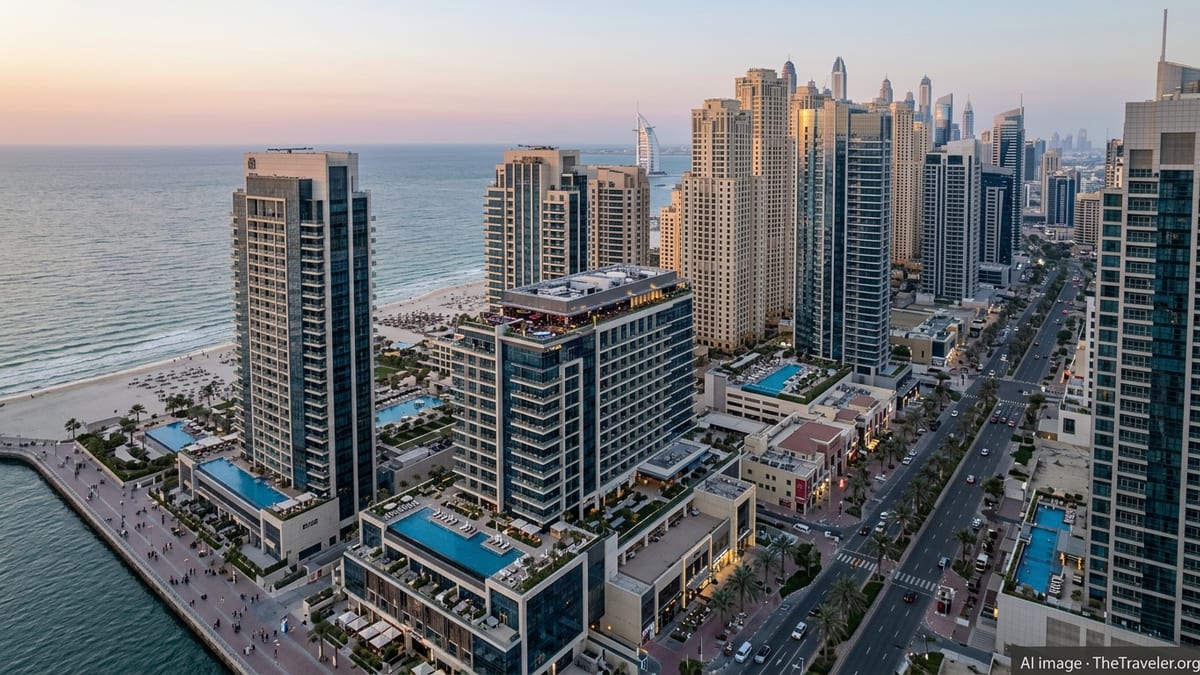
Record Room Count Caps Three Years of Tourism Growth
Dubai’s surging hotel inventory builds on a succession of record tourism years. Publicly available tourism performance data shows the city welcomed 18.72 million international overnight visitors in 2024, followed by 19.59 million in 2025, extending a steady post-pandemic rebound and reinforcing its status among the world’s busiest urban destinations.
As demand has climbed, the city’s hotel room count has expanded at pace. The Dubai Department of Economy and Tourism’s annual performance report indicated that hotel inventory stood at just over 154,000 rooms at the end of 2024. Subsequent market updates for 2025 and early 2026, reflecting new openings across prime districts such as Dubai Marina, Downtown and the Palm, point to a current inventory in the region of 158,700 rooms.
This expansion has not diluted performance. Sector updates for 2025 indicate average hotel occupancy around 80 percent across the year, with room nights, average daily rate and revenue per available room all trending higher. The combination of rising supply and sustained high occupancies is underpinning a sense of confidence among developers, lenders and operators that Dubai can absorb further growth, particularly at the top end of the market.
Market researchers note that the emirate now rivals major global hubs in sheer room count, with its inventory approaching that of long-established tourism capitals in Europe and Asia. The current wave of development, however, is far more skewed toward luxury and upper-upscale offerings than earlier building cycles, reshaping the city’s hospitality profile.
Luxury Segment Takes the Lead in New Supply
Industry analyses released over the past year consistently highlight luxury hotels as the clear growth engine within Dubai’s hospitality pipeline. Advisory firms tracking planned and under-construction projects report that close to half of upcoming rooms in the emirate are positioned in the luxury bracket, a significantly higher proportion than in previous development waves.
Recent and imminent openings underscore this tilt. New five-star properties in Dubai Marina, Business Bay, the Palm Jumeirah and the emerging Dubai Harbour district are adding thousands of keys in beachfront resorts, branded towers and lifestyle-led city hotels. Projects such as record-breaking high-rise hotels and flagship properties from global luxury brands are designed to attract affluent leisure travelers, long-stay guests and high-level business visitors.
Analysts say the focus on luxury reflects both investor preferences and evolving visitor demographics. Higher-spending guests, including long-haul holidaymakers, business travelers, event delegates and medical tourists, are seen as key to sustaining revenue growth in a city where room supply is already substantial. By concentrating new development at the top end, owners aim to protect margins against potential future price competition in the midscale segments.
This luxury bias is also aligned with broader real estate and tourism strategies. Dubai has become one of the world’s fastest-growing markets for high-end residential and branded residences, and the clustering of ultra-luxury hotels around waterfronts, marinas and new lifestyle districts helps to reinforce the city’s image as a premium destination across both hospitality and living.
Strong Performance Metrics Despite Rapid Expansion
Dubai’s hotel sector has so far managed to balance rapid room growth with firm operating metrics. Sector reports for 2025 point to citywide occupancy in the high seventies to low eighties in percentage terms, marking an improvement on already-strong 2024 levels. The uplift is notable given the additional supply being delivered across multiple districts.
Average daily rates have also moved higher, supported by a combination of robust international visitation, longer average stays and the growing share of luxury inventory. Market commentary indicates that rate growth has outpaced inflation over recent reporting periods, contributing to gains in revenue per available room and underpinning investor interest in new projects.
Five-star hotels appear to be at the forefront of this performance. Sector breakdowns suggest that the luxury segment has registered some of the strongest increases in both occupancy and revenue, benefiting from sustained demand for premium beachfront resorts, branded towers and centrally located city hotels. Deluxe and superior hotel apartments, which often serve extended-stay guests and corporate travelers, have also reported solid gains.
Crucially, this performance has not relied solely on one-off events. While Dubai continues to host major conferences, exhibitions and sporting fixtures, hospitality analysts highlight “organic” growth from repeat leisure travelers, regional short breaks and expanding corporate travel as a key driver. That baseline demand is seen as vital for supporting the enlarged room inventory of approximately 158,700 keys.
New Districts and Experiences Broaden the Visitor Map
The expansion of Dubai’s hotel inventory to around 158,700 rooms is reshaping the city’s geography of tourism. While traditional hubs such as Downtown Dubai, Sheikh Zayed Road and the Palm remain highly sought after, more recent projects are helping to elevate emerging areas including Dubai Creek Harbour, Expo City Dubai, Dubai Harbour and the expanded Dubai Marina corridor.
These new clusters typically blend hotels with retail, dining, entertainment, residential and office spaces, creating mixed-use environments that encourage longer stays and higher on-site spending. In Expo City, for example, new hotels and serviced residences tap into a growing ecosystem of business tenants, events and educational institutions, while also providing a base for visitors exploring the city’s outer attractions.
The sector’s growth is also being driven by a diversification of experiences. Publicly available studies of visitor trends point to increased interest in cultural districts along Dubai Creek, desert-based eco-retreats, wellness-oriented stays and gastronomy-led itineraries. This diversification has encouraged midscale and upscale properties to expand alongside luxury hotels, particularly in secondary neighborhoods and near new transport links.
As a result, Dubai’s hotel map is becoming more dispersed and nuanced. Visitors can now choose between ultra-luxury beachfront resorts, design-led urban hotels, family-oriented theme park resorts, eco-influenced desert lodges and more affordable options close to transport interchanges, all within the broader 158,700-room ecosystem.
Pipeline Points to Continued Upscale Growth
Looking ahead, industry outlooks suggest that Dubai’s hotel pipeline remains firmly tilted toward upscale and luxury projects, even as overall supply growth moderates from the breakneck pace of earlier years. Major international operators continue to announce new flagships in the city, while regional brands are expanding lifestyle concepts tailored to younger, experience-focused travelers.
Advisory firms tracking the development pipeline indicate that thousands more rooms are scheduled to come online over the next two to three years, a significant share of them in five-star or upper-upscale categories. Several of these projects are part of larger waterfront and island masterplans, where hospitality is integrated with marinas, beach clubs and high-end retail to create destination districts in their own right.
At the same time, there is increasing attention to sustainability and technology within new and existing hotels. Publicly available information shows more properties seeking sustainability certifications, introducing energy-efficient systems and investing in digital check-in, smart room controls and data-driven revenue management. These trends are expected to help operators maintain profitability and appeal as competition in the enlarged 158,700-room landscape intensifies.
For now, industry observers view Dubai’s hospitality boom as a calculated growth story rather than an unchecked race for keys. With luxury rooms leading the way and performance indicators holding firm, the city’s expanded hotel inventory appears well positioned to support its broader ambitions in tourism, trade, events and high-end urban living.