

More news on this day
Dubai’s role as a global crossroads has been sharply tested in recent weeks, as regional conflict and sweeping Middle East airspace closures force airports and airlines such as Emirates and Etihad to operate with significantly reduced schedules, longer flight times and persistent delays.
Get the latest news straight to your inbox!
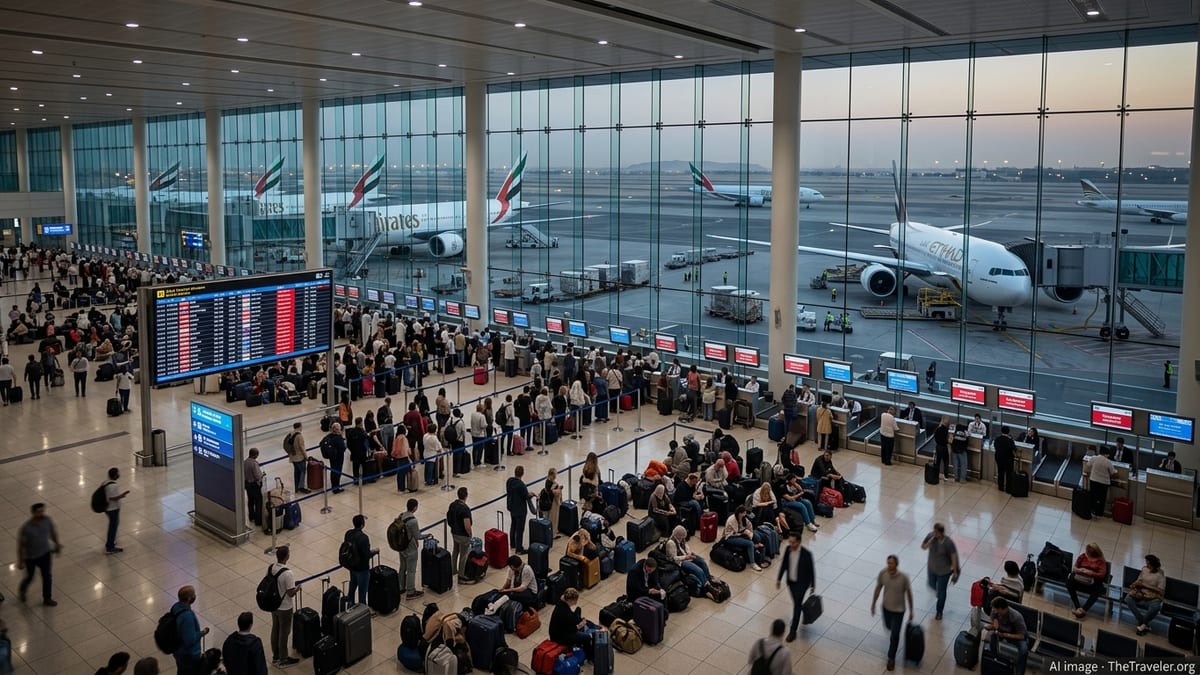
Record Traffic Meets Sudden Contraction
Dubai International Airport entered 2026 on a high, having handled a record 95.2 million passengers in 2025 and solidifying its position as the world’s busiest airport for international travel. That growth followed a rapid rebound from the pandemic and earlier weather-related disruptions, including historic flooding in 2024 that already pressured the hub’s resilience planning.
The latest regional conflict has abruptly reversed that momentum. After cross-border strikes involving Iran, Israel and the United States on 28 February 2026, multiple Middle East states imposed full or partial airspace closures. Operational bulletins and travel advisories indicate that the United Arab Emirates, Iran, Iraq, Israel, Jordan, Kuwait, Qatar, Bahrain and Syria have all applied significant restrictions, cutting capacity on key east–west corridors.
Dubai’s dual airports at DXB and Al Maktoum temporarily halted much of their activity during the initial days of the crisis, with industry analyses estimating thousands of cancellations across the wider Middle East and North Africa. Although limited services have resumed, DXB is reportedly running at a fraction of normal capacity, leaving terminals far quieter than just weeks earlier, when the airport routinely processed more than a quarter of a million passengers per day.
This sharp contraction is especially challenging for hub-and-spoke carriers that rely on dense networks of connecting flights. The squeeze on capacity is now filtering through to travelers globally, reshaping itineraries from Europe to Asia that long depended on Gulf hubs for efficient one-stop connections.
Gulf Carriers Tighten Schedules and Reroute
Emirates and Etihad, two of the region’s flagship long-haul airlines, have been forced into repeated schedule revisions since the latest escalation. In the immediate aftermath of the February attacks, industry reports show that both carriers suspended large portions of their operations from Dubai and Abu Dhabi, before cautiously restarting on a limited basis.
As of early March, aviation tracking and advisory services indicate that Emirates has restored only part of its global network, serving a reduced list of destinations from Dubai with extended flight times on many routes. Etihad has taken a similarly cautious approach from its Abu Dhabi base, gradually rebuilding a slimmed-down schedule after a several-day pause in all regular passenger flights.
Operational notices and public fare data suggest that where flights are operating, aircraft are frequently routed around closed or high-risk airspace. Services that once crossed Iran, Iraq or parts of the Levant now detour via narrower corridors over Turkey and Central Asia or via southern routes along Saudi Arabia, Egypt and Oman. Those diversions can add two to five hours to long-haul journeys, increasing fuel burn and disrupting tightly timed connection banks.
The cumulative effect is a thinner, more fragile schedule. Carriers are trimming marginal frequencies, consolidating passenger loads onto fewer flights and prioritizing routes with strong demand or strategic importance. For many travelers, that has translated into reduced choice, fewer convenient departure times and a higher likelihood of missed onward connections.
Delays, Cancellations and Passenger Strain
For passengers transiting Dubai and Abu Dhabi, the most visible impact has been a surge in delays and last-minute cancellations. Flight-status feeds and on-the-ground reports describe departure boards filled with rolling time changes as airlines wait for clearance in congested alternative corridors or adjust to shifting airspace advisories.
Before the current conflict, Dubai’s hub had already shown how quickly disruption could cascade. Heavy rain and storms in late 2025 produced waves of cancellations and multi-hour delays at DXB, leading to crowded terminals, long queues at transfer desks and missed connections for passengers heading to Europe, Asia and Africa. The present security-driven disruption is proving more complex, because operational constraints extend far beyond the UAE’s borders.
Recent travel advisories and corporate travel bulletins point to an elevated risk of journeys being altered at short notice, even for flights that appear to be operating normally at the time of booking. Some travelers have reported being rebooked via secondary hubs or entirely different continents as airlines attempt to bypass choke points in the Middle East, while others have experienced extended overnight layovers due to curfews and ad hoc route closures.
In response, airlines across the region, including Emirates and Etihad, have introduced temporary waivers that allow rebooking or rerouting without traditional change fees for affected itineraries. However, the scale of the disruption means customer-service channels remain under pressure, and some passengers are facing lengthy waits to secure new travel arrangements or refunds.
Regional Airspace Constraints Reshape Global Routes
The current Middle East airspace restrictions are unfolding on top of existing geopolitical constraints, particularly the long-standing closure of Russian airspace to many Western carriers. Airlines and aviation analysts note that the combination has created one of the most challenging routing environments for Europe–Asia traffic in decades.
With large portions of the Middle East effectively off-limits or subject to sudden closures, only a handful of viable east–west corridors remain fully usable. Reports from route-planning specialists describe traffic funnelling through already-busy airspace over parts of Saudi Arabia, Egypt and the eastern Mediterranean, intensifying pressure on air traffic control and amplifying knock-on delays when weather or technical issues arise.
For Gulf super-connectors, the impact goes beyond immediate operational headaches. Publicly available industry commentary highlights concerns about higher operating costs from longer flight times, disruptions to aircraft and crew rotations, and the potential erosion of the competitive advantage that hubs like Dubai and Abu Dhabi enjoy as fast, convenient stopovers between continents.
At the same time, secondary airports in relatively unaffected areas, such as some parts of the Arabian Sea rim and Central Asia, are positioning themselves as temporary relief hubs. Consultancy assessments and investor briefings suggest these airports are attracting diverted services and emergency charters, at least while the core Gulf gateways operate under constraint.
Uncertain Timeline and Long-Term Questions
The duration of the current disruption remains unclear. Ceasefire efforts and diplomatic engagement continue, but regional travel advisories issued in early and mid-March emphasize that partial airspace closures and sudden changes to routing permissions are likely to persist in the near term. Risk consultants describe a fluid environment in which day-to-day flight planning depends on evolving security assessments.
For Dubai Airports and carriers like Emirates and Etihad, that uncertainty complicates decisions about crew scheduling, fleet deployment and network rebuilding. Investing fully in restored schedules too early risks further waves of cancellations if tensions flare again, while moving too slowly could cede market share to competitors able to exploit alternative corridors.
Industry observers also point to broader strategic questions. The latest crisis has underlined the vulnerability of highly concentrated hub models to geopolitical shocks, especially in regions where key air routes traverse potential flashpoints. Some analysts anticipate a renewed push by airlines and regulators to diversify routings, strengthen bilateral air-service agreements outside traditional corridors and invest in technologies that help manage traffic in increasingly constrained skies.
In the meantime, travelers planning to pass through Dubai, Abu Dhabi or other Gulf hubs are being advised by airlines and travel management companies to allow more time for connections, monitor itineraries closely and consider flexible ticket options. With schedules still curtailed and airspace constraints ongoing, the region’s flagship airports and airlines are navigating one of their most severe operational tests since the pandemic era, even as they work to preserve their central role in global aviation.