

More news on this day
Dubai’s temporary cap limiting foreign airlines to one round trip per day is reshaping competition at one of the world’s busiest aviation hubs, amplifying the dominance of Emirates, flydubai and a tight circle of regional and partner carriers while squeezing capacity for rivals from India, Europe and beyond.
Get the latest news straight to your inbox!
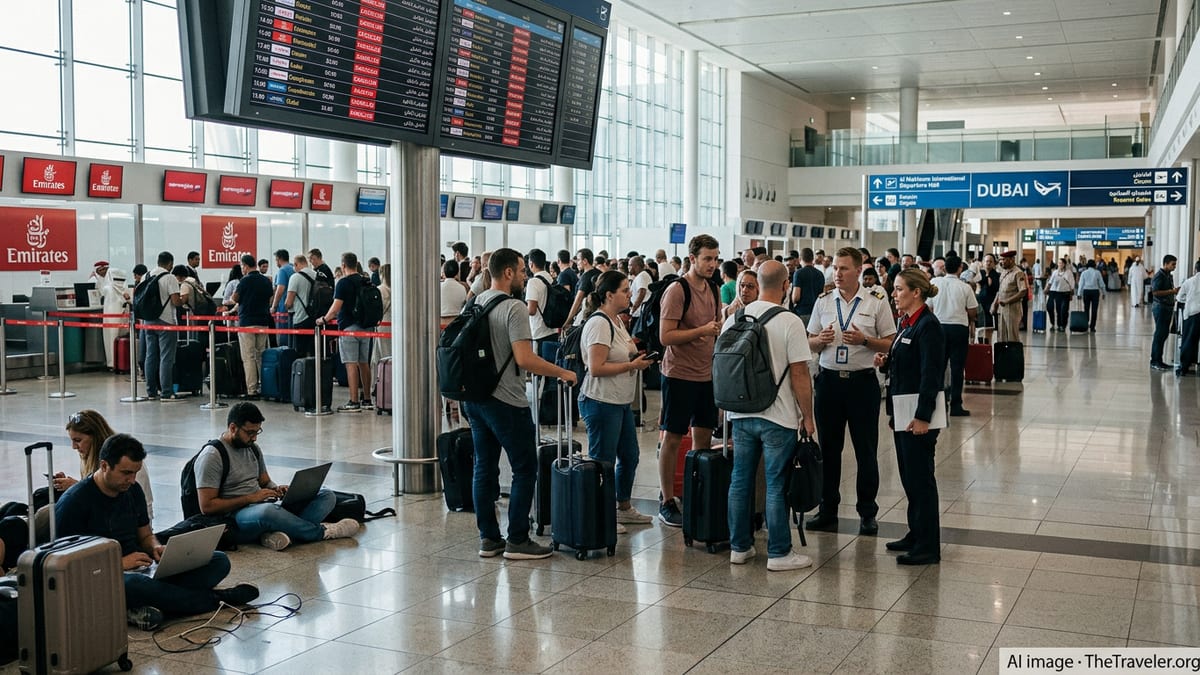
A Sudden Capacity Shock at a Global Mega-Hub
Publicly available information shows that Dubai Airports has instructed foreign carriers that, from April 20 to May 31, they may operate only one daily round trip to Dubai International and Al Maktoum International combined. The measure follows earlier wartime capacity restrictions and effectively extends them into the heart of the northern summer travel season.
Reports indicate that the cap slashes available seats for many foreign operators by more than 90 percent compared with previously approved schedules. Instead of multiple daily frequencies on trunk routes, each airline now faces a ceiling of roughly 30 or 31 flights in total over the six-week window, a severe constraint at an airport that routinely handles hundreds of international movements per day.
While the restriction is framed as a temporary operational response, aviation analysts note that it comes at a time when demand for Gulf connections is robust and when home-grown carriers in the United Arab Emirates are aggressively rebuilding and expanding networks. The timing has intensified scrutiny of how the policy interacts with market share dynamics in Dubai.
The cap applies uniformly to foreign airlines but does not affect Emirates or flydubai, both based in Dubai and categorized as local carriers. As a result, they retain the ability to operate dense banks of flights and preserve hub connectivity while competitors pare back schedules or suspend routes altogether.
Home Players Consolidate Their Grip
Emirates already ranked among the world’s largest long-haul carriers before the latest restrictions, operating an extensive network from Dubai to North America, Europe, Asia and Africa. The airline’s dual-class and premium-heavy Airbus A380 and Boeing 777 fleet underpins Dubai’s role as a super-connector hub linking east and west.
Flydubai, focused on short and medium haul services, complements Emirates by feeding regional traffic from the Middle East, South Asia, Central Asia and parts of Europe into the same city. Published schedules and partnership announcements show that the two carriers coordinate closely on timing and through-ticketing, offering passengers one-stop access to secondary cities that might otherwise merit only limited service from foreign competitors.
With foreign airlines restricted to a single daily rotation, these local advantages become more pronounced. Travelers who lose options on their preferred non-UAE carriers are often rebooked via Dubai on Emirates or flydubai, or opt proactively for those airlines to minimize disruption risk. For corporate contracts and frequent flyers, the perceived reliability of hub airlines with unconstrained slots could shift long-term loyalty.
Industry commentary suggests that the cap may also strengthen Dubai’s appeal as a transfer point for partners and aligned carriers such as Saudia, Qatar Airways and Lufthansa, whose broader networks interlock with Emirates and flydubai via codeshares and reciprocal arrangements on select routes. Even when these foreign brands are directly affected by the new limit, their passengers can still be funneled through Dubai on itineraries that rely heavily on the local giants.
Indian Carriers Among the Hardest Hit
The India to Dubai corridor is one of the busiest international markets in global aviation, driven by labor migration, business travel and tourism. Public data on passenger flows and seat capacity show that Indian airlines such as IndiGo, Air India and SpiceJet have built up dense schedules to the United Arab Emirates in recent years, frequently operating multiple daily flights from major metros and tier two cities.
Under the one-flight-per-day rule, those multi-frequency patterns are abruptly curtailed. Coverage from regional outlets indicates that some Indian carriers have had to cancel a large majority of previously planned services to Dubai, consolidating passengers onto a single daily round trip and, in some cases, suspending service from secondary cities altogether.
This reduction lands at a sensitive moment for India’s aviation sector, where IndiGo and the Air India group dominate domestic and international flows out of the country, while smaller players like SpiceJet battle financial and operational headwinds. The cap limits their ability to tap lucrative Gulf routes that typically help offset thinner yields elsewhere in their networks.
For passengers, the immediate impact is a sharp drop in available seats on Indian carriers into Dubai, with higher fares and reduced choice likely during the capped period. Many travelers are being shifted onto Emirates and flydubai flights or rerouted via other Gulf hubs operated by Qatar Airways and Saudia, further entrenching the position of these Middle Eastern brands in India’s outbound market.
European and Global Airlines Lose Ground
The new cap does not target any single region, and airlines from Europe, North America, Africa and Asia are also constrained to one rotation per day. However, its commercial impact varies sharply depending on each carrier’s business model and historic footprint in Dubai.
Long-haul operators that previously maintained multiple daily flights, or combined passenger and cargo services, are now forced to choose between premium-heavy banks and belly-freight oriented timings. Publicly available schedules suggest that some European airlines, including Lufthansa and other Star Alliance members, have adjusted timings to preserve connectivity into their home hubs while cutting overall frequencies.
For many global carriers, Dubai serves as a high-yield spoke rather than a central hub. When frequencies are removed, passengers can be more easily steered onto alternative routings via Gulf super-connectors or other alliance hubs. This dynamic risks a permanent shift in booking patterns that could be difficult to reverse even after the temporary cap is lifted.
Analysts observing schedule filings note that airlines with a single daily Dubai flight to begin with, including some transatlantic operators, are largely unaffected in pure numerical terms. Yet even they face challenges when onward feed from partner carriers is curtailed, and when competition from Emirates and flydubai remains unconstrained in the same markets.
Travelers Face Disruption as Debate Over Fairness Grows
For passengers, the most visible effects of the one-flight rule are cancellations, rebookings and narrowed choice. Travel advisories from airlines and agencies urge customers flying on foreign carriers to or from Dubai before May 31 to verify whether their flights are still operating, accept alternative routings or request refunds where eligible.
Reports indicate that priority is being given to repatriating stranded travelers and consolidating traffic onto the few remaining flights. Some foreign airlines have warned of limited availability in premium cabins, while economy seats on surviving services are filling quickly as consolidated demand chases constrained supply.
The policy has triggered debate across the industry over competitive neutrality in slot allocation at congested hubs. Commentators note that while capacity restrictions in response to operational or geopolitical pressures are not unusual, the specific design of Dubai’s temporary cap, which leaves local carriers untouched, inevitably tilts demand toward Emirates and flydubai and their close partners.
As the May 31 expiry date approaches, market participants will be watching for signs of whether the cap is allowed to lapse, extended in modified form, or replaced with a different framework. In the meantime, the episode underscores how quickly regulatory and operational decisions at a single mega-hub can reshape global traffic flows and reinforce the dominance of a handful of powerful airlines.