

More news on this day
Dublin Airport is sharpening its focus on Gulf connectivity as Emirates and Etihad expand their Irish operations, while Qatar Airways services between Dublin and Doha remain suspended amid ongoing airspace and security disruptions in the wider region.
Get the latest news straight to your inbox!
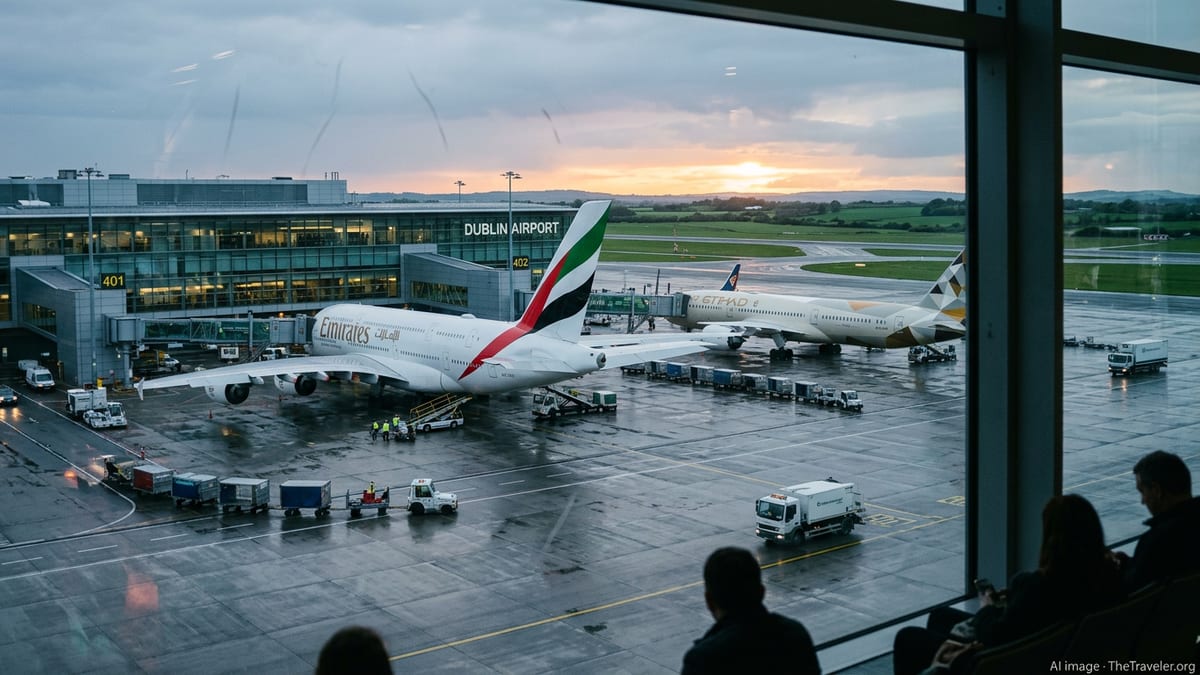
Emirates Builds Dublin into a Stronger Dubai Gateway
Publicly available information from the carrier indicates that Emirates is preparing a major uplift in capacity at Dublin, adding a third daily rotation between the Irish capital and Dubai from late October 2025. The move will build on the airline’s existing double daily service and is expected to enhance one-stop access for Irish travellers to destinations across the Middle East, Indian Ocean, Africa and Asia via its Dubai hub.
The planned third daily frequency is scheduled to commence in the winter 2025 season and is designed to offer a new early morning departure from Dublin, complementing established afternoon and evening departures. Industry coverage highlights that this additional wave of flights will improve connection times for both leisure and corporate passengers heading onwards to key markets such as Australia, Southeast Asia and the Indian subcontinent.
For Dublin Airport, the reinforcement of Emirates operations further anchors the airport as a significant European spoke into the Gulf super-connector network. Capacity growth on a route that is already operated by widebody aircraft is seen in aviation analysis as a vote of confidence in Irish demand and in Dublin’s status as a competitive long-haul gateway.
Route development commentators also point to the potential benefit for inbound tourism, as a larger Dubai schedule makes it easier for visitors from Asia and Australasia to reach Ireland with a single connection. Additional seats across three daily departures are expected to put downward pressure on fares during off-peak periods, even as strong premium-cabin demand continues to underpin the route’s economics.
Etihad Scales Up Dublin–Abu Dhabi to Double Daily
Etihad Airways is also in expansion mode at Dublin. Reports in Irish and trade media outline a phased ramp-up of services between Dublin and Abu Dhabi that began with a shift to ten weekly flights in mid-2024 and is progressing to higher frequencies through 2025. The airline has now confirmed plans to restore a full double daily schedule from April 2026, effectively returning capacity on the route to pre-pandemic levels.
The Abu Dhabi carrier’s timetable filings and published network maps show Dublin firmly embedded in its global hub strategy at Zayed International Airport, which has consolidated all passenger operations into the new Terminal A. Frequent Dublin services feed Etihad’s network across the Gulf, Indian subcontinent, East Asia and Australasia, giving Irish travellers another one-stop alternative to reach key destinations such as Sydney, Bangkok and Manila.
Industry commentary indicates that demand from Ireland to Abu Dhabi and beyond has rebounded strongly, with some sources citing a near 20 percent year-on-year increase in Irish-origin traffic that has supported Etihad’s frequency increases. The planned double daily pattern from spring 2026 is expected to improve connection banks in Abu Dhabi, offering shorter transfer times and more same-day links compared with a single daily operation.
From Dublin Airport’s perspective, Etihad’s growth contributes to a more diversified Middle East offer, reducing reliance on a single hub and adding resilience in times of regional disruption. Aviation analysts note that competing services via both Dubai and Abu Dhabi may stimulate product and pricing competition, encouraging carriers to invest in newer aircraft and upgraded cabin experiences on the Irish routes.
Qatar Airways Dublin Services Remain Suspended
In contrast to the expansion by Emirates and Etihad, Qatar Airways flights between Dublin and Doha remain suspended. Publicly available schedules and booking channels show no regular Qatar Airways passenger services operating on the route in March 2026, and Dublin Airport coordination documents list no active allocations for the Doha service in the current season.
The absence of Qatar Airways in Dublin is unfolding against a backdrop of instability in regional airspace. Over the past year, multiple Middle East airspace closures have been reported in international media following escalations involving Iran, leading to temporary shutdowns or capacity cuts at major hubs including Doha, Dubai and Abu Dhabi. These disruptions have particularly affected airlines whose networks are strongly concentrated in the Gulf.
More recent coverage of attacks on Iranian targets and subsequent retaliatory actions describes widespread flight cancellations, diversions and delays involving carriers based in Qatar and the United Arab Emirates. While operations at Doha’s Hamad International Airport have partially resumed under emergency conditions, standard commercial traffic has been slow to normalise, and schedules remain significantly reduced on some corridors.
In that context, aviation observers suggest that Dublin is among a number of secondary European gateways where Qatar Airways has yet to restore regular service. The combination of operational complexity in Qatari airspace, global fleet redeployments and strong competition from other Gulf airlines in Ireland appears to be delaying a full reinstatement of the Dublin–Doha route.
Passenger Impact and Competitive Dynamics for Irish Travellers
For Irish passengers, the current landscape effectively channels most Gulf-bound and connecting traffic through Dubai and Abu Dhabi, with Emirates and Etihad acting as the primary Middle East connectors from Dublin. Travel booking platforms show healthy seat availability on these routes, particularly as capacity scales up over the next 18 months, although fares can fluctuate sharply during peak holiday and migrant-travel periods.
Industry analysts note that the absence of Qatar Airways reduces the number of one-stop combinations available to Irish travellers bound for parts of South Asia, Southeast Asia and Oceania where Doha previously offered convenient timings. Some passengers have shifted itineraries to route via continental European hubs or to connect through London in order to retain access to oneworld alliance links and specific corporate contracts.
At the same time, the strengthening of Emirates and Etihad schedules is seen as partially offsetting the loss of Doha connectivity by creating more options and frequencies through Dubai and Abu Dhabi. Aviation data providers report that additional Irish-origin traffic is now being funnelled through these hubs, with knock-on benefits for tourism and trade links between Ireland and the United Arab Emirates.
Travel agents and online intermediaries are responding by recalibrating their default routings, often prioritising Dublin’s direct Gulf links where schedules allow. This shift consolidates Dublin’s role as Ireland’s primary long-haul gateway and underscores the strategic importance of its partnerships with Middle Eastern carriers in a period of global airspace volatility.
Outlook for Dublin’s Middle East Connectivity
Looking ahead, Dublin Airport’s connectivity to the Middle East appears set to lean increasingly on a dual-hub model centred on Dubai and Abu Dhabi. With Emirates preparing to move to three daily flights from winter 2025 and Etihad targeting a double daily schedule by April 2026, the Irish capital is on course to enjoy its highest-ever capacity to the Gulf region, even without Doha in the mix.
Regulatory decisions on passenger caps at Dublin remain an underlying constraint, but recent analysis suggests that within current limits there is still scope for long-haul growth if carriers upgauge aircraft or refine schedules. Etihad’s clearance to increase its Dublin frequencies and Emirates’ confidence in adding a third daily rotation indicate that, for now, Middle East routes remain a priority in the airport’s long-haul portfolio.
Whether Qatar Airways returns to Dublin in the near term is likely to depend on a combination of regional security conditions, airspace stability and the airline’s global network strategy. For the moment, publicly available information points to an extended pause on the Dublin–Doha link, with no firm restart date in published timetables.
In the meantime, Ireland’s air links to the Gulf are being reshaped around the growing presence of Emirates and Etihad, reinforcing Dublin’s position on the map for travellers seeking one-stop access between Ireland and a wide sweep of destinations across the Middle East, Africa, Asia and Australasia.