

More news on this day
Dublin Airport has spent the past three years in the crosshairs of regulators, planners and passengers alike. Now, as it targets a place among Europe’s 50 best airports by 2026, the Irish hub is working through a complex checklist: lifting growth-limiting caps, investing in comfort and technology, cutting emissions and future-proofing airside operations.
The prize is not a formal league table position, but a reputational shift from congestion and queues to a smooth, sustainable gateway that can credibly sit alongside Europe’s leading airports.
More News
- TSA Rolls Out $45 ConfirmID Fee for Travelers Without REAL ID at Security
- Flying Blue Launches February 25% Promo Rewards on Transatlantic and Regional Routes
- United Fast-Tracks Starlink Wi‑Fi Across Fleet, Free for MileagePlus Members
From Capacity Crunch To Record Volumes
The starting point for Dublin Airport’s current strategy is pressure. Passenger numbers have risen sharply, hitting a record 36.4 million travellers in 2025, an increase of more than 5 percent on 2024, according to airport figures. That followed 33.3 million terminal passengers in 2024, despite efforts by operator daa to dampen demand to stay within a long-standing planning cap.
A condition attached to the development of Terminal 2 in 2007 limits the combined capacity of Terminals 1 and 2 to 32 million passengers a year. As post‑pandemic demand surged, the Irish Aviation Authority (IAA), which oversees slot coordination, began applying a corresponding limit on available seats. For the 2025 summer season it set a cap of 25.2 million seats, arguing that planning constraints were now the binding factor rather than the physical infrastructure.
The tension between real-world demand and legal ceilings has shaped much of Dublin Airport’s recent story. While airlines and tourism groups argue that Ireland is losing connectivity as rival hubs expand, local communities have raised concerns about noise and environmental impact. For daa, any aspiration to climb European quality rankings depends on reconciling this growth curve with the regulatory framework.
A turning point came with High Court orders that temporarily prevented the IAA from taking some planning conditions into account when setting capacity, opening the way for higher slot volumes. In September 2025, the authority published draft coordination parameters for summer 2026 that would allow up to 25 additional daily slots without, it insists, degrading service quality. That shift underpins the airport’s claim that it can handle more passengers while continuing to improve the experience.
Legal Battles, Slot Decisions And The Passenger Cap
The legal and regulatory context is central to how Dublin Airport positions itself in the European league. Any assessment of best airports increasingly weighs reliability and availability alongside comfort, and for years the 32‑million cap has been perceived as a structural weakness.
The IAA’s draft decision for the 2026 summer season highlights a more granular approach to capacity, with limits defined down to 10‑minute intervals. The aim is to squeeze more movements out of existing infrastructure by smoothing peaks and protecting minimum service levels at security, check‑in and on the airfield. The authority has been clear that any extra slots must not come at the cost of growing queues or compromised safety standards.
In parallel, daa has lobbied the government to legislate for the removal of the passenger cap outright, arguing that the airport has already demonstrated its operational ability to process 36 million or more travellers a year. The operator points to 2024, when Dublin managed more than 100,000 passengers on 171 days, and 2025, when three out of every five days saw six‑figure volumes, as evidence that the facility can sustain higher throughput if planning catches up with reality.
How this stand‑off is resolved over the next 18 months will be critical. If lawmakers do lift or substantially reframe the cap, Dublin Airport will gain more room to grow connectivity and attract new carriers, a key ingredient in European rankings that often factor route networks and on‑time performance. If constraints persist, the focus will have to be on doing more with the same volumes, leaning heavily on operational improvements and technology.
Technology Upgrades And A New Security Experience
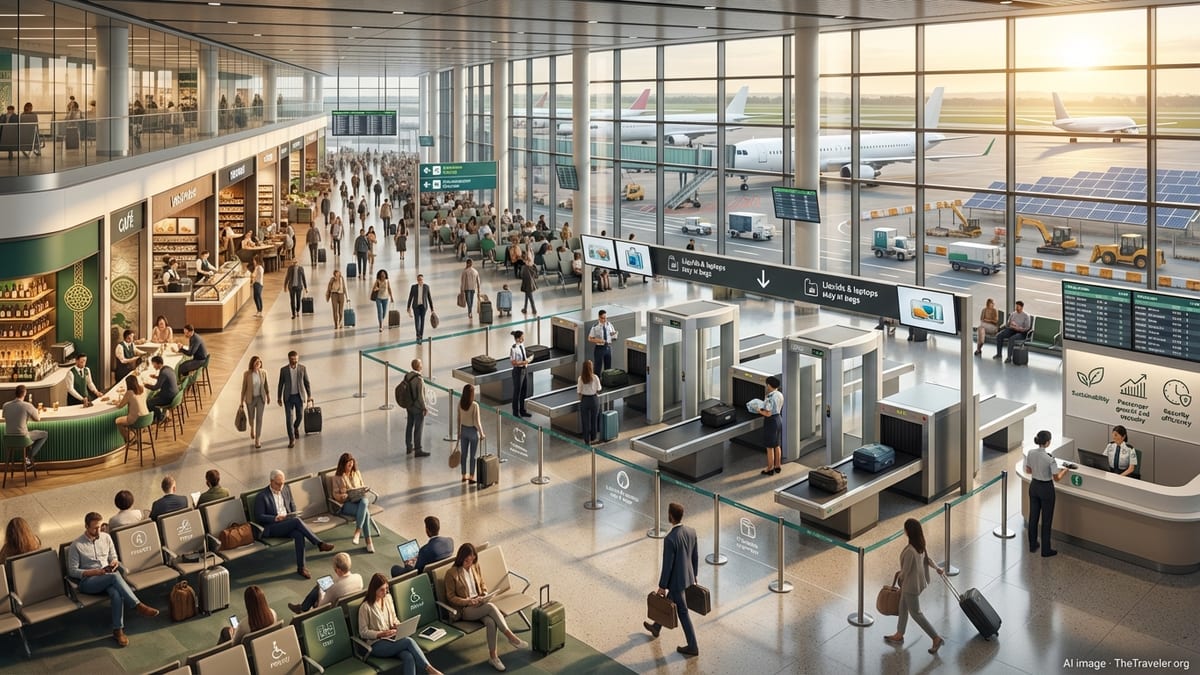
For passengers, the most visible changes at Dublin Airport have been at security. In 2025, the hub completed the rollout of advanced C3 scanners across both terminals, a transformation that culminated in a major rule change from September that year. The airport scrapped the long‑standing 100 millilitre liquid limit and the requirement to remove electronics, allowing travellers to keep laptops and larger liquid containers in their bags while still complying with security rules.
The scanners generate high‑resolution three‑dimensional images of cabin baggage, enabling staff to inspect contents more easily and reducing the need for manual checks. For most passengers that translates into fewer trays, faster lines and a less stressful experience. Dublin Airport’s management has described the systems as best‑in‑class and has framed the rollout as an example of the airport moving ahead of some larger European peers in adopting next‑generation screening.
The effect on performance metrics has been tangible. By the end of 2025, 97 percent of passengers were clearing security in under 20 minutes, according to daa, with the airport reporting “all‑time high” satisfaction scores. Shorter, more predictable queues are one of the most visible attributes in consumer surveys that feed into rankings of Europe’s best airports, and Dublin’s leadership sees security efficiency as one of its new calling cards.
Behind the scenes, the move to C3 technology also lays the groundwork for more automated lanes and better resource planning. With detailed data on throughput and bottlenecks, the airport can adjust staffing faster and smooth morning peaks, which in turn supports on‑time departures. Punctuality, a recurring weakness in earlier years, improved for a fourth consecutive year in 2025, with 71 percent of flights leaving on time and 85 percent of early‑morning departures pushing back as scheduled.
Comfort, Retail And The Subtle Art Of Dwell Time
Alongside technical upgrades, daa has invested heavily in what it calls “everyday friction points” in the terminals. In the run‑up to the 2025 summer season, the airport unveiled more than 1,000 new seats for passengers, including dedicated seating for people with reduced mobility and additional charging points. Boarding gate areas, often cited by travellers as cramped, received hundreds of extra seats designed to make waiting time less uncomfortable.
Lounges have been a particular focus. The Liffey Lounge and Martello Lounge were fully revamped, with work under way to double the capacity of the Terminal 1 lounge via a relocated Fast Track facility on a new mezzanine level. At the premium end of the market, Dublin added new suites at its Platinum VIP terminal and launched an Airport Club loyalty scheme that bundles lounge access, Fast Track and discounts in duty free, targeting frequent fliers who often shape perceptions in global surveys.
Retail and food options are being refreshed in tandem. Recent openings include new bars, cafes and quick‑service outlets across both terminals, with more on the way. The airport has flagged plans for a revamped duty‑free area in Terminal 1 and a new sit‑down Italian restaurant, alongside additional Irish‑themed bars and a wine bar in Terminal 2. While such changes are incremental, they contribute to an overall sense of choice and quality that plays strongly in customer opinion scores.
Even modest interventions can have disproportionate impact. Responding to passenger feedback about the long walk to certain gates in Terminal 1, the airport recently installed benches along key corridors, providing rest stops for older passengers and families. It is a small, low‑cost move, but one that signals a more responsive, customer‑centric mindset as Dublin seeks to shake off past criticism about neglecting the passenger voice.
Sustainability And The Path To Greener Growth
Any airport hoping to climb European rankings now has to demonstrate clear progress on sustainability, and Dublin is no exception. In April 2025, the airport confirmed a second phase of its on‑site solar farm, aiming to have 20 percent of its electricity needs covered by renewable solar energy by 2030. Phase two alone would see around 6,000 additional panels installed by late 2027, enough to power the baggage systems in both terminals and cut demand on the national grid.
The solar roadmap sits alongside other initiatives to reduce the airport’s environmental footprint. Dublin has been pushing passengers towards public transport, reporting in 2025 that more than half of travellers now arrive by bus or other non‑private car methods. That modal shift is important not just for emissions, but also for congestion on approach roads, one of the historical pain points identified by passengers.
Further sustainability measures include modernising ground‑support equipment, improving building energy efficiency and integrating environmental constraints into capacity decisions. The IAA has repeatedly stressed that airspace, runway and terminal capacity cannot be considered in isolation from noise and emissions limits imposed by planning authorities. For Dublin, aligning operational ambitions with climate commitments is both a reputational and regulatory necessity.
These efforts will be watched closely by European benchmarking bodies and consumer groups that increasingly incorporate environmental criteria into their assessments of airport quality. A credible, measurable path to greener growth will help Dublin counter criticism that expanding capacity is incompatible with Ireland’s climate targets.
Future Infrastructure: Tunnels, Stands And A More Efficient Airfield
While terminal improvements are already visible, some of Dublin Airport’s most significant projects will unfold over the rest of the decade. In late 2025, daa set out plans for a 1.1 kilometre underpass beneath key taxiways and the cross runway, a 265 million euro scheme designed to untangle airside vehicle movements that have become more complex since the opening of the North Runway in 2022.
The twin‑cell tunnel will link the main terminal piers with the West Apron, allowing service vehicles, catering trucks and baggage systems to cross under active taxiways rather than waiting for gaps in aircraft movements. The project, scheduled for completion by 2030, is intended to cut journey times, reduce the risk of delays and enhance safety by minimising interactions between aircraft and ground traffic on the surface.
Though the benefits will not be fully felt by 2026, the underpass forms part of a broader long‑term infrastructure plan that includes new aircraft stands and contact gates. daa has been clear that, even with the current terminals, additional gate capacity will be essential to handle anticipated growth in transatlantic and short‑haul traffic over the coming decades.
For passengers, the value of such projects will be measured in tangible improvements to punctuality, shorter taxi times and fewer remote stands requiring bus transfers. In competitive terms, these factors can make the difference between an airport being seen as a convenient connecting hub and one that travellers try to avoid. Dublin’s management is betting that a more efficient airfield, coupled with smoother processes inside the terminals, will narrow the gap with Europe’s best‑rated airports.
Chasing Rankings: How Dublin Measures Up In Europe
There is no single definitive list of Europe’s 50 best airports, but a handful of indices and passenger surveys shape the narrative. In one widely cited global ranking released in mid‑2025 by a passenger rights firm, Dublin Airport placed 121st worldwide, up 12 positions year on year, scoring strongly on customer opinion and obtaining solid marks for punctuality and food and retail.
Viewed through a European lens, that performance leaves Dublin in the middle of the pack: competitive on core metrics but still overshadowed by hubs in Spain, Scandinavia and parts of Central Europe that have invested heavily in architecture, seamless connections and high‑speed rail links. Climbing to a symbolic threshold such as 24th among Europe’s top 50 by 2026 will require further gains in reliability and comfort, as well as progress on bottlenecks outside the airport’s direct control, like road access.
Dublin’s recent trajectory, however, is positive. Passenger satisfaction has reached record levels, security has been transformed by technology, and retail and lounge offerings are being refreshed. Crucially, the airport appears to have moved beyond the operational crises that once saw it labelled among Europe’s most stressful gateways, even if some consumer indices still reflect that reputation with a lag.
The next two years will test whether these improvements are durable. Continued high volumes, potential new long‑haul routes and any disruption from construction or regulatory changes could all impact the experience. For now, daa’s strategy is to keep layering incremental enhancements while pushing for structural changes on capacity and planning that will allow Dublin to grow without slipping back into congestion.
FAQ
Q1. Why is Dublin Airport aiming to be among the 50 best airports in Europe by 2026?
Dublin Airport’s management sees higher rankings as a way to attract more airlines, support tourism and business travel, and strengthen Ireland’s position as a transatlantic hub. Improving its standing also signals to passengers and regulators that the airport has addressed past problems with queues, congestion and limited capacity.
Q2. What are the main capacity constraints facing Dublin Airport?
The biggest constraint is a planning condition that caps the combined capacity of Terminals 1 and 2 at 32 million passengers a year. This has led the Irish Aviation Authority to impose seat limits in the slot allocation process, which in turn restricts how many flights airlines can operate, even though the physical infrastructure could handle more passengers.
Q3. How is Dublin Airport improving the security screening experience?
The airport has installed advanced C3 security scanners across both terminals, allowing passengers to leave laptops and larger liquid containers in their bags. This technology speeds up screening, reduces the need for manual searches and has helped ensure that the vast majority of passengers clear security in under 20 minutes.
Q4. What comfort upgrades have been introduced in the terminals?
Dublin has added more than 1,000 new seats, upgraded lounges, expanded Fast Track facilities and increased the number of charging points. It has also refreshed food, drink and retail options and made small but meaningful changes such as adding benches along long walking routes to the gates.
Q5. How is Dublin Airport addressing sustainability?
The airport is expanding its on‑site solar farm with the goal of generating 20 percent of its electricity from solar power by 2030. It is also encouraging greater use of public transport, investing in more efficient equipment and integrating environmental limits into capacity planning to balance growth with climate and noise concerns.
Q6. Will passengers see fewer delays as a result of these changes?
Management expects ongoing improvements in punctuality as security becomes more efficient, airside vehicle routes are streamlined and new stands and gates are added over time. Punctuality indicators have already improved for several consecutive years, though weather, airline operations and air traffic control issues will always play a role.
Q7. What does the new underpass project mean for travellers?
The planned 1.1 kilometre underpass will not change the terminal experience directly, but it should shorten airside vehicle journeys and reduce congestion around taxiways. Over time this is expected to support more reliable operations, fewer delays on the ground and smoother turnaround times for aircraft.
Q8. How important are lounges and retail in airport rankings?
Lounges, shops and dining options contribute significantly to passenger satisfaction scores, especially among frequent travellers. Modern, comfortable lounges and a good mix of local and international brands can lift an airport’s perception from purely functional to enjoyable, which is reflected in many survey‑based rankings.
Q9. Could the passenger cap stop Dublin from climbing the rankings?
If the cap remains in place, it may limit the number of new routes and frequencies Dublin can support, which could hold the airport back compared with expanding rivals. However, even within current limits, improvements in reliability, comfort and sustainability can still boost its performance in quality‑focused rankings.
Q10. When will travellers notice the full impact of Dublin’s long‑term plans?
Many recent upgrades, particularly around security and terminal comfort, are already visible. Larger infrastructure projects such as the underpass and new stands will roll out over the rest of the decade. By 2026, passengers should see a noticeably smoother and more modern operation, even as the airport continues building towards its 2030 goals.