

More news on this day
Early-stage discussions around a potential nonstop Dublin to Bangkok route are drawing intense interest from travelers and aviation watchers, with public reports indicating that Irish and Thai authorities are exploring how to fast-track what would be one of Europe’s most ambitious new long-haul links.
Get the latest news straight to your inbox!
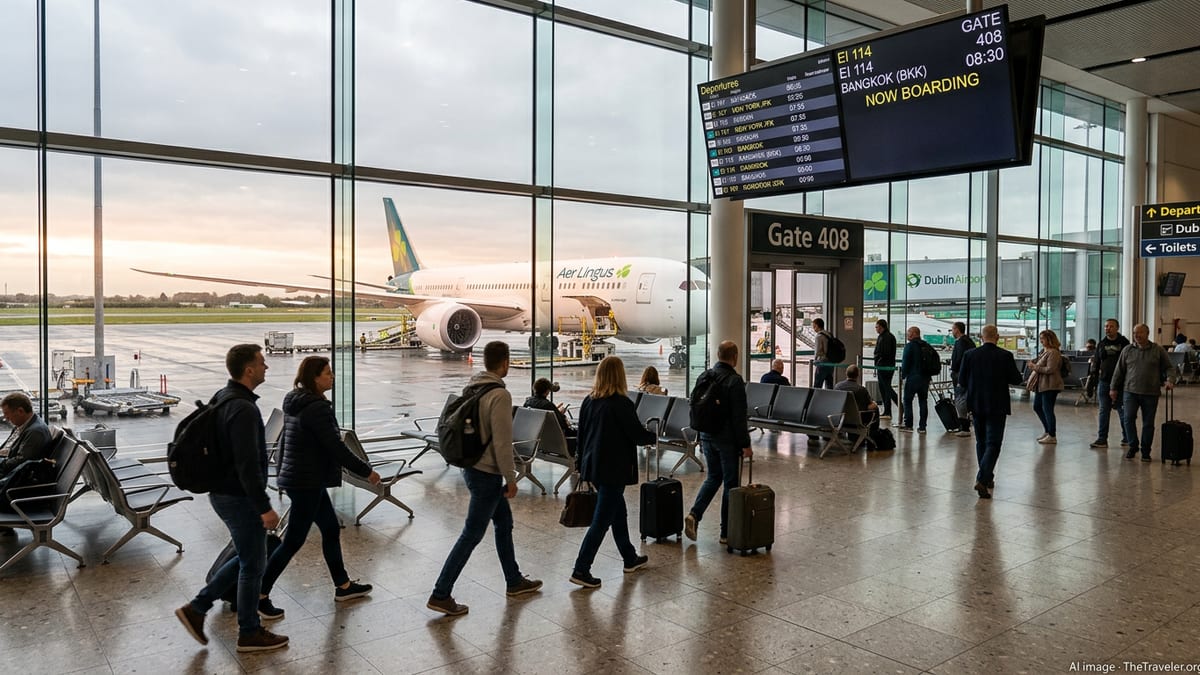
A Strategic New Link Between Ireland and Southeast Asia
The proposed nonstop connection between Dublin and Bangkok would bridge two rapidly growing hubs, cutting journey times by several hours compared with today’s common one-stop routings via Istanbul, the Gulf, or major European gateways. For Irish travelers, Bangkok serves as one of Asia’s busiest transfer points to Thailand’s beach destinations and wider Southeast Asia. For Thai and regional travelers, Dublin offers streamlined access to Ireland and onward links to the United Kingdom and North America.
Current itineraries between the two cities typically involve at least one connection, with popular routings via Abu Dhabi, Doha, Istanbul, or key European hubs. Publicly available travel forums and booking data show a steady rise in Irish demand for Thailand, particularly during the European winter and peak holiday seasons, underscoring the commercial appeal of a nonstop link.
A dedicated Dublin–Bangkok service would also sit within a broader trend of airlines adding long-range routes into Thailand from Europe and North America, as carriers seek to capture strong leisure demand and diversify beyond traditional business-heavy markets.
Government-Level Talks and Regulatory Hurdles
According to recent coverage in Irish and regional aviation media, discussions involving Irish government departments, Thai counterparts, and airport stakeholders are examining how such a route could be supported and accelerated from a regulatory and infrastructure perspective. These talks are understood to focus on air service agreements, slot availability, and potential policy measures that could make the route more attractive to one or more airlines.
Dublin Airport is simultaneously facing pressure around its longstanding 32 million annual passenger cap and separate restrictions on night flights. Recent European regulatory findings and domestic political debate have intensified calls to lift or amend these limits, with airlines warning that failure to do so could constrain growth and jeopardize new long-haul opportunities. The proposed Dublin–Bangkok nonstop would likely depend on additional capacity and more flexible slot allocation at peak times.
On the Thai side, Bangkok Suvarnabhumi continues to expand its role as a long-haul gateway, with new and returning direct connections from Europe and North America in recent seasons. Route-development efforts by Thai aviation authorities and airport operators have placed emphasis on high-yield visitors and diversified source markets, positioning Ireland as a logical, if currently underserved, origin.
Tourism, Trade, and Diaspora Benefits
A nonstop route between Dublin and Bangkok would have significant implications for tourism flows in both directions. Ireland has seen Thailand cement its reputation as a preferred long-haul holiday destination, particularly for younger travelers and winter escape seekers. A direct service would cut total travel time, reduce missed-connection risk, and remove the need for transits through large intermediate hubs, making trips more appealing for families and first-time long-haul travelers.
From Thailand and neighboring countries, easier access to Ireland could stimulate growth in high-spend leisure tourism, English-language study programs, and niche segments such as golf and cultural tourism. Tourism boards on both sides have been promoting multi-country itineraries, and a direct Dublin–Bangkok flight would neatly plug into routes that combine Ireland with the United Kingdom or continental Europe.
The route would also support business and trade. Ireland’s technology, pharmaceuticals, and financial services sectors maintain growing links with Asian partners, while Thai investors and tour operators are increasingly active in European markets. A nonstop option would save hours for corporate travelers currently forced to connect via other European or Gulf hubs, strengthening bilateral ties and opening new conference and event possibilities.
Airline Candidates and Fleet Considerations
While no carrier has publicly committed to operating the Dublin–Bangkok nonstop, industry analysis points to a small pool of realistic candidates. Long-range aircraft such as the Airbus A350 and Boeing 787 families are well-suited to the route’s distance and demand profile, offering improved fuel efficiency, lower noise, and more comfortable cabins for flights of 11 to 13 hours.
Several European and Asian airlines already deploy such aircraft on comparable stage lengths between Thailand and key European capitals. Public route announcements in recent seasons show that carriers continue to experiment with new point-to-point links into Bangkok, particularly from markets where strong leisure demand can offset lower volumes of premium business traffic.
Any airline stepping in to operate Dublin–Bangkok would need to weigh aircraft availability, crew basing, seasonality, and yield forecasts. However, the combination of growing Irish outbound demand, Dublin’s connectivity to secondary European and transatlantic markets, and Bangkok’s position as a major Southeast Asian gateway gives the route clear strategic potential.
What This Could Mean for Travelers
For passengers, a successful launch of nonstop Dublin–Bangkok flights would transform trip planning. Instead of scrutinizing layover times in Abu Dhabi, Doha, Istanbul, or Frankfurt and navigating long overnight transfers, travelers could opt for a single overnight or daytime flight from one capital to the other. This would be especially attractive for time-pressed holidaymakers and business travelers seeking to maximize days on the ground.
Nonstop service typically supports more predictable schedules and can improve overall reliability, particularly during periods of disruption affecting intermediate hubs. It may also broaden options for premium cabins, with flat-bed business class and more spacious economy products tailored to very long sectors, although final offerings would depend on the operating airline’s configuration.
Fares will remain a key question. New long-haul routes often launch with promotional pricing to stimulate demand, before settling into a structure shaped by competition on one-stop itineraries. Travelers would likely continue to see competitive alternatives via established hubs, but a nonstop option could push airlines across several regions to refine pricing and service on the broader Europe–Thailand market.
With government-level talks under way and wider debates about airport capacity and long-haul strategy intensifying, the proposed Dublin–Bangkok nonstop is emerging as a test case for how quickly Ireland and Thailand can convert policy ambition into concrete connectivity. If the route moves from discussion to reality, it has the potential to redefine how travelers on both sides of the world think about the journey between the Irish capital and the Thai gateway.