

More news on this day
Flights between Dublin Airport and key Gulf hubs Doha, Dubai and Abu Dhabi have been wiped from Wednesday’s schedule after a second consecutive day of cancellations, with airlines warning that further disruption is likely as Middle East airspace remains severely restricted.
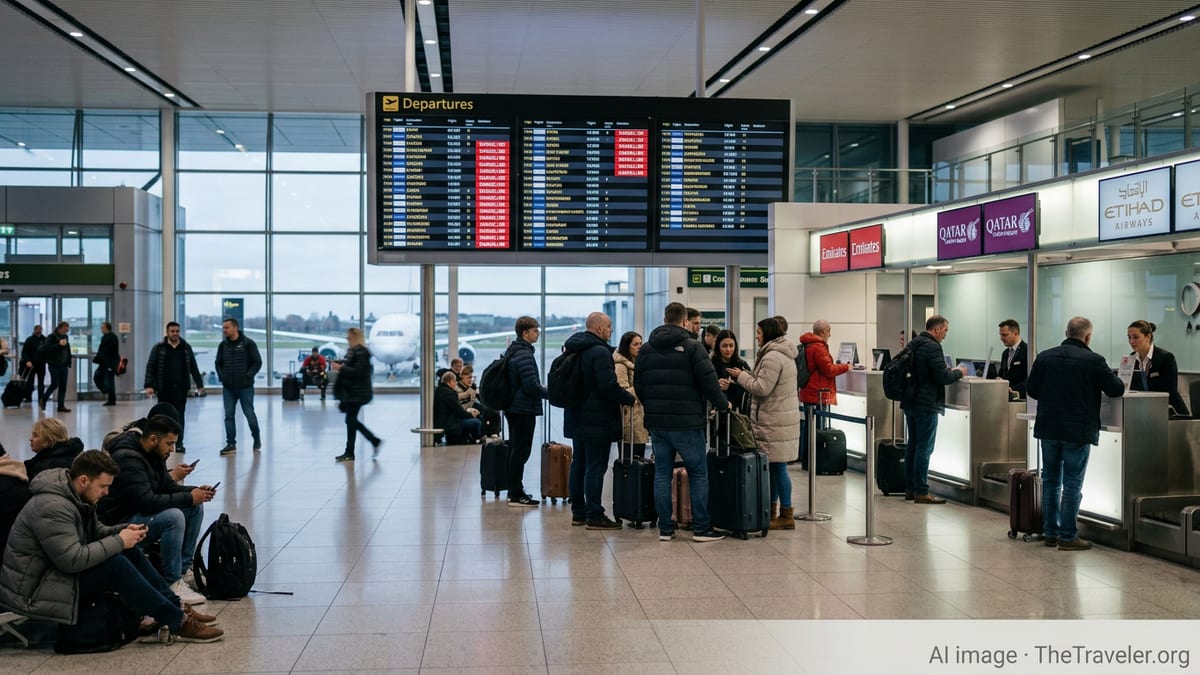
Second Day of Cancellations Hits Dublin–Gulf Routes
Dublin Airport confirmed that all scheduled services to and from the Middle East on Tuesday were cancelled, and that airlines have already moved to scrub much of Wednesday’s Doha, Dubai and Abu Dhabi programme as uncertainty over airspace access continues.
Qatar Airways has cancelled six flights between Dublin and Doha on Tuesday, comprising three inbound and three outbound services, and has also pulled its four scheduled flights for Wednesday, two in each direction. Etihad Airways has cancelled all four of its Tuesday flights between Dublin and Abu Dhabi, as well as its early morning inbound service on Wednesday.
Emirates cancelled the six flights it was due to operate between Dublin and Dubai on Tuesday, three arrivals and three departures. As of Tuesday evening no final decision had been announced on its full Wednesday schedule, but airport authorities warned that passengers should assume disruption will continue and only travel to the airport once their flight status has been verified with the airline.
The rolling wave of cancellations means that since Saturday a total of 56 flights have been scrapped on Dublin’s links with major Gulf hubs, disrupting travel plans for thousands of passengers who rely on these routes both for point to point journeys and for onward long haul connections to Asia, Africa and Australasia.
Conflict and Airspace Closures Ripple Into Ireland
The latest disruption is a direct consequence of fast escalating conflict in the Middle East, where US and Israeli strikes on Iran and subsequent retaliatory missile and drone attacks have triggered widespread airspace closures. Authorities in Iran, Iraq, Israel, Qatar, Kuwait, Bahrain, Syria and the United Arab Emirates have imposed restrictions that have effectively shut major aviation corridors across the Gulf region.
Dubai, Abu Dhabi and Doha, three of the world’s most important transit hubs, have remained largely closed or severely constrained since the weekend, with airlines including Emirates, Etihad and Qatar Airways suspending regular commercial passenger services. Industry trackers report that thousands of flights to and through the region have been cancelled since Saturday, making this the most disruptive aviation event since the peak of the Covid era.
For Ireland, the closures are felt most acutely on Dublin’s non stop links to the Gulf, which feed extensive global networks. With Qatari airspace shut and operations from Dubai and Abu Dhabi curtailed, carriers have little flexibility to reroute aircraft in a way that would permit normal schedules to operate. Even where overflight permissions exist, longer routings would add time, fuel burn and complexity at a moment when airlines already face major operational challenges.
The impact is being magnified by the hub and spoke model that underpins Gulf connectivity. When flights into the hubs are grounded, waves of onward services are also affected, leaving passengers stranded mid journey in Europe, Asia and Africa as well as in the Gulf itself. Irish travellers who began trips last week have found themselves caught up in this global web of disruption.
Thousands of Irish Travellers Stranded in Gulf Region
Irish authorities estimate that there are hundreds of citizens currently stranded in the wider Gulf region as a result of the sudden suspension of services and the closure of key airports. Many are holidaymakers or business travellers who had transited through Doha, Dubai or Abu Dhabi en route to destinations in Asia and Australasia, while others are residents returning to Ireland for work or study.
With regular commercial flights suspended and airspace over several countries closed, options to return home have narrowed sharply. Limited repatriation and special services are beginning to appear on some routes, but capacity remains far below normal and demand is intense, pushing up fares on alternative routings via Europe or Asia.
Irish travel agents report that callers seeking rebooking options face lengthy waiting times as airlines prioritise immediate operational decisions and safety assessments. In many cases passengers are being advised to remain where they are, keep accommodation secured and stay closely in touch with their airline or tour operator for updates, rather than attempting complicated overland or multi stop alternatives.
The Department of Foreign Affairs is monitoring the situation and has urged Irish citizens in the affected countries to register their details, follow local security advice and maintain regular contact with family at home. Officials say they are liaising with European partners and airline representatives as carriers and governments assess when it may be safe to reopen major air corridors.
Airlines Extend Suspensions and Warn of Ongoing Disruption
The three Gulf carriers that serve Dublin are among a wider group of airlines that have extended suspensions across their networks. Qatar Airways has confirmed that operations remain temporarily halted while Qatari airspace is closed, with an update on its plans expected on Wednesday morning in Doha. Etihad has suspended all flights to and from Abu Dhabi until at least mid afternoon on Tuesday local time, stating that regional airspace closures continue to impact its operations.
Emirates, based in Dubai, has temporarily suspended all flights to and from its hub until at least late afternoon on Tuesday local time, and has offered affected passengers the option to rebook within a set window or request refunds. Budget carriers flydubai and Air Arabia have also halted services to and from the United Arab Emirates for much of Tuesday, with some routes to neighbouring countries suspended until later in the week.
Industry analysts say that even once airspace begins to reopen, a rapid return to normal schedules is unlikely. Aircraft and crews are now out of position across multiple continents, and airlines will need days to rebuild rotations and restore connectivity. Safety assessments of preferred corridors, military activity and the risk of further escalation will also weigh heavily on route planning.
For travellers using Dublin’s Gulf routes, that means disruption could extend well beyond the current wave of cancellations. Aviation experts warn that some services may initially return at reduced frequencies, with priority given to repatriation and high demand trunk routes, while more marginal services are restored later. Passengers with non essential trips in the coming days are being encouraged to consider deferring travel where possible.
What Dublin Passengers Should Do Now
Dublin Airport has urged all passengers booked on flights to or from Doha, Dubai or Abu Dhabi to keep a close eye on live flight information and to liaise directly with their airlines before travelling to the airport. With schedules changing at short notice, turning up in the hope of a standby seat is unlikely to be successful and may add to congestion in terminal areas.
Under European air passenger rights rules, customers whose flights are cancelled are entitled to choose between a refund, re routing at the earliest available opportunity or re routing at a later date, subject to seat availability. However, compensation payments may not apply where airlines can show that cancellations were caused by extraordinary circumstances that could not have been avoided even if all reasonable measures had been taken, a test that conflicts and airspace closures typically meet.
Consumer groups advise passengers to keep all documentation, including booking confirmations and receipts for any reasonable out of pocket expenses such as meals and accommodation, as these may be claimable depending on the precise circumstances and airline policies. Travellers are also being reminded to check the small print of their travel insurance, as cover levels vary widely for disruption caused by conflict and airspace closures.
With the situation in the Middle East evolving hour by hour, both airlines and Dublin Airport stress that safety remains the overriding priority. While there is cautious optimism that some air corridors could reopen later this week, the experience of the past few days suggests that passengers on Dublin’s Gulf routes should prepare for schedules to remain fluid well into the coming days.