

More news on this day
A new bilateral aviation agreement between Ireland and South Korea is expected to clear the way for long-awaited nonstop flights between Dublin and Seoul, a move widely viewed as a breakthrough for trade, tourism and Ireland’s global air connectivity.
Get the latest news straight to your inbox!
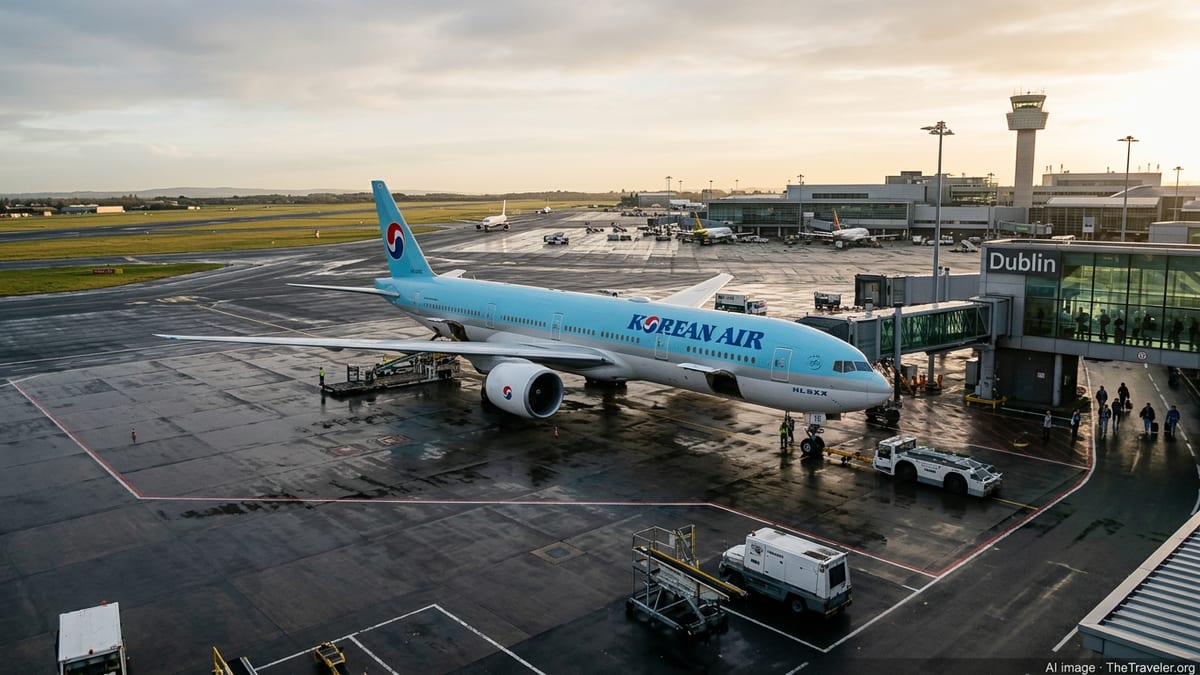
Agreement Paves Way for First-Ever Dublin–Seoul Nonstop Route
Publicly available treaty records show that Ireland and the Republic of Korea are finalising an updated bilateral air services framework designed to permit direct scheduled flights between the two countries. The agreement, which aligns traffic rights, capacity and designation rules, is described in official documentation as a modernised basis for operating air services between and beyond their respective territories.
Under the new framework, designated airlines from each side will be able to operate routes linking Ireland and South Korea without relying on intermediate hubs in Europe or the Middle East. At present, passengers travelling between Dublin and Seoul typically route via locations such as Frankfurt, London, Istanbul or the Gulf, often adding many hours to overall journey times.
The planned agreement comes against a backdrop of increasing passenger demand between Ireland and East Asia. Travel industry data and route search platforms indicate a steady rise in Ireland–Korea itineraries in recent years, particularly among leisure travellers, students and business passengers connecting between Dublin and Seoul via one or more stops.
Industry observers note that while the bilateral treaty itself does not launch flights, it is a prerequisite for any carrier wishing to mount a nonstop service. Once signed and brought into force, the agreement is expected to trigger detailed route-planning and slot-allocation work by airlines and airport operators on both sides.
Korean Air Eyes Dublin as Part of Wider Europe Expansion
Attention is focusing on Korean Air as the most likely operator of the first Dublin–Seoul nonstop connection. Recent Korean media coverage and specialist aviation reports indicate that Dublin has featured on Korean Air’s list of promising new European destinations as the carrier reshapes its long-haul network following the acquisition of Asiana Airlines.
The consolidation of Korea’s two major full-service airlines is prompting a reassessment of overlapping routes and an exploration of new city pairs across Europe. Reports from Seoul-based business outlets have highlighted Dublin, alongside destinations such as Copenhagen, as a candidate for future expansion, reflecting both tourism potential and Ireland’s role as a European base for global technology and pharmaceutical firms.
Separate booking data and fare information show that Korean Air is already actively marketing Ireland–Korea itineraries, primarily using one-stop connections from Dublin to Seoul via other European hubs. Travel search engines list a substantial volume of connecting options, underscoring that a nonstop service would be building on established demand rather than entering an untested market.
A nonstop link from Incheon International Airport to Dublin Airport would also plug directly into Korean Air’s extensive onward network across Japan, China and Southeast Asia. For Irish travellers, that could translate into shorter, more convenient journeys to a wide swathe of Asia, avoiding double connections and complex transfers.
Strategic Boost for Trade, Investment and Tourism
Government economic assessments and tourism board publications consistently identify South Korea as a growth market for Ireland in both trade and visitor numbers. South Korea is already an important export destination for Irish pharmaceuticals, medical devices and agri-food products, while Korean technology and industrial firms have established a growing presence in Ireland.
Nonstop flights between Dublin and Seoul are expected to strengthen these ties by cutting travel times for business delegations, investors and technical staff. Business travel specialists note that direct connectivity often plays a tangible role in location decisions for regional headquarters, data centres and research facilities, especially in sectors that require frequent face-to-face collaboration.
Tourism agencies in both countries have been promoting Ireland’s landscapes and culture to Korean visitors, while encouraging Irish travellers to explore Seoul and wider South Korea. Data published by national tourism authorities in recent years show Korean visitor numbers to Ireland trending upward, albeit from a relatively modest base compared with larger European markets.
Travel industry analysts suggest that a nonstop service could act as a catalyst for new tour packages, education links and cultural exchanges. Irish universities already welcome South Korean students, and simplified travel between the two capitals could support further academic cooperation, short-term language programmes and youth travel.
Connectivity Gains Amid Capacity Pressures at Dublin Airport
The timing of the planned aviation agreement coincides with a wider debate about runway capacity and passenger caps at Dublin Airport. Regulatory filings and recent public commentary from airlines underline concerns that Dublin’s long-standing annual passenger limit may constrain new long-haul routes if not addressed in time for upcoming slot seasons.
Airlines and airport stakeholders are engaged in ongoing consultations with the Irish Aviation Authority on future coordination parameters. Draft documentation for the upcoming scheduling seasons outlines the pressure on early-morning and late-evening long-haul banks, the time periods most attractive for East Asian departures and arrivals to facilitate onward connections.
Against this backdrop, any Dublin–Seoul nonstop service will require careful slot planning to secure commercially viable timings at both ends of the route. Aviation consultants point out that successful Asia–Europe routes typically rely on overnight eastbound sectors and daytime westbound returns, allowing passengers to connect efficiently to domestic and regional networks.
Even with these constraints, Dublin has steadily expanded its long-haul offering in recent years, adding new transatlantic links and exploring further services to Latin America and South Asia. Industry observers argue that the prospect of a direct connection to Seoul underscores the strategic case for continued investment in infrastructure and regulatory flexibility at Ireland’s largest airport.
Passengers Poised to Benefit from Shorter Journeys and New Options
For travellers, the most immediate impact of a Dublin–Seoul nonstop route would be reduced journey times and a simpler travel experience. Current itineraries between the two cities often involve total travel times of 15 to 20 hours or more, with transfers at busy hubs such as Frankfurt, London, Amsterdam or Istanbul.
A direct service has the potential to cut several hours from typical door-to-door travel, particularly for passengers originating outside the main European gateways. For Irish residents outside Dublin, the ability to connect domestically and then fly nonstop to Seoul could also streamline trips that currently involve crossing a second European city on the way to Asia.
Competition experts note that the arrival of a new nonstop option frequently influences pricing and service levels across the wider market, including connecting itineraries sold by rival carriers. Additional capacity between Ireland and Northeast Asia may encourage more competitive fares, greater schedule choice and improved product offerings as airlines vie for high-yield corporate and premium-leisure traffic.
While final route announcements, schedules and launch dates will depend on airline decisions following the signing of the aviation agreement, the direction of travel is clear. As Ireland and South Korea move toward a more liberalised air services framework, passengers, businesses and tourism stakeholders are preparing for a new era of direct connectivity between Dublin and Seoul.