

More news on this day
Dublin’s chronic congestion, overstretched public transport and tightening parking restrictions are converging into a commuting crisis that is reshaping daily life for workers and complicating travel plans for visitors to Ireland’s capital, according to recent data and published analyses.
Get the latest news straight to your inbox!
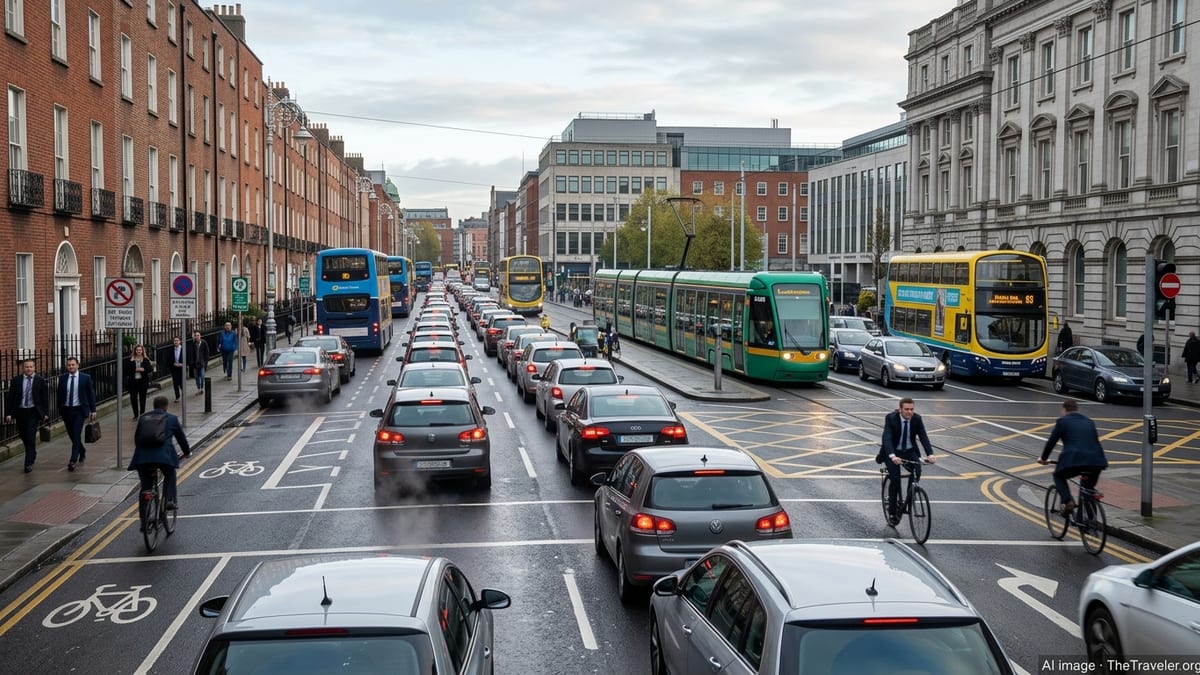
A Capital City Struggling to Move Its Growing Workforce
Recent transport and mobility reports portray a city whose infrastructure is struggling to keep pace with a fast-growing workforce and tourism economy. Central Statistics Office figures on rail and commuter usage show that passenger numbers on services into Dublin continue to climb, with almost 17 million rail passengers recorded nationally in the first four months of 2025 and DART passenger journeys up by about a quarter between 2022 and 2023. These trends point to surging demand on key commuter corridors into the capital.
At the same time, international traffic benchmarking has placed Dublin among the most congested cities in the world in 2025, with motorists facing some of Europe’s slowest peak-hour travel times over relatively short distances. Separate survey findings on national travel habits indicate that the private car still dominates, accounting for close to seven in ten trips across Ireland. The combination of high car use and intensifying public transport demand is feeding daily bottlenecks across Dublin’s arterial routes.
Environmental assessments published in 2024 underline how persistent car dependency in and around Dublin is now a critical urban challenge. National data compiled for Ireland’s State of the Environment reporting show that, even with some gradual shift towards walking and cycling, car trips still account for the majority of movements, including in the Greater Dublin Area. For commuters, this reality is increasingly experienced as longer journey times, less predictable arrivals and higher stress levels before the workday even begins.
For travellers arriving in the city for business or leisure, these pressures can translate into missed connections, longer transfers between airport, hotels and offices, and growing uncertainty about how long it will actually take to cross town at peak times. In a tourism market that often sells Dublin as a compact, easy-to-navigate gateway to Ireland, the commuting squeeze is becoming harder to overlook.
Overcrowded Trams, Packed Buses and Delayed Capacity Upgrades
Public transport is carrying record numbers of passengers, but capacity is under strain. Preliminary figures from the National Transport Authority for 2023 pointed to the busiest year ever on Ireland’s main public transport networks, with more than 300 million journeys on bus, rail and tram services nationwide. Within that total, services in the Dublin metropolitan area account for a substantial share, reflecting the capital’s role as the country’s main employment and education hub.
Luas tram services on both the Red and Green lines are frequently cited in local coverage as being at or beyond comfortable capacity during peak hours, with multiple trams sometimes arriving already full. A detailed timetable review circulated in late 2024 outlined plans to raise frequencies using existing tram fleets, but these improvements are rolling out against a backdrop of ongoing complaints about crowding, particularly on key commuting stretches into the city centre.
Rail services face similar pressures. Dublin’s DART commuter rail network has registered strong growth in passenger numbers in recent years, and a major order of new electric multiple-unit trains is intended to expand capacity under the DART+ investment programme. However, reports in late 2025 indicated that the introduction of these new trains has been delayed until at least early 2027. This postponement means peak-time crowding on existing services is likely to persist for several more years, even as more workers are encouraged to shift from car to rail.
Bus services, including those restructured under the BusConnects programme, are moving more people but not always more reliably. Official monitoring published in early 2025 highlighted substantial increases in passenger boardings on corridors where redesigned routes have been introduced, yet also acknowledged continuing issues with punctuality. For daily commuters, that mix of fuller vehicles and inconsistent timings reinforces a perception that no single mode currently offers a reliably smooth journey into central Dublin.
Parking Pressures and a Rewired City Centre
As public transport strains to absorb demand, private car use has run into its own set of constraints, particularly in Dublin’s historic core. A redesigned city centre traffic plan, implemented in phases since 2024, is explicitly aimed at ending the dominance of through-traffic by private cars by the end of the decade. New routing rules, lane reallocations and turn restrictions are intended to make it much harder to drive across the centre simply as a shortcut between suburbs.
The plan does not formally close the city to drivers, but it does make access more convoluted for those seeking to pass through without stopping. For workers who once relied on cross-city car commutes, the practical effect is longer and less predictable journeys, particularly at rush hour. For travellers who plan to pick up rental cars and use central hotels as a base for day trips, the combination of circuitous routes and heavier peak congestion now requires more careful scheduling.
Parking is another growing stress point. Surveys of urban motorists and mobility trends in 2025 highlight a perceived lack of available parking and rising costs around central Dublin. Hotel operators and tourism businesses have reported that guests increasingly ask in advance about guaranteed spaces and about whether car-free options are viable. In parallel, environmental and transport strategies point toward gradually reducing surface parking in prime central locations to free space for bus lanes, cycle tracks and wider pavements.
These shifts are reshaping how visitors experience the city centre. Travellers who arrive by car may find themselves circling inner streets looking for spaces, or parking further out and transferring onto trams or buses. While this can encourage more sustainable choices, the change has been rapid enough that many arrivals are still surprised by how impractical it has become to rely on a private vehicle in Dublin’s core, especially during commuter peaks.
Active Travel Gains Ground but Cannot Replace Urgent Reform
One of the few bright spots in Dublin’s commuting picture is the growing role of active travel. The latest Walking and Cycling Index for the Dublin metropolitan area, published in early 2026, estimates that people who choose to walk, wheel or cycle instead of driving are removing hundreds of thousands of potential car trips from the region’s roads each day. The report suggests that without this shift, congestion would be even more severe across key radial routes into the city.
Policy documents from the Department of Transport and the National Transport Authority frame this trend as central to Ireland’s National Sustainable Mobility Policy, which aims to significantly increase the share of daily journeys made by walking, cycling and public transport by 2030. The expansion of segregated cycling infrastructure, together with the roll-out of bike-sharing schemes, is intended to make active modes more attractive for shorter urban trips.
Environmental assessments note, however, that active travel gains are starting from a low base relative to the dominance of private cars. National statistics compiled for 2022 still show car trips accounting for close to 70 percent of journeys, with rail and tram use representing only a small fraction. Analysts argue that, without rapid increases in high-capacity public transport and tighter management of parking and road space, active travel alone cannot resolve the structural commuting bottlenecks now visible across Dublin.
For travellers, these dynamics translate into a more complex transport landscape. Walking between central attractions is often pleasant and efficient, and cycling can be faster than driving over short distances. Yet for longer cross-city journeys, or for transfers between accommodation, office districts and the airport, visitors still find themselves choosing between crowded public transport or increasingly constrained car options.
Strategic Projects, Slow Delivery and Mounting Pressure
Long-term transport strategies for Dublin are extensive on paper. Major projects such as BusConnects core bus corridors, the MetroLink north-south rail line and further phases of DART+ are all positioned as transformative interventions that would provide higher-capacity alternatives to private cars. Capital investment programmes released over the past two years detail a pipeline of station upgrades, track improvements and fleet expansions aimed at a more integrated, high-frequency network.
Yet travel and infrastructure commentary increasingly emphasises the gap between plans and delivery timelines. The absence of key pieces of infrastructure, such as a cross-city rail tunnel linking Dublin’s main stations, has been repeatedly highlighted in historical and recent analyses as a structural limitation on the network’s ability to redistribute flows. Some proposals from earlier decades have been re-examined and then set aside, leaving the existing system to absorb both current demand and continued population growth.
This slow pace of implementation is drawing sharper criticism as congestion indicators worsen. International traffic index rankings for 2025 and early 2026 show Dublin moving up the list of the world’s most congested cities, even as official climate and mobility policies call for substantial reductions in transport emissions. Business groups, environmental organisations and commuter advocates are using these figures to argue that the capital’s competitiveness and quality of life are now directly threatened by the commuting crisis.
For Ireland’s wider travel sector, the stakes are significant. Dublin is the primary gateway for international arrivals and a showcase for the country’s infrastructure. If journeys between the airport, city centre, office districts and rail hubs continue to involve long delays and opaque options, there is a risk that visitor experiences will suffer even as overall arrival numbers remain strong. The emerging consensus across much of the published commentary is that the current combination of congestion, overcrowded public transport and parking pressures cannot be sustained without more urgent and coordinated reform.