

Driving between Victoria and central Vancouver Island, I kept facing the same decision: should I stop in Duncan or push on to Nanaimo.
After several runs up and down Highway 1, trying everything from quick coffee breaks to overnight stays, I finally have a clear sense of how these two very different communities work as road trip stops.
They are only about 45 minutes apart, but the experience on the ground is surprisingly different. This is my honest, firsthand comparison of Duncan versus Nanaimo as a travel stop between Victoria and central island.
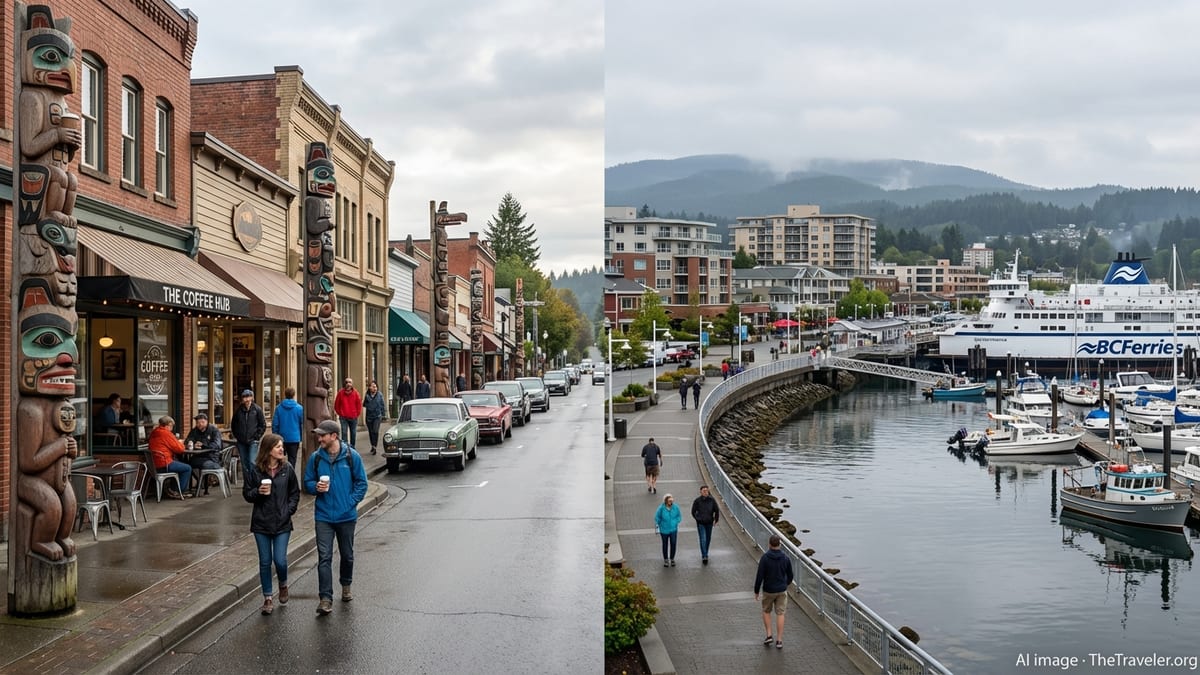
Geography, Driving Time and Overall Convenience
On paper, Duncan is the obvious halfway stop. It sits roughly midway between Victoria and Nanaimo just off the Trans Canada Highway, and I felt that every time I drove it. From Victoria, I usually reached Duncan in under an hour, just after the mental fatigue of the Malahat started to creep in.
Pushing on to Nanaimo meant another 45 minutes or so of driving, which felt long on wet winter evenings but easy enough on bright summer days. For a straightforward, “I just need a break” stop, Duncan’s location simply works.
Nanaimo, on the other hand, is not really a halfway stop. It is the regional hub at the northern end of this leg of Highway 1, where ferries connect to the mainland and Highway 19 carries traffic toward Parksville, Qualicum, and beyond.
When I stopped in Nanaimo, it was usually because I was ending one segment of the trip: catching or leaving a ferry, changing drivers, or staying the night before continuing north. As a pure mid-drive pause, it felt slightly out of the way, but as a pivot point for the rest of the island, it made a lot of sense.
In real driving terms, the choice changed how my days flowed. On early departures from Victoria, I liked breaking in Duncan for a relaxed hour and then cruising on to central island in one go.
On late afternoon or evening runs, I found it less stressful to push past Duncan, get all the highway driving done, and then decompress in Nanaimo with an overnight stay. If you tend to tire easily behind the wheel, Duncan is kinder. If you want to reach the main transport and service hub before you stop, Nanaimo is the safer bet.
One thing I did not anticipate was how traffic patterns would affect my choice. Highway 1 remains fairly smooth, but I noticed congestion and lower speeds around Duncan itself, especially at peak times.
Nanaimo had more overall traffic but felt more like a city drive, with multiple routing options. If you are anxious about gridlock on a tight ferry schedule, I found it less risky to push to Nanaimo first and relax afterward rather than linger in Duncan and worry about delays.
First Impressions and Atmosphere
My first proper stop in Duncan came on a gray spring morning when I ducked off the highway mostly in search of coffee. The shift in atmosphere surprised me. Within a few blocks of downtown, the traffic noise faded and I was walking among small independent shops, a café in a historic garage building, and the kind of local calm you almost never get in a highway town. Duncan calls itself the heart of the Cowichan region, and while that slogan sounded like marketing at first, it did match how the place felt on foot: compact, neighborly, and much more about locals than tourists.
Nanaimo landed very differently. My first impression there was defined by big-box stores on approach, long multi-lane stretches, and directional signs to multiple ferry terminals and highways. It felt like a working port city before it felt like a destination. Only after I parked and walked toward the waterfront did the mood shift. The harbour, the seawall walk, and the islands sitting offshore softened the urban edges. Still, it never lost the sense of being a busy, practical city, not a quaint stopover. If Duncan is a small-town pause, Nanaimo is very much a hub.
Over repeat visits, those first impressions stayed fairly consistent. In Duncan, I found myself slowing down almost by default. I would plan a quick coffee and stretch, then end up wandering between murals and totem poles, or chatting with local vendors at the farmers’ market. In Nanaimo, I moved with more purpose: grab a meal, restock, walk the harbourfront, and then either carry on north or line up for a ferry. There is plenty of charm in Nanaimo, especially near the water, but I had to go find it; Duncan’s charm is the part you stumble into as soon as you park.
This difference matters if you are trying to decide what kind of break you need. When I was restless and wanted a mental reset, Duncan’s slower, more intimate scale worked better. When I needed to feel “plugged back in” to full services, nightlife, and transport options, Nanaimo fit the bill. Neither atmosphere is inherently better, but they serve very different moods.
Cafes, Food and That Critical Coffee Stop
On road trips, my most important decision moments are rarely grand. They are about where to get a coffee that does not taste like burnt highway fuel, or where to grab a simple meal that will not leave me regretting it on the next stretch of road. In that department, Duncan surprised me. The downtown core has a cluster of independent cafes and bakeries within a short walk of free or low-cost parking, and they clearly cater to both locals and travelers. I remember one particular stop in a historic building where everything from the bread to the pastries felt genuinely handmade and the crowd was a mix of road-trippers and regulars greeting each other by name.
Nanaimo, unsurprisingly, offered more variety but less intimacy. On one pass north I was running late for an evening engagement in Parksville and needed food fast. I pulled into a commercial strip just off the highway, grabbed a quick chain-restaurant meal, and was back in the car in twenty minutes. It was efficient but forgettable. On another trip, when I had more time, I headed down to the waterfront and found better local options: smaller restaurants, pubs with harbour views, and bakeries that felt much more tied to place. The trade-off was time. By the time I navigated into downtown, parked, ate, and worked my way back to the highway, a “quick” meal stop had become a full break.
Quality-wise, I would give a slight edge to Duncan if your goal is a short, soulful stop. The food scene there is compact but surprisingly thoughtful, and it is easy to park once and handle coffee, a snack, and a short walk without burning much time. If you want breadth of choice or you are gluten-free, vegan, or just particular, Nanaimo’s larger restaurant scene naturally wins. I did, however, find myself sifting through more generic options in Nanaimo before finding something that felt worth the calories.
One detail that mattered more than I expected was opening hours. In the shoulder seasons and on Sundays, some of Duncan’s smaller spots had limited hours or closed earlier than I hoped. That left me defaulting to the few places that were open rather than the places I most wanted to try. Nanaimo, by contrast, rarely felt “closed.” Even late in the evening, I could usually find somewhere still serving, especially near the harbour or in the commercial strips. If you are driving outside typical lunch hours or in the off-season, that wider window in Nanaimo becomes a real advantage.
Walkability, Sights and How Much There Is To Do
When I actually gave myself time in Duncan rather than just a coffee stop, the town proved much more interesting than I expected. The downtown is flat and very walkable, with sidewalks that felt safe and comfortable even when I was tired from driving. I spent one late-morning layover there wandering among the carved totem poles that dot the streets, following a self-guided route from the visitor information I picked up nearby. It did not feel like a major tourist attraction, but as a way to stretch my legs and get a sense of local Indigenous and settler history, it was quietly impressive.
Outside the core, Duncan is also a gateway to the broader Cowichan Valley: vineyards, river kayaking, farm visits, and a well-regarded year-round farmers’ market. On a trip when I had plenty of time, I detoured west toward Lake Cowichan and came back through Duncan for a relaxed dinner. That loop turned the town from a simple stop into a base. The downside is that most of these activities require either additional driving or pre-planning. If you only have a tight 45-minute break between Victoria and central island, you will barely scratch the surface.
Nanaimo offers much more in terms of sheer volume of things to do, but it spreads them out. I found the waterfront area the easiest to enjoy on short notice: a stroll along the harbour walkway, a quick ferry ride across to a nearby island when time allowed, or simply sitting with a view of the working port and sailboats. There are downtown galleries, museums, and parks, plus larger malls and shopping areas inland that felt more practical than inspiring. If you are staying overnight, Nanaimo supports a full evening out in a way Duncan simply cannot match. There are more shows, more pubs, and more options if the weather turns bad.
What Nanaimo lacks, at least from my perspective, is that instant, contained charm that makes a brief stop memorable. I had to decide in advance which part of the city I wanted to experience, then commit to parking and walking there. The city does not naturally reveal itself in a single glance from the highway off-ramp. Duncan, by contrast, is practically a one-glance place; once you park downtown, most of what you might want to see is within easy reach. If your stop is short and you want to make it count, Duncan feels simpler. If you have several hours or a night and want more options, Nanaimo wins by scale alone.
Lodging, Cost and Overnight Comfort
One of my bigger decision moments came when I needed an overnight break between Victoria and points north. I had two realistic choices: book a room in Duncan, enjoy a quieter evening, and finish the drive in the morning, or push on and stay in Nanaimo where there would be more hotel options and better access to early ferries or onward highways. I tried both approaches on different trips.
In Duncan, accommodation felt limited but human. I stayed at a straightforward, mid-range property a short drive from the core that was clearly aimed at business travelers and families passing through. It was clean, quiet, and slightly cheaper than what I was finding in Nanaimo for similar quality. The evening was low-key: a casual dinner, a short walk, and an early night. I slept well, partly because the town itself quieted down quickly after dark. The trade-off was that everything closed earlier and there was not much to do if I suddenly felt like going out late.
Nanaimo’s lodging scene felt closer to what you would expect in a small city and ferry port. I found chain hotels near the waterfront, budget motels closer to the highway, and plenty of mid-range options spread around town. Prices varied with season and ferry demand, but they were generally a bit higher than Duncan for comparable rooms, especially near the harbour. On the plus side, staying in Nanaimo meant I could walk to more restaurants, catch evening events, or simply explore the seawall after dinner. The downside was more noise, more traffic, and the constant sense of being in transit alongside a lot of other people doing the same thing.
In terms of comfort, I personally preferred overnighting in Nanaimo when my trip involved early or late ferries or connections to flights. It was simply more practical to wake up already in the city where everything was happening. When my schedule was looser, Duncan was a calmer, less expensive place to break the journey. If you are a light sleeper or traveling with kids who need an early bedtime, Duncan’s quieter nights might be worth the relative lack of nightlife. If you care more about having choices after dark, Nanaimo is the better fit despite the slightly higher cost.
Traffic, Parking, Safety and General Stress Levels
Stress is subjective, but I found the two stops created different kinds of tension. Duncan’s main stress points were the traffic lights and congestion along the highway corridor. Coming from Victoria, I frequently hit a series of slower sections approaching town, particularly at busier times. Once I was actually off the highway and parked, though, everything relaxed. Parking downtown was usually straightforward, and walking felt safe and manageable. Even at night, I did not feel uneasy moving between my car, restaurant, and lodging, though I still took the usual precautions I would in any small city.
Nanaimo concentrated most of its stress into the approach and the immediate urban grid. The tangle of highway interchanges, signage to multiple ferry terminals, and city traffic demanded more attention than Duncan ever did. At first, I overshot exits or found myself in the wrong lane more often than I care to admit. With repetition, this got easier, but I still budgeted extra mental energy for Nanaimo’s approach, especially in rain or darkness. Once parked, my experience varied by area. In the downtown and harbourfront districts where I spent most of my time, I felt as safe as in any mid-sized Canadian city, but the environment was undeniably more urban: more people, more activity, more late-night noise.
Parking availability also played a role in my preference. In Duncan, I could usually find a spot close to where I wanted to be without much hunting, and often for free or at low cost. In Nanaimo, it depended heavily on timing and neighborhood. Around the waterfront, I sometimes circled for a while or settled for paid parking farther from my destination than I would have liked, which ate into my break time. If your tolerance for driving in cities is low, Duncan will feel gentler. If you are used to maneuvering urban streets, Nanaimo is manageable, but I would still avoid arriving right at rush hour if I could help it.
From a general safety perspective, I did not encounter anything that made me feel genuinely unsafe in either place. Both are normal communities with the usual mix of residents, workers, and visitors. The slight edge for peace of mind on late-night walks goes to Duncan simply because of its smaller scale and quieter streets. Nanaimo’s busier core required more awareness, especially near bars and ferry terminals after dark, but it also came with more people around, which some travelers may find reassuring rather than intimidating.
Transport Connections and When Each Stop Truly Shines
One reason I kept giving Nanaimo another chance was its role as a transport node. If you are connecting to the mainland, Nanaimo is where it all happens. It hosts ferry terminals linking to major ports across the water and now also has a fast passenger ferry service connecting downtown Nanaimo to downtown Vancouver in about an hour and a bit. It also has an airport linking to major Canadian cities, as well as regional bus connections and onward highway routes to central and northern Vancouver Island. Whenever my trip involved catching a ferry or flight, Nanaimo was the place I needed to end up, not just a nice optional stop.
Duncan does not try to compete on that level. Instead, it slots into the journey as a strategic pause. The town’s location about halfway between Victoria and Nanaimo, combined with regular regional bus services to both, made it a logical break when I was traveling by public transport. Stepping off a bus, grabbing a meal, and then catching a later connection north or south was straightforward, and the scale of the place meant I never felt lost. For road trips that continued west toward Lake Cowichan or into the Cowichan Valley wine region, Duncan worked even better as a small hub. It is not the center of island transport, but it is a practical crossroads.
Seasonality also shifted the equation. In peak summer, Nanaimo’s role as a ferry and vacation hub meant larger crowds, fuller parking lots, and more pressure on accommodation. That brought energy but also a higher risk of sold-out sailings and longer waits. In those months, I appreciated Duncan even more as a quieter, less congested place to regroup away from the busiest bottlenecks. In the shoulder seasons and winter, Nanaimo calmed down a little, and its weather was broadly similar to Duncan’s: mild, often wet, but rarely extreme. I noticed that both towns remained functional year-round, but Nanaimo’s broader service base made it feel more resilient if weather or schedules went sideways.
If you are strictly deciding where to stop between Victoria and central island with no ferries or flights involved, Duncan is usually the more logical choice. It breaks the drive neatly in two and offers a satisfying stop without forcing you into city driving. If your route includes the mainland or you are chaining several transports together, Nanaimo’s connectivity matters more than its mid-trip convenience. Over time, I learned to be honest about whether I needed a rest or a connection. When I needed the former, I stopped in Duncan. When I needed the latter, I pushed on to Nanaimo, even if I was tired.
The Takeaway
After multiple drives between Victoria and central Vancouver Island, I stopped thinking of Duncan and Nanaimo as competing stops and started seeing them as different tools for different kinds of trips. Duncan is where I pull over when I want a human-scale break: good coffee, a walkable core, a sense of being briefly folded into a small community rather than passing through a corridor of franchises. It is affordable, calm, and easy to navigate, but limited in nightlife, big-city services, and last-minute flexibility.
Nanaimo, by contrast, is the place I aim for when my trip hinges on logistics. It has the ferries, the airport access, the wide choice of hotels and restaurants, and enough urban infrastructure to absorb schedule changes and last-minute needs. It also brings more traffic, more decision points, and more mental load, particularly on the approach and when parking. As a mid-drive coffee stop, it can be cumbersome. As a launchpad for ferries, flights, or onward exploration of central and northern Vancouver Island, it is essential.
If I were advising someone driving this route for the first time, I would say this. If you simply need a pleasant stop between Victoria and central island, choose Duncan. Plan an hour there, walk the core, grab a proper coffee and something local to eat, and then continue north. If your trip involves ferries, early starts, or complex connections, accept that Nanaimo is the smarter place to base yourself, even if it feels less instantly charming. On my own future trips, I will keep using both, but I will be clearer with myself about what I actually need each time: rest or reach.
FAQ
Q1. Is Duncan or Nanaimo a better quick coffee and restroom stop between Victoria and central island?
Duncan generally works better for a quick, low-stress stop. It sits about halfway, is easy to reach from the highway, and has a compact, walkable core with independent cafes and services close together. Nanaimo can certainly provide coffee and facilities, but by the time you navigate city traffic and find parking, it rarely feels like a simple in-and-out break.
Q2. Which is more convenient if I am catching a ferry to or from the mainland?
Nanaimo is much more convenient for ferry travel. It hosts major terminals linking Vancouver Island to the mainland and acts as a central transport hub. If your trip is built around ferry schedules, it makes sense to plan your main stop or overnight stay in Nanaimo rather than in Duncan.
Q3. Where will I find cheaper and quieter accommodation for an overnight stop?
In my experience, Duncan tends to offer slightly cheaper, quieter accommodation options compared with similar-quality stays in Nanaimo, especially near the waterfront. The trade-off is fewer choices and less nightlife, but if you want a calm night’s sleep and do not need city amenities, Duncan is usually the better value.
Q4. Which town feels safer and less stressful to navigate for nervous drivers?
Duncan feels less stressful overall for cautious drivers. The town is smaller, parking is typically easier, and the downtown streets are uncomplicated. Nanaimo is not inherently unsafe, but its busier multi-lane approaches, complex signage for different terminals, and denser core demand more confidence and attention, especially in bad weather or after dark.
Q5. If I only have 45 to 60 minutes to spare, where will I get more out of my stop?
With less than an hour to play with, I consistently got more out of stopping in Duncan. I could park once, grab a coffee or snack, walk among the local shops and totem poles, and still get back on the road without feeling rushed. In Nanaimo, short visits tended to disappear into parking, traffic, and longer walks between points of interest.
Q6. Which is better as a base for exploring nearby nature and smaller communities?
Duncan is a stronger base if you want to explore the Cowichan Valley, vineyards, river activities, and smaller rural communities. Everything feels close and easy to reach on side roads. Nanaimo is better if you are aiming north toward Parksville, Qualicum, or beyond, or if you plan day trips that rely on its ferry links and broader transport network.
Q7. How do seasonal crowds affect the choice between Duncan and Nanaimo?
In peak summer, Nanaimo can feel very busy due to ferry traffic, tourism, and events. That energy can be fun, but it also means more congestion and higher pressure on parking and accommodation. Duncan, while still active, rarely feels overrun and can be a more relaxed place to pause during the busiest months.
Q8. Where will I find more dining options, especially later in the evening?
Nanaimo clearly has more dining options overall, including restaurants, pubs, and late-opening spots, particularly around the harbour and commercial districts. Duncan has some excellent independent options, but they are fewer and many keep more limited hours, especially outside peak seasons. For late dinners or spontaneous night outings, Nanaimo is the safer choice.
Q9. If I am traveling by bus rather than car, which stop works better?
Both Duncan and Nanaimo are served by regional bus routes, but they serve different roles. Duncan is a handy mid-route pause where you can step off, eat, and reboard later, while Nanaimo functions as a major transfer point and final destination for many services. If you need connections or onward routes, Nanaimo is more important; for a simple mid-journey break, Duncan is easier to absorb in a short stop.
Q10. For a family road trip with kids, which stop is more practical?
For families, Duncan is more practical as a brief daytime stop: quicker parking, shorter walks, and a gentler downtown environment make it easier to wrangle kids and keep the break short. If you are staying overnight or need access to larger supermarkets, entertainment, or medical services, Nanaimo becomes more appealing despite the extra complexity.