

I planned a Vancouver Island trip around cultural experiences, not beaches or breweries. I wanted museums, Indigenous stories told by local communities, everyday arts life and the kind of street-level details that make a place feel lived in.
That is how I ended up splitting my time between Duncan in the Cowichan Valley and British Columbia’s capital, Victoria. On paper they are only about an hour apart by road, but they delivered very different kinds of culture.
Some of what I found genuinely surprised me. Some of it frustrated me. If you are trying to decide between Duncan and Victoria for a culture-focused trip, here is what it actually feels like to experience both back to back.
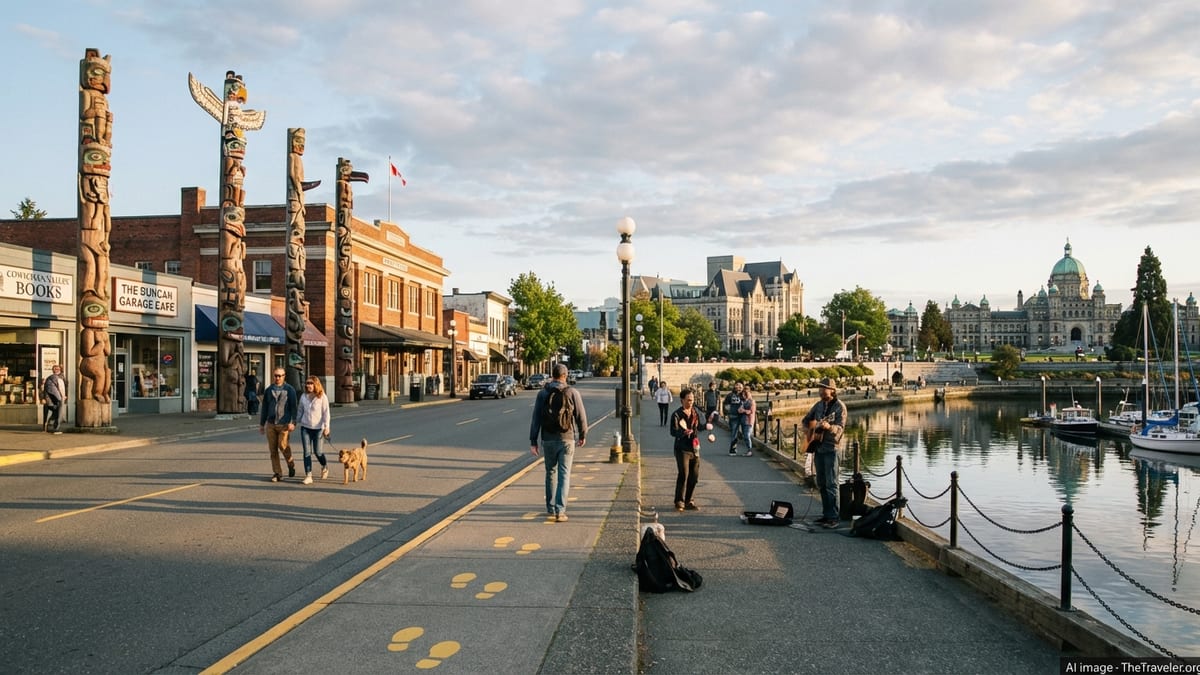
First Impressions: Small-Town Totems vs Capital-City Grandeur
Arriving in Duncan, my first impression was how compact everything felt. The historic train station, Cowichan Valley Museum, weekly farmers’ market, and a web of totem poles are all within a short walk of each other. Following the yellow footprints on the sidewalk for the official Totem Tour, I could literally feel the pace of my trip slow down. Conversations happened on street corners, staff remembered me when I came back the next day, and cultural spaces felt woven into daily life rather than set apart behind grand facades.
Victoria, by contrast, hit me with scale and ceremony. The Royal BC Museum anchors a whole “cultural precinct” with the Inner Harbour, the parliament buildings and the Victoria Conference Centre all clustered together. In the evenings around events like the “Victoria at Dusk” light and art walk between the Royal BC Museum, Ship Point and Bastion Square, downtown felt like a curated stage: polished, atmospheric, and undeniably impressive. It is culture that knows it is on display.
Emotionally, Duncan felt more like visiting someone’s neighbourhood. Victoria felt like walking into a national showcase. Both have a place in a cultural itinerary, but they set very different expectations from the moment you step onto the street.
If you like your culture served in dense, walkable doses without much spectacle, Duncan will feel comfortable right away. If you enjoy a bit of urban drama and heavy-hitting institutions, Victoria is hard to beat on first impressions.
Indigenous Culture: Depth vs Accessibility
I went into this trip specifically wanting to learn from local Indigenous communities, not just see their art in a glass case. Duncan calls itself the City of Totems, and that is not marketing fluff. There are more than 40 totem poles in and around downtown, each with an artist story on interpretive signs, and the self-guided Totem Tour is clearly a point of pride for the city. I liked that I could walk it at my own pace just by following those yellow footprints, and that the poles sit in everyday spaces: outside shops, around parks, beside the old train station. It felt like culture embedded in normal life rather than a staged exhibit.
The bigger draw for me was the Quw’utsun’ Cultural and Conference Centre along the Cowichan River. It is designed as a living cultural space with traditional buildings, totems, riverside trails and programming that can include dance performances, salmon barbecues and craft workshops. In theory this is exactly the kind of place I want to support. In practice, access hinges on timing and planning. Some programs run seasonally or around specific events, and when I checked, several offerings required calling ahead or watching local calendars to confirm dates and availability. I found that a bit frustrating, because I could not simply drop in at any time and expect a full interpretive program, especially outside the busiest summer window.
Victoria gives a very different Indigenous experience. At the Royal BC Museum, Indigenous history is interpreted on a provincial scale in the core Human History galleries and in rotating exhibitions. It is more polished and more curated. The RBCM is currently hosting large shows like “Odysseys and Migration” and other feature exhibitions on a defined schedule, and similar standards apply to their Indigenous content. I appreciated the contextual depth and the quality of curation, but the tradeoff was that I was often looking at objects and reconstructions without the same sense of being in a living community space.
If you want a personal, place-based introduction to Coast Salish culture and are willing to do a bit of legwork to align with tours or events, Duncan has more emotional weight and direct connection. If you are short on time and need guaranteed, high-quality interpretation without advance coordination, Victoria’s Royal BC Museum is the safer and more predictable choice.
Museums, Galleries and Everyday Arts Life
Duncan’s museum scene is small but surprisingly layered if you look beyond the immediate town core. The Cowichan Valley Museum inside the 1912 E&N train station opens limited hours in winter, generally Thursday to Saturday, then expands to daily hours in the summer. Admission is by donation, which kept my cultural costs low, but the tradeoff was having to plan around those narrow time windows. I twice found myself waiting for opening hours with coffee in hand because I had misjudged the schedule.
Once inside, I was glad I persisted. The museum focuses on the multicultural history of the Cowichan Valley, and it does that in a grounded way: logging, rail history, settlement stories and local First Nations history all share space. Beyond Duncan itself, Tourism Cowichan highlights a cluster of small museums, from the BC Forest Discovery Centre, with its heritage railway and logging exhibits on a 100-acre site, to niche spots like the Hand of Man Museum and Cowichan Bay Maritime Centre. Each adds another layer, but they do require a car and a willingness to hop between communities.
What surprised me in Duncan was how active the arts calendar felt for a small place. The Cowichan Performing Arts Centre hosts everything from tribute concerts to touring shows. Downtown galleries and co-ops like Imagine That! run rotating exhibitions, and during my February visit there were overlapping shows on mental health and local painters. Pair that with the year-round Duncan Farmers’ Market and seasonal events at nearby Chemainus Theatre Festival, and you get an arts ecosystem that feels busy relative to the town’s size.
Victoria, by contrast, offers sheer density and international reach. The Royal BC Museum alone can fill an entire day, especially if you factor in temporary exhibitions with specific end dates and ticketing windows, like “Wildlife Photographer of the Year” or “Critical Distance.” Add in smaller spaces such as the Maritime Museum of British Columbia, local contemporary galleries, historic house museums and performance venues, and you quickly reach decision overload. During my stay I had to be selective, choosing just one major museum per day or I found myself mentally fatigued.
For serious museum people, Victoria is the more satisfying destination, especially in poor weather when you can bounce between indoor institutions with ease. For travelers who prefer a few meaningful cultural stops without the sense of an endless checklist, Duncan offers a more digestible set of options that still feel authentic and locally rooted.
Cost, Crowds and Value for Money
From a budget perspective, Duncan was consistently easier on my wallet. Admission to the Cowichan Valley Museum is by donation, and many smaller cultural stops around the valley follow a similar model or keep fees low. The BC Forest Discovery Centre and other attractions do charge admission, but even then I found prices reasonable compared with big-city equivalents. The farmers’ market, local galleries and community events were either free to browse or donation-based, so it was easy to fill a day with culture without watching my budget evaporate.
Victoria is a different story. Major institutions like the Royal BC Museum charge standard city-level admission, and special exhibitions can add to the cost. It felt fair for what I got in terms of curation and facilities, but a full cultural day in Victoria, with a museum, a performance and dinner downtown, quickly became the most expensive 24 hours of my trip. That matters if you are traveling with a family or planning several days of museum-hopping.
On the flip side, Duncan almost never felt crowded. Even on a Saturday, I could linger in front of exhibits and talk to staff without feeling rushed. At the BC Forest Discovery Centre, I rode the heritage train multiple times without long waits. In Victoria, crowd levels varied with day and season, but popular exhibitions at the Royal BC Museum, plus events like Victoria at Dusk, did mean queueing, timed entries and busy galleries. I had to accept that I would be viewing some exhibits shoulder to shoulder with other visitors.
In terms of value, I would say Duncan gives you more cultural time per dollar, while Victoria gives you more cultural depth per stop. If you are the kind of traveler who measures a day in the number of meaningful conversations and unhurried moments, Duncan wins. If you are more focused on seeing flagship exhibits and covering a broad sweep of history and art, Victoria justifies its higher cost.
Logistics, Transport and How Easy Each Place Is to Use
One of my key decision moments was whether to base myself in Victoria and day trip to Duncan, or split my stay across both. In the end I did a bit of both, and the travel itself shaped my impressions. The drive between the two is about 60 kilometers, typically under an hour by car in good conditions. If you do not want to drive, there is a BC Transit bus that runs roughly four times a day between Duncan’s Village Green Mall and downtown Victoria, with a journey time just over an hour and a low fare, which makes a cultural day trip workable without a car.
Once I was in each place, getting around on foot made a big difference. Duncan’s cultural core fits into a compact radius: the train station museum, totem poles, local galleries, community centre and many events are reachable within minutes on foot. That compactness is a real advantage if you have limited mobility or simply dislike complicated transit planning. For sites further out like the BC Forest Discovery Centre or other Cowichan museums, I still found a car practically necessary.
Victoria demands more walking but rewards it with variety. From the Inner Harbour I could easily reach the Royal BC Museum, the parliament buildings, downtown galleries, historic streets like Government Street and Bastion Square, and waterfront performance spaces such as Ship Point. Public transport covers more distant neighborhoods, but for cultural sightseeing I rarely needed it. The urban grid is straightforward, and I felt safe walking in the main cultural areas into the evening, especially on nights when there were organized events and good foot traffic.
If convenience is your top priority and you prefer a single small hub where everything is close together, Duncan is easier to manage and less tiring. If you are comfortable with more walking and want a broader menu of cultural districts within the same city, Victoria is more complex but also more rewarding.
Seasonality, Timing and What Sells Out
The biggest practical difference I noticed between Duncan and Victoria was how sensitive Duncan’s cultural offerings were to the calendar. The Cowichan Valley Museum runs limited winter hours and moves to daily openings in summer. Many smaller museums and attractions across the Cowichan region do something similar, expanding in peak months and cutting back in the shoulder season. Events like farmers’ markets, art shows and theatre performances run year-round, but the specific programs change month by month and often across short date ranges.
During my February visit, there were several overlapping arts events in Duncan, including gallery shows at Imagine That! and performances at the Cowichan Performing Arts Centre, plus ongoing winter markets. That was great, but it meant I had to check local event calendars carefully to avoid missing something by a day or a week. I also noticed that experiences at the Quw’utsun’ Cultural and Conference Centre were not as predictable as, for example, a daily museum schedule. Some visits benefit greatly from calling ahead to confirm guided tours or cultural demonstrations, and that level of planning is not everyone’s style.
In Victoria, the main cultural institutions felt more predictable. The Royal BC Museum publishes exhibition dates months in advance, with clearly stated opening and closing windows. Feature shows like “Wildlife Photographer of the Year” or “Odysseys and Migration” can be busy, and on peak weekends timed tickets can sell out for popular time slots, but if I planned a few days ahead I never felt shut out. Larger annual and seasonal events, such as the Victoria at Dusk art and light walk in mid-February, were also advertised with clear dates and locations, which made it easier to build an itinerary around them.
If you enjoy chasing seasonal festivals and do not mind some uncertainty, Duncan and the wider Cowichan Valley can be very rewarding, especially when there are theatre runs, markets and special events layered together. If you prefer a clear baseline of cultural options that exist regardless of season, Victoria delivers more consistency and less guesswork.
Three Real Decisions I Had to Make
The first big decision was where to stay. Initially I considered using Victoria as a base and day tripping to Duncan, but the bus schedule and my desire for early-morning walks around Duncan’s totems convinced me to spend at least one night in the Cowichan Valley. That turned out to be a good call. Waking up in Duncan let me visit the farmers’ market as it opened, then walk the Totem Tour without rushing for a return bus. If you are serious about Duncan’s cultural scene, I would not rely solely on day trips; at least one overnight makes the experience more relaxed.
The second decision was how to allocate museum time in Victoria. With several exhibitions running at the Royal BC Museum plus other museums nearby, I had to choose whether to stack multiple museums into one day or spread them out. I tried cramming two major museums into a single rainy day and regretted it. By mid-afternoon I was skimming labels instead of absorbing them. On my next day in Victoria, I limited myself to one big museum and one smaller gallery and felt far more engaged. If I did it again, I would firmly cap myself at one major institution per day and leave room for unscripted wandering.
The third decision involved how much effort to put into Indigenous-focused experiences. In Duncan, meaningful engagement required proactive steps: checking the Quw’utsun’ Cultural and Conference Centre schedule, looking at Cowichan event listings, and being ready to shift plans if a tour or performance was available. In Victoria, it was easier to default to the Royal BC Museum’s existing Indigenous galleries without that extra effort. In hindsight, I wish I had carved out more time and flexibility in Duncan to align with community-led programming, even if it meant skipping a smaller museum elsewhere. The depth of connection there felt different enough that it deserved more of my attention.
The Takeaway
After moving back and forth between Duncan and Victoria, I ended up feeling that they serve two very different cultural moods. Duncan is intimate, community-driven and sometimes a little rough around the edges in terms of schedules and predictability. When things line up, it delivers real connection: chatting with docents at a small museum, following the totems through town, or wandering the riverside near the Quw’utsun’ Cultural and Conference Centre. I left feeling like I had brushed up against a living community rather than just a curated story about it.
Victoria is polished, comprehensive and much more structured. If you want guaranteed access to major exhibitions, clearly posted hours, and the ability to fill multiple days with museums and performances without worrying too much about seasonality, it is the more reliable choice. The downside is that it can feel a bit like cultural tourism on rails: excellent, but with less room for serendipity and fewer direct encounters with everyday local life.
If your top priority is Indigenous-led, place-based experiences and you are willing to plan ahead and accept some uncertainty, I would say Duncan is more interesting. If you are a museum enthusiast, traveling with a family, or visiting in the depths of winter when outdoor and seasonal options shrink, Victoria will give you more to work with and fewer logistical headaches.
Ideally, you do not choose one or the other. A night or two in Duncan paired with several days in Victoria gives you the best of both: the intimacy of a small valley community and the breadth of a provincial capital. If I were planning this trip again, that is exactly how I would structure it, and I would protect more unstructured time in Duncan so I could better align with community events and let the culture meet me halfway.
FAQ
Q1. Is Duncan or Victoria better if I only have one full day for culture?
If you have just one day and want guaranteed access to big-name museums and exhibitions, Victoria is the safer choice. If you prefer a slower, small-town feel with a focus on totem poles, local history and markets, Duncan can still deliver a satisfying cultural day, but some experiences depend more on timing and opening hours.
Q2. How long does it take to travel between Duncan and Victoria without a car?
By BC Transit bus, the trip between Duncan’s Village Green Mall and downtown Victoria typically takes a little over an hour each way. Service is limited to a handful of departures per day, so you need to check times in advance if you are planning a same-day cultural visit in either direction.
Q3. Which city has better Indigenous cultural experiences?
Duncan offers more direct, place-based experiences tied to the local Quw’utsun’ people, especially through the Totem Tour and the Quw’utsun’ Cultural and Conference Centre, but access can depend on season and programming. Victoria has strong Indigenous interpretation at the Royal BC Museum, which is more predictable and polished but one step removed from everyday community life.
Q4. Is Duncan worth an overnight stay or just a day trip from Victoria?
If you are serious about experiencing Duncan’s culture, I recommend at least one overnight. That makes it easier to visit the Cowichan Valley Museum during its limited hours, explore the totem poles at a relaxed pace and potentially align with markets or evening events. A day trip from Victoria is possible, but you will feel more rushed and dependent on tight bus or driving schedules.
Q5. How expensive are cultural activities in Duncan compared with Victoria?
In Duncan, many cultural activities are low cost or by donation, including the Cowichan Valley Museum and several small museums around the valley. In Victoria, major institutions such as the Royal BC Museum charge higher admission, and special exhibitions or performances can increase daily costs. Overall, Duncan tends to offer more culture per dollar, while Victoria concentrates more content into each paid experience.
Q6. What is the best season to visit for cultural experiences?
Victoria is reliable year-round, with major museums and venues open in all seasons and special exhibitions scheduled far in advance. Duncan and the wider Cowichan Valley are liveliest in late spring through early fall, when museums expand their hours, farmers’ markets move outdoors and festivals and theatre runs are more frequent. In winter, you will still find culture in Duncan, but you need to pay closer attention to specific dates and hours.
Q7. Can I see enough culture in Duncan without a car?
Within Duncan itself, you can walk to the Cowichan Valley Museum, many totem poles, galleries and the community centre, so it is possible to have a meaningful day without a car. However, several notable sites around the Cowichan region, such as the BC Forest Discovery Centre and other small museums, are easier to reach by car or organized tour.
Q8. How family friendly are Duncan and Victoria for cultural trips?
Both are family friendly but in different ways. Duncan offers low-pressure environments, open spaces and manageable museum sizes that work well for kids who tire quickly. Victoria provides more structured family programming, especially at larger institutions like the Royal BC Museum, but the crowds and higher costs can be more demanding for families on a budget.
Q9. Will I feel rushed if I try to combine both cities in a short trip?
If you have three days or fewer, combining both can feel compressed, especially if you rely on bus schedules. With four or more days, you can give Victoria two or three full days and still spend a night in Duncan without feeling frantic. The key is not to overbook museum visits and to leave some flexibility for local events.
Q10. Which city would I personally choose if I had to pick only one?
If I had to pick only one for a culture-focused trip, I would personally choose Victoria for its depth, reliability and range of museums and events. However, if my priority were specifically Indigenous-led, place-based experiences and a slower pace, I would accept the extra planning and choose Duncan instead.