

More news on this day
The European Union Aviation Safety Agency has extended its conflict-zone warning over large parts of the Middle East and Persian Gulf, prolonging a de facto ban on most European airline flights through the region as military tensions escalate and airspace closures ripple across global travel networks.
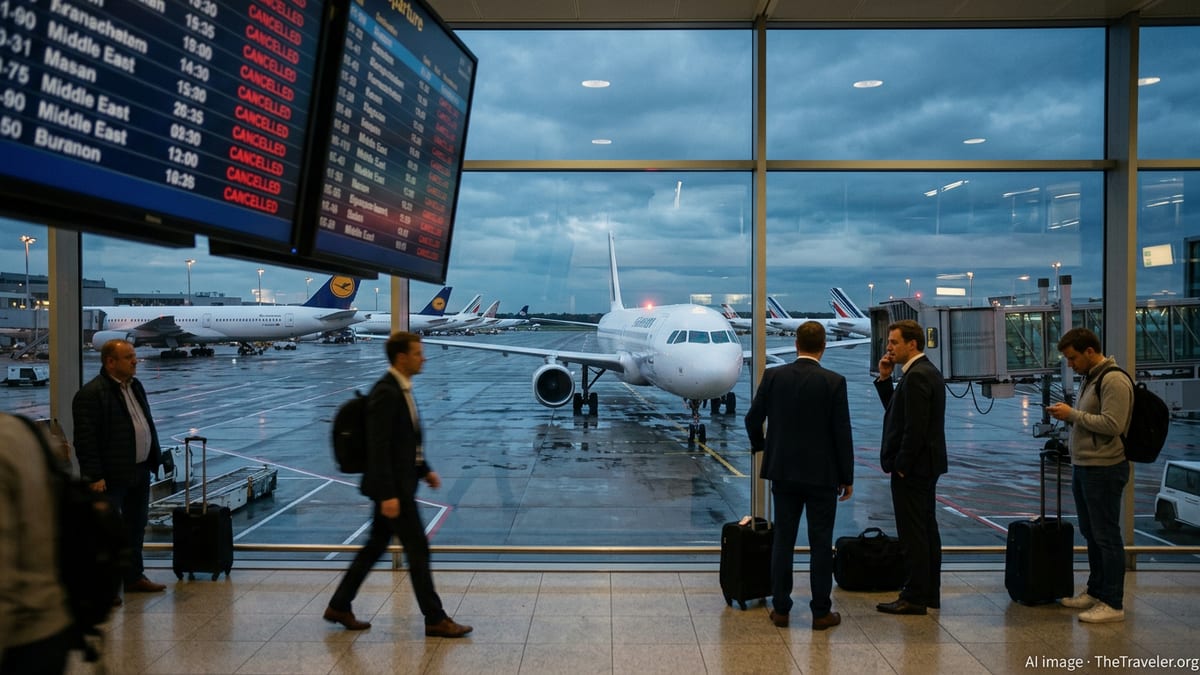
What the Extended EASA Warning Actually Covers
The latest update from the European Union Aviation Safety Agency maintains its Conflict Zone Information Bulletin for the entire airspace of 11 Middle Eastern and Gulf countries, including Iran, Iraq, Israel, Jordan, Lebanon, Saudi Arabia, the United Arab Emirates and Qatar. Airlines overseen by European regulators are advised not to operate at any altitude within these flight information regions, effectively blocking routine overflights and many direct services.
The extension follows coordinated strikes on targets inside Iran on February 28 and subsequent reprisals that have raised the risk of miscalculation in one of the world’s busiest aviation crossroads. EASA and EU member states concluded that the threat to civilian aircraft from missiles, drones and military activity remains unacceptably high, particularly at cruising levels where long haul jets would normally traverse the region.
While the bulletin is technically advisory, European carriers and many non European airlines treat such warnings as binding for safety and liability reasons. That has translated into widespread cancellations, diversions and rerouting of flights that would typically pass through Gulf hubs or use Middle Eastern skies as the most direct corridor between Europe, Asia and East Africa.
The extension currently runs until March 11, 2026, but officials stress that the end date is a review point rather than a guarantee that operations will normalize. The guidance will be revisited as military and diplomatic developments unfold on the ground and in regional airspace.
How Airlines Are Responding Across the Region
Major European groups have moved quickly to align with the extended EASA guidance. Lufthansa and its subsidiaries have prolonged suspensions on routes to Tel Aviv, Beirut and Tehran, and continue to pause flights to Gulf destinations such as Dubai, Abu Dhabi and Dammam into mid March. Air France has maintained its own halt on services to Dubai and Riyadh, while keeping flights to Tel Aviv and Beirut off the schedule at least into the second week of March.
Elsewhere in Europe, Aegean Airlines has widened its cancellations to cover a broad swathe of the Middle East, including Israel, Lebanon, Iraq, the United Arab Emirates and Saudi Arabia, with most affected routes now shelved into mid March. Turkish airlines and carriers based in Türkiye have extended suspensions to Iran, Iraq, Syria, Lebanon and Jordan until at least March 9, with selective operations to other countries only where national authorities judge the risk to be lower.
Gulf and regional airlines have adopted a patchwork of strategies that reflect both national security decisions and commercial realities. In the United Arab Emirates, Emirates and Etihad are operating only limited schedules, focusing on repatriation and carefully controlled services as airspace remains tightly managed. Some international carriers have begun cautiously resuming flights to the UAE, but often on reduced frequencies and with complex routing to avoid closed skies elsewhere in the region.
Beyond the immediate Middle Eastern market, the knock on effects have reached Asia Pacific and transcontinental networks. Airlines such as Cathay Pacific, Thai Airways and Japan Airlines have trimmed or rerouted services that would normally overfly the Gulf, trading shorter great circle tracks for longer detours over Central Asia or North Africa in order to remain clear of conflict zones highlighted in the EASA bulletin.
Impact on European Travelers and Global Connections
For passengers, the extended warning translates into ongoing uncertainty, longer journeys and a wave of rebookings. Travelers heading between Europe and popular Middle Eastern destinations are seeing outright cancellations or last minute itinerary changes as airlines adjust schedules in line with the latest safety assessments and national airspace closures.
The disruption is particularly acute for those who rely on Gulf hubs such as Dubai, Abu Dhabi and Doha as bridges between Europe and Asia, Africa or Australasia. With many flights into these hubs curtailed and overflight rights restricted across multiple neighboring countries, itineraries that once required a straightforward one stop connection now involve multi stop detours or date changes. In some cases, travelers are being rerouted via southern corridors over the Red Sea or via northern tracks that add several hours of flying time.
Travelers already in the region are facing crowded rebooking queues, congested call centers and scarce availability on remaining services. Some governments and carriers have laid on special evacuation or repatriation flights to move stranded citizens and residents out of affected countries, but capacity remains limited relative to normal traffic flows at this time of year.
Business travel and tourism are feeling the strain as well. Corporate travel managers are rewriting itineraries for staff, while tour operators adjust schedules or cancel departures altogether for destinations caught in the affected airspace. Even travelers whose final destination lies outside the Middle East may be affected if their tickets include a connection through an impacted hub or a code share flight operated by a carrier bound by EASA guidance.
Risk Drivers Behind the Extended Ban
EASA’s decision to prolong its conflict zone bulletin is rooted in specific operational risks rather than general geopolitical unease. The recent wave of missile and drone strikes has highlighted the danger of sophisticated weapons systems operating near established civilian air corridors, especially when military actors use long range ordnance capable of reaching typical cruise altitudes for passenger jets.
Analysts and regulators are also tracking reports of electronic interference, including satellite navigation disruption and GPS jamming across parts of the region. Such interference can complicate navigation and air traffic management in already congested skies, particularly during high tension periods when civil and military traffic may be sharing or rapidly reconfiguring airspace.
The memory of past aviation disasters in conflict zones looms large in current risk calculations. European and international regulators have been determined not to repeat scenarios in which airliners continued to traverse airspace over active battlefields. The latest EASA bulletin represents a conservative approach that prioritizes the avoidance of even low probability but high consequence events.
Behind the scenes, national aviation authorities, military planners and air navigation service providers are sharing data and radar tracks to help the agency refine its assessment. Officials suggest that a more nuanced, corridor based approach could emerge later if tensions ease and certain flight levels or routes can be clearly segregated from military operations, but for now broad avoidance remains the guiding principle.
What Travelers Should Do Now
With the EASA warning extended and many airlines adjusting schedules day by day, travelers with existing bookings to or through the Middle East in March should assume plans may change at short notice. The most important step is to monitor reservations closely and rely on official communications from the operating airline or booking agent rather than third party rumor or social media posts.
Most major carriers have activated flexible rebooking or waiver policies for affected itineraries, allowing passengers to change travel dates, reroute via alternative hubs or in some cases request refunds. That said, alternative capacity is finite, particularly on peak Europe Asia and Europe Africa flows that would normally use Gulf hubs, so reissuing tickets early can improve the chances of securing suitable new options.
Travelers who must transit the region for essential reasons should build in additional time, including longer connection windows and contingency plans for overnight stops if rerouting is required. For non essential trips, particularly to destinations directly affected by airspace closures, postponing travel until after the current EASA review horizon may be the least stressful choice.
Looking ahead, regulators and airlines alike stress that safety considerations will continue to override commercial pressure. As long as the security situation remains volatile and airspace closures persist across the Middle East and Persian Gulf, European operators are expected to maintain a cautious posture, with the EASA bulletin serving as the key reference point for what is and is not considered acceptable risk in the skies above the region.