

More news on this day
Hundreds of Easter holiday travelers have been left stranded across Europe and the Gulf as British Airways and Pegasus Airlines cancelled 25 flights and delayed 134 others over the peak Easter weekend, snarling connections at major hubs in the United Kingdom, Turkey, the United Arab Emirates and Austria.
Get the latest news straight to your inbox!
Major Hubs From Heathrow to Dubai Hit by Wave of Disruptions
Publicly available operational data compiled over the Easter peak shows that British Airways and Pegasus Airlines together cancelled 25 flights and pushed back departure times on a further 134 services, creating knock-on delays across already busy terminals. The disruption was concentrated at London Heathrow, Istanbul Sabiha Gökçen, Vienna International Airport and key airports in the UAE, including Dubai and Abu Dhabi.
Reports indicate that services between Europe and the Middle East bore the brunt of the problems. British Airways flights connecting the UK with Gulf gateways were among those most affected, while Pegasus operations at Istanbul’s Sabiha Gökçen airport, a critical low cost transfer point, saw multiple rotations scrubbed or heavily delayed. Travel industry coverage notes that some of the affected routes linked Istanbul and London with Vienna and major hubs in the UAE, amplifying the impact on connecting passengers.
The timing of the disruption coincided with the busy Easter getaway, when families, migrant workers and short break travelers converge on the same routes. Aviation analysts quoted in industry reports highlight that capacity at many European hubs is already tightly balanced during holiday peaks, meaning that a relatively small number of cancellations and long delays can cascade quickly across the network.
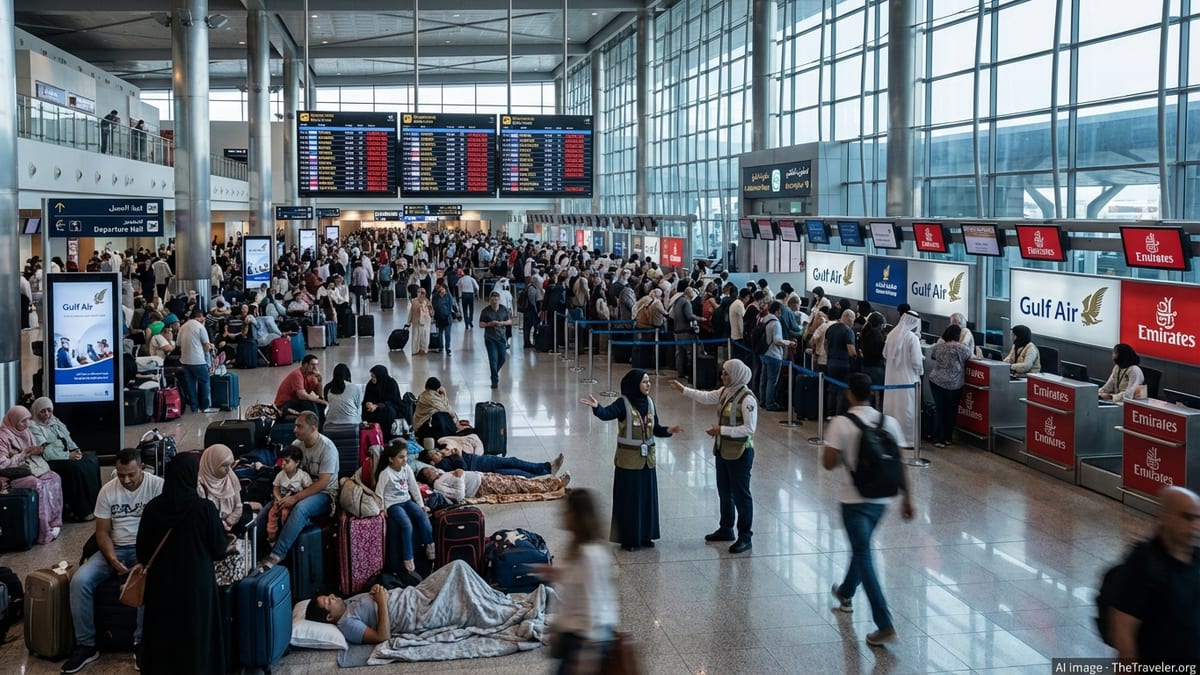
At Heathrow, one of Europe’s most congested airports, the combination of full flights and limited spare aircraft reportedly left many passengers facing long waits for alternative options. In Istanbul, images shared by travelers on social platforms showed crowded departure halls and extended queues at customer service desks as passengers sought rebooking and information.
Knock-on Effects for Connections Across Europe and the Gulf
According to travel disruption trackers, the 25 cancellations and 134 delays affected not only point to point journeys but also a web of onward connections. Vienna International Airport, which relies on a mix of flag carriers and partner airlines to feed its network, saw links from London and Istanbul disrupted, affecting travelers heading to Central and Eastern Europe.
In the Gulf, passengers connecting in Dubai and Abu Dhabi to long haul services toward Asia and Oceania were among those most exposed. When a feeder flight from London or Istanbul arrived late or did not operate at all, travelers often missed tightly timed onward departures and were forced to rebook for the following day, in some cases requiring overnight stays.
Travel and aviation outlets report that, in several instances, delayed departures of three hours or more translated into missed curfews or slot restrictions at destination airports. This pushed some flights into outright cancellation, further stretching airline operations teams that were already attempting to reposition aircraft and crews for the post holiday period.
Additionally, airspace constraints linked to ongoing tensions in parts of the Middle East have recently forced many carriers, including British Airways and Pegasus, to adopt longer routings around restricted zones. Industry analyses suggest that these diversions leave less margin for recovery when schedules come under pressure, making networks more vulnerable to widespread disruption on peak days.
Passenger Experiences: Long Queues, Missed Holidays and Scrambled Plans
Travel forums and social media posts from the Easter weekend describe a familiar pattern of frustration: passengers arriving at airports to find flights delayed repeatedly or suddenly marked as cancelled on departure boards. Some holidaymakers reported losing the first night of pre booked hotel stays, while others missed family events or business meetings planned around the long weekend.
Accounts from Heathrow, Sabiha Gökçen and Vienna refer to lengthy waits to speak with airline representatives and limited availability of same day alternatives, particularly on popular leisure routes. With many Easter services operating close to or at full capacity, rebooking often meant accepting itineraries with overnight stops, detours through alternative hubs or travel on different days altogether.
Families traveling with children and older passengers appeared to be among the hardest hit, as disrupted flights turned relatively short journeys into day long ordeals. Reports highlight instances where travelers spent hours in terminal seating areas waiting for updated departure times or hotel vouchers, while simultaneously trying to rearrange ground transport and accommodation at their destinations.
Some passengers also raised concerns about communication, noting that flight status notifications in airline apps or via email did not always arrive in time to avoid unnecessary trips to the airport. Others reported that information displayed on airport boards and mobile tools occasionally conflicted, adding to confusion during an already stressful holiday period.
Rights, Compensation and What Stranded Travelers Can Do
Consumer organizations and passenger rights specialists point out that travelers affected by the British Airways and Pegasus disruptions may, in some circumstances, be protected by European Union Regulation 261/2004 and equivalent UK rules. These frameworks generally require airlines to provide meals, refreshments and hotel accommodation when significant delays or overnight disruptions occur, as well as alternative transport to the final destination.
Where cancellations or long delays are judged to be within an airline’s control and not caused by extraordinary circumstances such as severe weather or sudden airspace closures, eligible passengers may also qualify for financial compensation. The amount is typically based on flight distance and length of delay on arrival, and can reach several hundred euros per person on longer routes.
Travel law commentators recommend that passengers keep boarding passes, booking confirmations and any written explanation of the disruption provided at the airport or via digital channels. These documents can be essential when submitting claims directly to airlines or, if needed, escalating disputes to national enforcement bodies or alternative dispute resolution schemes.
Travel insurance may offer an additional layer of protection, particularly for costs not covered by airline obligations, such as missed hotel nights, prepaid excursions or replacement tickets on other carriers. Policy wording varies widely, so specialists advise reviewing coverage carefully and filing claims promptly with all supporting receipts and correspondence.
Ongoing Vulnerability of Holiday Travel Corridors
The Easter weekend turmoil underscores the continued fragility of key travel corridors linking the UK, Turkey, Austria and the Gulf. Aviation analysts note that demand has rebounded strongly on many of these routes, driven by leisure travel, migrant worker flows and business traffic, yet infrastructure and staffing at some hubs remain under pressure.
Recent industry data shows that European airports and airlines have experienced several periods of heightened disruption in recent weeks, often tied to a combination of weather, airspace restrictions, operational bottlenecks and tight aircraft utilization. In this context, the British Airways and Pegasus cancellations and delays during Easter are seen as part of a broader pattern rather than an isolated incident.
Observers suggest that passengers planning future peak period trips on these corridors should allow additional buffer time for connections, consider earlier departures where possible and familiarize themselves with both airline policies and applicable passenger rights before travel. While such steps cannot prevent cancellations or delays, they may reduce the risk of missed onward flights and ease the process of seeking assistance when problems arise.
As airlines and airports review performance over the Easter period, operational adjustments in the coming weeks are expected to focus on improving resilience during holiday peaks. For travelers, however, the scenes of crowded terminals and departure boards filled with yellow and red warnings serve as another reminder that even routine journeys can quickly become uncertain when disruption spreads across interconnected global networks.