

More news on this day
Severe storms colliding with peak Easter Sunday demand across North America have triggered widespread delays and cancellations, exposing how vulnerable the region’s tightly packed travel networks remain to disruptive weather.
Get the latest news straight to your inbox!
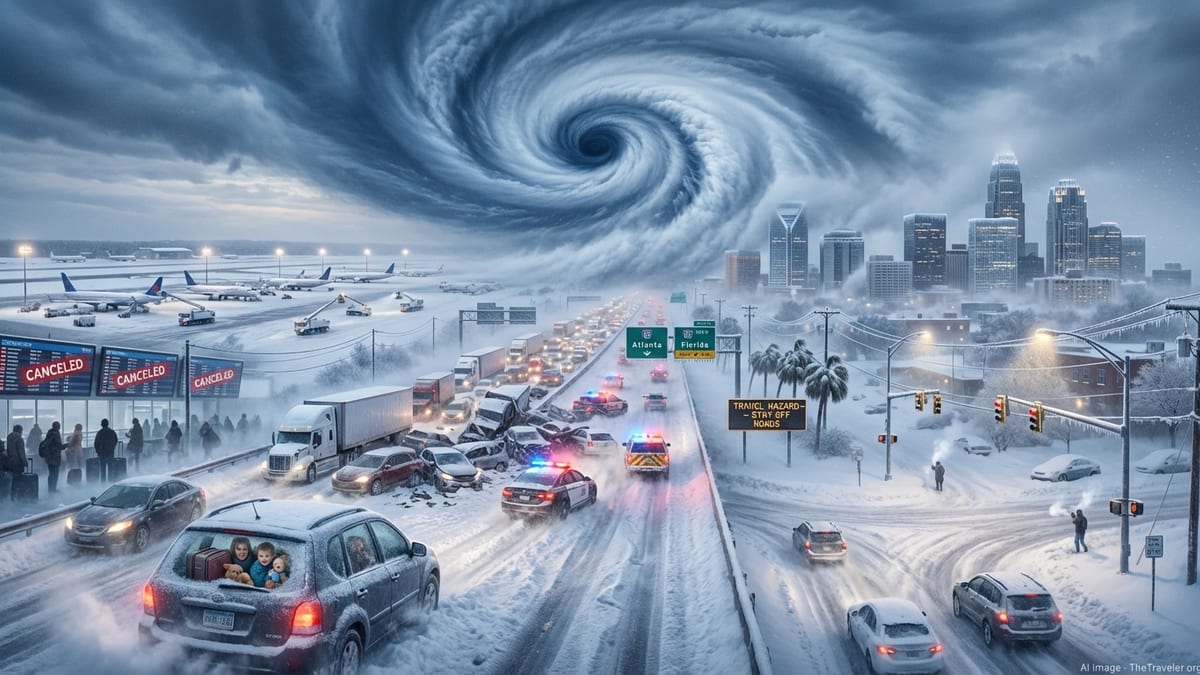
Storms Collide With Peak Holiday Travel Demand
Easter Sunday in 2026 fell on April 5, aligning a major religious holiday with the heart of North America’s volatile spring storm season. Publicly available aviation data and media coverage indicate that thunderstorms, heavy rain and localized flooding swept across key air corridors from the Midwest to the Gulf Coast and Southeast between Good Friday and Easter Sunday.
Reports drawing on national flight-tracking platforms show that, between the Thursday before Easter and Holy Saturday, more than 15,000 flights across the United States were delayed, with several hundred outright cancellations concentrated at major hubs. Coverage citing FlightAware data noted more than 6,000 delays and close to 500 cancellations on Easter Saturday alone, as storms disrupted operations from Chicago and Dallas to Houston and Miami.
The disruption arrived amid what airline trade groups had already identified as a record spring travel period. Industry association projections for March and April anticipated around 171 million passengers on U.S. carriers, a modest but significant increase over the previous year. That surge meant that once weather began to interfere with takeoff and landing windows, there was little spare capacity in the system to absorb missed connections or reposition aircraft and crews in time for Easter Sunday flights.
Across Canadian and cross-border routes, the effects were felt in the form of cascading delays on services linking Toronto, Montreal and Vancouver with U.S. hubs. While cancellations were more concentrated in the U.S. storm zones, Canadian travelers faced missed connections, extended waits at transit points and crowded rebooking lines as airlines attempted to re-stitch disrupted schedules heading into the holiday.
Ground Stops and Gridlock Reveal Structural Weaknesses
The Easter weekend chaos followed a series of March storm events that had already strained the aviation grid. In late March, a powerful spring system crossing the eastern United States triggered one of the season’s most severe air travel disruptions, with thousands of delays and well over a thousand cancellations reported in a single day at the height of the event. Coverage from aviation-focused outlets described extensive ground stops and delay programs at major hubs as storms swept across Illinois, New York and Massachusetts.
Just days before Easter, national tracking data showed another major storm day in which more than 3,000 flights were delayed and over 100 canceled as severe thunderstorms, rapid snowmelt and flash flooding converged across multiple high-volume corridors. Chicago O’Hare was highlighted as a focal point, absorbing dozens of cancellations and close to a thousand delays as ground stops and heavy traffic management initiatives slowed operations.
Travel reports and passenger accounts from those March events documented how quickly the system can seize when storms hit several hubs at once. Federal aviation planners introduced rolling ground stops to manage safety and congestion, but those controls rippled across networks, leaving aircraft out of position and crews timed out. As the Easter holiday approached, many airlines were still working through the tail of these earlier disruptions, which left fewer buffers when another round of storms aligned with peak demand.
On the ground, road and rail networks faced similar constraints. Heavy rain and thunderstorms across parts of the Midwest and South created hazardous driving conditions and localized flooding on major interstates, slowing long-distance traffic and airport access. Regional rail and intercity bus operators reported weather-related delays and temporary suspensions on select routes, compounding the pressure on travelers seeking alternatives to disrupted flights.
Passengers Confront Long Lines, Patchy Information and Mounting Costs
The sequence of March and Easter storm disruptions has renewed scrutiny on how well North American carriers and infrastructure operators manage passenger experience when weather overwhelms carefully timed schedules. Travelers posting on social platforms and in consumer forums over recent weeks have highlighted long waits for customer service, limited proactive communication and inconsistent treatment of vouchers or rebooking options.
Publicly available coverage of the Easter storm weekend indicates that many passengers encountered hours-long lines at airport service counters as cancellations mounted. While some airlines issued weather waivers allowing free changes ahead of the worst conditions, others were slower to update guidance, leaving passengers uncertain whether to risk traveling to the airport or to rebook pre-emptively.
Experts quoted in prior reporting on March’s major storm days have noted that even when weather is the root cause, disruptions come with significant financial and emotional costs for travelers. Hotel stays, meals, child care adjustments and lost work time add up quickly, particularly when rebooking pushes travel to less convenient days or overnight red-eyes. Families traveling for Easter religious services or reunions faced especially fraught choices, weighing the cost of last-minute changes against the risk of missing events entirely.
The uneven recovery patterns also illustrate a widening gap between larger carriers with deeper fleets and regional operators with more limited flexibility. While big airlines can sometimes shift widebody aircraft or open extra sections to clear backlogs once weather improves, smaller players may be forced to cancel and consolidate flights over several days, prolonging the disruption for passengers in secondary markets.
Climate Volatility Meets a Maxed-Out Aviation System
The Easter travel chaos has intensified debate over how North American transport systems should adapt to an era of more frequent and intense weather events. Climate scientists and meteorological agencies have documented trends toward more volatile spring storm patterns in parts of the United States and Canada, with severe thunderstorms, heavy rainfall and late-season snow events often clustered in short windows.
Industry analysts observing recent seasons argue that this volatility is colliding with an aviation system that is already operating near capacity. Airlines have focused on high load factors and optimized schedules to maximize revenue, while airport infrastructure and air traffic control modernization have struggled to keep pace with demand growth. As a result, when storms shut down a hub for several hours or force traffic to reroute, there are few unused gates, spare aircraft or open time slots available to absorb the shock.
Policy discussions in Washington and Ottawa have increasingly turned to questions of resilience. Proposals in circulation include accelerating investments in air traffic management technology, reinforcing drainage and flood protection at vulnerable airports, and revisiting scheduling practices that leave little room for disruption. Some analysts have suggested that regulators may eventually need to consider stricter controls on peak scheduling at saturated hubs if weather volatility continues to intensify.
For now, responsibility for managing risk continues to fall heavily on individual travelers, who are encouraged by consumer advocates to build additional flexibility into trip planning, favor early departures, and monitor multiple channels for real-time updates. The Easter storm chaos, arriving on the heels of several notable March disruptions, has underscored how quickly even routine itineraries can spiral when weather and capacity collide.
Warning Sign for the Summer Travel Season
With the North American summer travel season only weeks away, the Easter weekend turmoil is being treated by many observers as an early stress test. Summer brings its own meteorological challenges, including heat waves, convective thunderstorms and wildfire smoke that can reduce visibility and close runways or flight paths.
Travel data from recent years show that summer already accounts for some of the highest delay totals on the calendar, as airspace fills with both holidaymakers and business travelers. If spring storms have already strained airlines and airports at current staffing and infrastructure levels, analysts warn that a repeat of similar patterns in June, July or August could yield even more severe ripple effects.
Consumer advocates and travel planners are using the Easter disruption as a case study when advising clients and the public. Recommendations now emphasize booking nonstop flights whenever possible, allowing longer connection windows, considering rail on short to medium-haul corridors where available, and purchasing travel insurance with robust interruption coverage. For those tied to fixed dates, such as school vacations or major events, the advice increasingly centers on contingency planning, including backup routes and flexible lodging reservations.
Ultimately, the storms that swept across North America over Easter weekend have highlighted a structural reality: a complex travel ecosystem that operates efficiently only when conditions are close to ideal. As climate volatility increases and demand continues to rise, the latest bout of holiday chaos is being interpreted less as an isolated episode and more as a preview of a new, more fragile normal for North American travel.