

More news on this day
Millions of Easter holidaymakers are facing extended disruption across Europe and the UK as Storm Dave, rail engineering works, heavy road traffic and cross-Channel bottlenecks combine to create ongoing travel chaos for flights, trains, motorists and ferry passengers.
Get the latest news straight to your inbox!
Flights hit by weather, congestion and new border checks
Air travel, usually the quickest way to escape for the long Easter weekend, has been heavily affected by strong winds linked to Storm Dave and the knock-on impact of widespread delays. Published coverage indicates that gusty conditions have forced airlines to revise schedules, with short-notice cancellations and diversions particularly affecting airports in Scotland, Northern Ireland and northern England.
Reports from travel industry analysts suggest that passengers heading to European destinations are also contending with longer queues at departure and arrival halls. The gradual introduction of the European Union’s new Entry/Exit System is prompting airports and carriers to warn travellers about potential bottlenecks at border control, especially during peak holiday periods.
Some airports have experienced lengthy security and check-in queues as record numbers of passengers pass through terminals over the four-day holiday. Publicly available information shows that several regional airports are handling higher volumes than last year, putting additional pressure on baggage systems and staffing at security lanes.
With aircraft and crews out of position after earlier cancellations, delays are spreading through airline networks beyond the worst of the stormy conditions. Travellers are being urged by operators and airport bulletins to monitor flight status closely and to allow extra time for check-in, security and passport control.
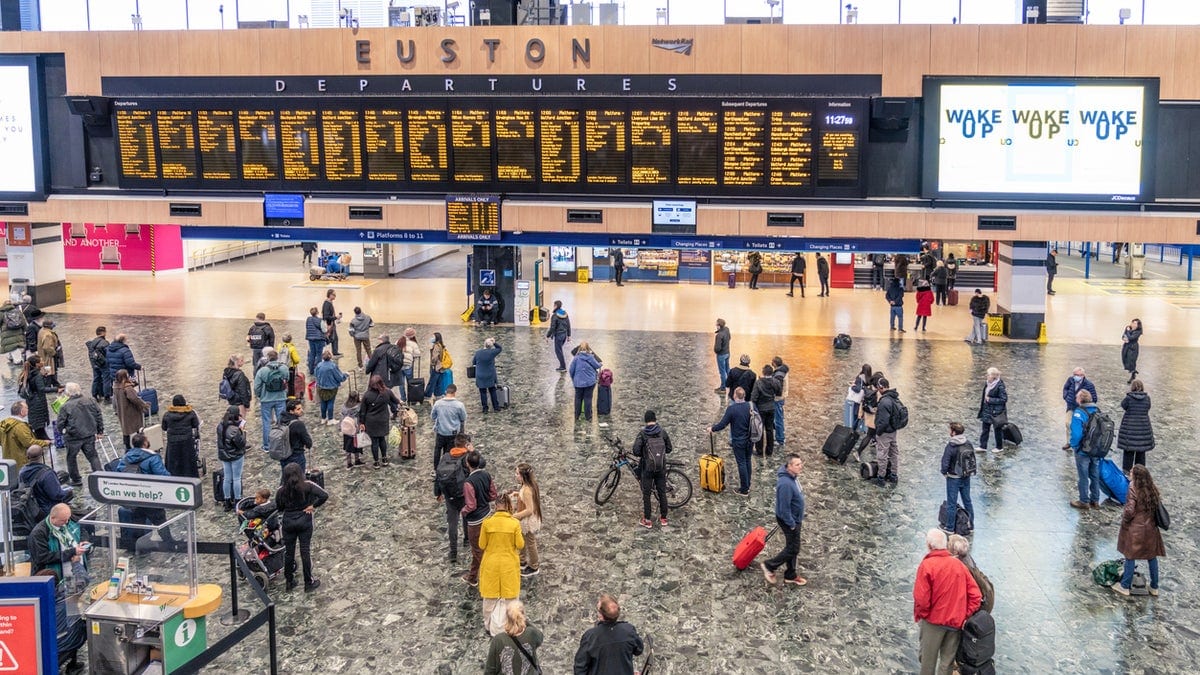
Rail passengers face major Easter engineering works
Rail travel has emerged as one of the most disrupted parts of the transport network this Easter. Extensive planned engineering works on key main lines in Britain have coincided with the holiday rush, leading to closures, reduced timetables and replacement buses on several intercity and commuter routes.
According to publicly available rail updates, one of the most significant interventions involves a six-day blockade on a busy stretch of the West Coast Main Line from Good Friday. This closure is forcing long-distance operators to reroute or replace services, lengthening journey times between London, the Midlands, north-west England and Scotland.
Elsewhere, upgrades and maintenance works are taking place on routes serving major leisure destinations and airports, including sections of the Great Western and East Coast networks. In London, parts of the Elizabeth line, London Overground and Docklands Light Railway are shut for track and signalling work, adding further pressure to the remaining suburban services and local roads.
Storm Dave has compounded these planned disruptions by damaging overhead power lines and bringing down debris onto tracks in some regions, according to rail operator alerts. This combination of scheduled works and weather-related incidents has left many passengers facing complex diversions, extended journey times and crowded replacement buses at the height of the Easter getaway.
Road network strained by holiday traffic and storm conditions
On the roads, motoring organisations are reporting one of the busiest Easter weekends in recent years, with tens of millions of leisure journeys forecast across the UK. Forecasts compiled by traffic data firms and roadside assistance providers indicate prolonged congestion on major holiday routes, particularly around traditional bottlenecks and popular coastal and countryside destinations.
Traffic is reported to be especially heavy on sections of the M25, M4, M5 and key approaches to ports in Kent. In some locations, journey times are estimated to be more than double the seasonal average, as local traffic mixes with long-distance getaway traffic and freight movements serving ports and logistics hubs.
Storm Dave’s strong winds and heavy showers are adding to the difficulties for drivers, with yellow weather warnings covering large parts of Scotland, Northern Ireland, north Wales and northern England. Transport agencies have highlighted an increased risk of high-sided vehicles overturning, fallen branches and sudden surface-water flooding, all of which can trigger rolling lane closures and additional delays.
National highway operators have removed large stretches of non-essential roadworks in an attempt to keep traffic moving more freely over the holiday period. However, contraflow systems and reduced speed limits remain in place at several key pinch points, and reports indicate that incidents and breakdowns in these areas can quickly cause lengthy tailbacks.
Ferry and Eurotunnel services struggle with queues and weather
Sea crossings are also experiencing significant disruption as holidaymakers attempt to reach continental Europe. The Port of Dover has warned of very busy conditions throughout the Easter period, with traffic management systems in Kent activated to manage queues of cars and lorries heading for cross-Channel ferries.
Publicly available information from port authorities shows that strong winds in the Channel have led to delays and occasional cancellations on some ferry services. Rough seas have lengthened crossing times and forced operators to adjust schedules at short notice, causing knock-on congestion on surrounding roads and in port holding areas.
The Eurotunnel shuttle between Folkestone and Calais has remained a key pressure point, with high demand from motorists combining with tighter border checks for travellers heading into the Schengen area. Earlier technical problems on the fixed link in recent months have highlighted the vulnerability of this corridor, and transport analysts note that any fresh disruption during the current peak would quickly spill over to nearby motorways and the Port of Dover.
In the Irish Sea, some sailings between Britain and Ireland have also faced weather-related delays, according to operator updates. Passengers are being advised through public statements to arrive in good time for check-in, but not excessively early, to avoid adding to congestion at terminals already operating close to capacity.
Travellers urged to build in extra time and backup plans
With problems affecting air, rail, road and sea simultaneously, travel organisations and consumer groups are highlighting the importance of careful planning for anyone yet to set off. Published guidance encourages passengers to check live departure and arrival boards, sign up for operator alerts and build generous buffers into connection times.
For those driving to ports or airports, motoring bodies recommend avoiding peak departure windows where possible and having alternative routes planned in case of unexpected closures or incidents. Drivers heading to Kent are being reminded that traffic management measures around Dover and the Eurotunnel terminal can significantly extend journey times even when crossings are operating.
Rail passengers are being urged to confirm whether their regular services are affected by engineering works before leaving home and to expect bus replacements on some intercity and commuter routes. Travel commentators note that some passengers may find it easier to adjust their plans to travel on less busy days of the holiday period if their arrangements are flexible.
Across all modes, consumer advocates stress that passengers should familiarise themselves with their rights to rebooking and compensation in the event of delays and cancellations. With the Easter getaway coinciding with severe weather, heavy demand and major infrastructure works, disruption looks set to linger beyond the peak weekend, affecting return journeys as well as outbound trips.