

More news on this day
Millions of travelers heading away for the Easter holiday period are facing severe disruption across air, rail, road and ferry networks, as strikes, planned engineering works, new border controls and unsettled weather converge on one of the busiest travel weekends of the year.
Get the latest news straight to your inbox!
Record air traffic collides with strikes and staff shortages
Airports across Europe and North America entered the Easter peak with near record seat capacity and passenger numbers, while also managing a series of operational flashpoints. Aviation data cited in recent industry analysis indicates that scheduled capacity across key European markets for the five days around Easter has risen to its highest level since before the pandemic, with around 25 million seats available on departing flights.
At the same time, a succession of local and national disputes is constraining that capacity. In Spain, ground-handling staff at major airports launched walkouts beginning on 30 March 2026, coinciding with the first major Easter getaway day and threatening delays, baggage backlogs and short-notice cancellations on both domestic and international services. According to passenger-rights briefings, the action targets 13 airports that handle a large share of Spain’s holiday traffic, from Barcelona and Madrid to coastal gateways popular with tourists.
France is braced for further turbulence over Easter Monday on 6 April, with cabin crew at easyJet’s six French bases planning industrial action that published travel-industry coverage suggests could lead to 25 to 40 percent of the airline’s flights from Paris Charles de Gaulle, Orly, Nice, Lyon, Bordeaux and Nantes being canceled. That disruption is expected to ripple across intra-European leisure routes that are heavily used by families returning home at the end of the long weekend.
Beyond Europe, U.S. aviation has already seen several heavy disruption days in March 2026 as storms swept across major hubs, with thousands of delays and more than 1,000 cancellations concentrated around key airports such as Atlanta and New York. Separate coverage of Miami International Airport shows that at least 175 flights were disrupted there alone heading into the Easter period, underlining how weather-sensitive networks can quickly become overloaded at peak times.
New border checks and passenger rights add to airport pressure
Alongside industrial action and weather, new border controls are expected to slow passenger flows through some European airports during the Easter rush. Travel bulletins in recent days have highlighted warnings that the rollout of the European Union’s Entry-Exit System could add more than two hours to border-control queues for some travelers, particularly at busy holiday gateways handling large numbers of non-EU passengers.
Industry commentary suggests that airports and airlines are urging travelers to allow extra time for check-in and document checks, especially where biometric registration will be required for the first time. Some aviation leaders are publicly arguing that a full rollout of new systems should be delayed until after the main holiday season, citing the risk that test-phase glitches and staff training needs will collide with already stretched operations.
For passengers caught up in cancellations and long delays, the Easter period is also likely to test awareness of air passenger rights. Guidance published by consumer and legal organizations in recent weeks notes that European rules distinguish between disruption caused by an airline’s own staff, such as cabin crew strikes at a carrier like easyJet, and disruption caused by third parties such as airport ground handlers. In the former case, compensation may be payable in addition to rerouting and care; in the latter, travelers may be entitled to assistance and refunds but not necessarily cash compensation.
Travel advisers point out that the concentration of disruption on peak days increases the difficulty and cost of rebooking, making it harder for travelers to find same-day alternatives. They recommend that passengers monitor their airline’s app closely, keep boarding passes and receipts for additional expenses, and consider flexible or refundable tickets where possible when traveling around major holiday weekends.
Major Easter rail shutdowns reshape journeys
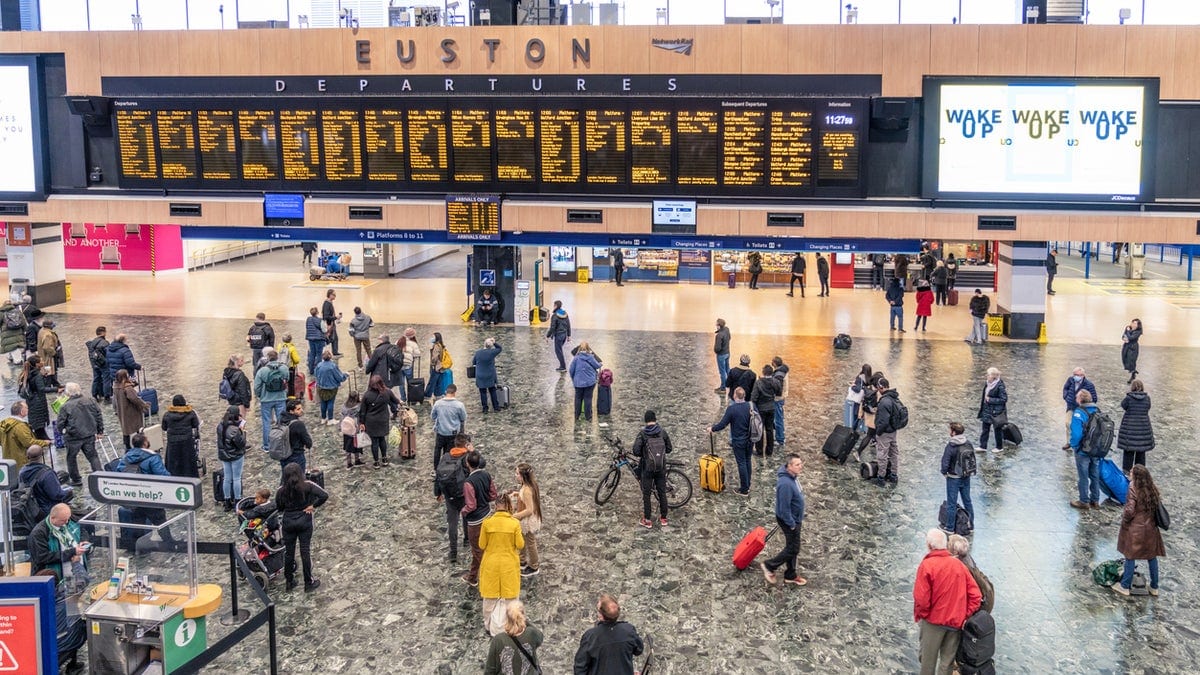
Rail travelers are also facing an intense period of disruption, particularly in the United Kingdom and parts of continental Europe, where infrastructure managers have scheduled large blocks of engineering work over the Easter break. According to recent network announcements, Britain’s West Coast Main Line between London Euston and Milton Keynes is due to close for six days from Good Friday through 8 April, as part of a multihundred-million-pound program to replace worn track and upgrade signaling.
This closure affects one of the country’s busiest intercity corridors, connecting London with Birmingham, Manchester, Liverpool and Scotland. Replacement buses and diversions are planned, but journey times will be longer and capacity reduced. Additional track and station works are planned on other routes in northern England and the Midlands, with rail operators advising passengers to check timetables carefully before setting out.
Elsewhere in Europe, travel bulletins highlight that rail services in Germany, Spain, the Netherlands and Switzerland are experiencing a mix of planned engineering and sporadic industrial action, creating a patchwork of local disruptions rather than a single nationwide shutdown. Traffic projections from German highway and rail authorities anticipate particularly heavy demand on cross-border routes, with delays likely where services share congested corridors with freight or construction projects.
Passenger-rights information from European institutions underlines that rail operators must provide clearer real-time information and rerouting options in the event of serious disruption, including, in some cases, the ability for travelers to arrange their own alternative transport if no solution is offered within a defined period. However, travel advocates caution that such rules are still unevenly understood and applied, especially when delays cascade across multiple operators in different countries.
Road congestion peaks as motorists chase limited alternatives
On the roads, motoring organizations across Europe report that this Easter is shaping up to be one of the busiest since before the pandemic, as drivers seek flexibility in the face of rail and air uncertainty. Forecasts cited in recent UK travel coverage suggest that Maundy Thursday and Good Friday are expected to carry the heaviest traffic volumes, particularly on orbital and radial motorways such as the M25 around London, the M5 toward the South West and the M40 toward the Midlands.
In Germany, traffic agencies have warned of so-called wave traffic patterns forming on key Autobahn stretches used by holidaymakers and cross-border travelers. With rail engineering and intermittent strikes limiting capacity on some long-distance services, more families are turning to cars or rental vehicles, a shift that can quickly lead to gridlock around popular departure windows and at major junctions.
Weather is another complicating factor for road users. The 2025 to 2026 European storm seasons have already featured severe wind and rain events that periodically disrupted travel, and forecasters note that unsettled conditions can still arise in early spring. Heavy rain, strong crosswinds and localized flooding can force temporary speed limits, lane closures and even bridge restrictions, all of which add to journey times just as traffic volumes surge.
Authorities and road operators are encouraging motorists to stagger departure times where possible, carry basic supplies in case of long tailbacks, and use live traffic apps or variable-message signs to reroute around major incidents. However, with Easter holiday rentals and ferry crossings often booked to strict check-in times, many travelers have limited flexibility to shift their travel windows.
Ferry routes and cruise calls feel knock-on effects
Sea travel, while often presented as a calmer alternative to crowded airports and trains, is not immune to Easter disruption. Recent travel-industry roundups note that several ferry operators on busy short-sea routes in northern Europe have been adapting timetables to cope with both heavy demand and weather-related constraints, occasionally consolidating lightly booked overnight sailings into fewer, fuller services.
High winds and rough seas associated with late-season storms can lead to delayed or canceled crossings on exposed routes, particularly in the English Channel, North Sea and Irish Sea. When this happens during a peak weekend like Easter, vehicles can quickly back up in port approaches, with limited spare capacity on subsequent sailings to absorb stranded passengers and freight.
Cruise itineraries touching Mediterranean and Atlantic ports over the Easter period are also exposed to wider transport issues on land. Published coverage indicates that rail engineering works and local industrial action can complicate transfers between ports, airports and city centers, particularly in countries where cruise terminals rely heavily on a single rail line or motorway connection. Late arrivals of feeder flights or transfer coaches can, in turn, delay departures or force adjustments to shore-excursion schedules.
Travel analysts suggest that the overlapping pressures on air, rail, road and sea at Easter 2026 illustrate how tightly interconnected modern transport systems have become. Problems in one mode, such as an airline strike or a mainline rail closure, can quickly spill over into others, amplifying queues, congestion and frustration across the network at precisely the moment when millions are trying to travel.