

More news on this day
Millions of Easter holidaymakers are facing a turbulent getaway this year, as a mix of strikes, rail engineering works, traffic jams, new border checks and storm-related disruption creates widespread travel chaos across airlines, railways, roads and ferry routes.
Get the latest news straight to your inbox!
Airline passengers caught in a perfect storm of delays
Air travel is bearing the brunt of the Easter rush, with reports indicating that major European hubs and key UK airports are under pressure from a combination of staff disputes, severe weather and tighter border procedures. Industry tracking data shows that airlines have already cut or rescheduled hundreds of services around the peak holiday period, particularly on routes linking the UK with Spain and other Mediterranean destinations.
Published coverage highlights that strike action by ground staff and security workers at several Spanish airports, scheduled across the first week of April, is adding to the strain on carriers operating Easter sun routes. At the same time, disruption linked to storms in parts of northern Europe in late March left aircraft and crews out of position, feeding into knock-on delays for the start of the holiday getaway.
In the UK, publicly available information on airport operations indicates that staffing constraints and new EU border rules are lengthening processing times for passengers departing to and arriving from the Schengen area. The phased introduction of the Entry/Exit System for non-EU nationals is being closely watched by travel bodies, which warn that even small slowdowns at passport control can quickly turn into long queues during peak bank holiday periods.
Analysis of recent performance data at major hubs suggests that residual disruption is likely to persist beyond the initial weather or strike days, as airlines work to reposition aircraft and manage crew duty limits. Travel analysts are advising passengers to allow additional time for check-in and security and to expect that missed connections could take longer to resolve while schedules remain fragile.
Major rail engineering works and strikes disrupt Easter timetables
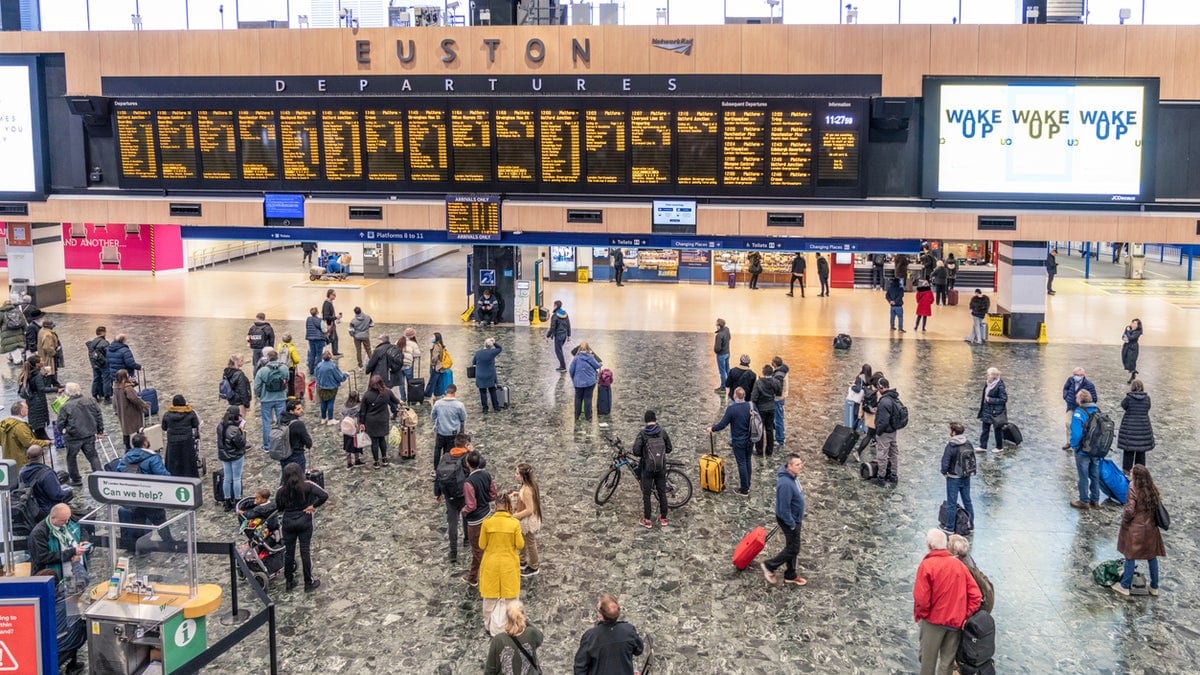
Rail passengers are also facing a difficult Easter, with extensive engineering projects and targeted strike action altering timetables and closing some of the busiest stretches of track. Network information published ahead of the long weekend shows that one of the most significant bottlenecks is on the West Coast Main Line, where services between London and Milton Keynes are suspended for six days around Easter as infrastructure upgrades proceed.
The closure on this key corridor affects long-distance services linking London with Birmingham, Manchester, Liverpool, North Wales and Scotland, forcing operators to divert trains or replace them with buses on certain sections. Replacement road transport between Milton Keynes and alternative mainline stations is expected to lengthen journey times and place additional pressure on already congested motorways.
Elsewhere on the network, Easter Sunday is emerging as the most heavily affected day, with additional work scheduled between Warrington and Wigan and on lines feeding some airport and coastal destinations. According to rail industry notices and journey planners, passengers on these routes are being advised to check revised timetables carefully and to be prepared for multiple changes between trains and buses.
The rail disruption comes on top of an unsettled winter and early spring for European networks, with recent windstorms and snow events in the 2025 to 2026 season having already caused temporary closures and reduced speeds on key cross-country lines. Observers note that this has left little slack in rolling stock and crew availability just as demand surges for the Easter school holidays.
Motorists warned of long queues on key Easter escape routes
On the roads, motoring organisations and traffic data providers report that Britain’s motorways are braced for some of the heaviest volumes of the year. Forecasts for Easter 2026 indicate particularly busy conditions on the M25 around London, the M4 and M5 towards the West Country, and the M1 and M6 serving routes to the Midlands, northern England and Scotland.
Peak congestion is expected from Thursday afternoon into Good Friday, as day-trippers, airport passengers and families setting off on longer breaks converge on the same stretches of road. Historical traffic patterns from previous Easter weekends suggest that even minor incidents can quickly cause lengthy tailbacks when demand is this high, especially around major junctions and roadworks.
Official planning documents and public information from the Department for Transport point to additional pressure in Kent, where Operation Brock measures are ready to be activated on the M20 should delays build at the Channel ports. Under this system, lorries bound for France are funnelled into a dedicated lane to prevent freight queues from spreading across the wider motorway network.
Travel organisations are advising drivers to plan routes carefully, avoid the busiest times where possible and factor in extra time for unexpected delays. Those connecting with flights or ferries are being urged to pay close attention to live traffic updates, given the risk that motorway congestion could compound disruption already affecting air and sea travel.
Dover and Channel crossings face Easter bottlenecks
Sea routes are also under strain as thousands of holidaymakers choose to drive to mainland Europe for the Easter break. The Port of Dover has repeatedly featured in recent years as a pressure point during holiday peaks, and this Easter is no exception, with port advisories warning of the potential for long queues for both cars and coaches.
Publicly available guidance for ferry passengers indicates that Good Friday morning is expected to be the busiest outbound period, with operators advising travellers not to arrive excessively early in order to ease pressure on local roads. Coach operators have been directed in past peak periods to use dedicated processing facilities in Dover’s Western Docks, a system that may again be relied upon to keep traffic moving through the town.
Reports from cross-Channel operators and logistics bodies also highlight sensitivity to delays caused by French border checks and to any weather-related disruption in the Strait of Dover. Even short suspensions of services due to high winds or sea conditions can result in a backlog of vehicles, with knock-on effects on the A20 and A2 approaches to the port.
Eurotunnel services from Folkestone are facing similar pressures, with high demand for shuttle services transporting cars and coaches under the Channel. With trains running at or near full capacity across the long weekend, any operational issue or extended border check can quickly lengthen waiting times in holding areas.
Passengers adapt as fragmented disruptions stretch across Europe
Beyond the UK, Easter movements across mainland Europe are being complicated by a patchwork of strikes, storms and operational issues. Recent reporting has detailed air traffic control and airline walkouts in Germany, Spain and Scandinavia in March, many of which were timed close to or within the broader Easter and Semana Santa holiday period.
These actions have resulted in multiple waves of cancellations and reroutings, particularly on intra-European routes that carry a high share of leisure travellers. Combined with storm systems that disrupted flights and ground transport in parts of northern Europe in late March, the cumulative impact has been to erode the timetable resilience that airlines and rail operators rely on at peak times.
For travellers, the effect is a more fragmented and unpredictable pattern of disruption, where a localised strike or weather event in one country can ripple out across the continent through shared aircraft, crew and rail stock. Consumer groups note that many passengers are now building additional buffer days into their itineraries, especially when travelling for cruises, tours or family events that are difficult to rebook at short notice.
Travel specialists suggest that this Easter’s difficulties may offer a preview of how future peak periods will look as transport networks operate closer to full capacity, with less margin for error when external shocks occur. While operators are working to restore reliability, the experience of Easter 2026 underlines how quickly air, rail, road and sea systems can become intertwined when disruption strikes.