

More news on this day
Thousands of Easter holidaymakers bound for Spain are facing hours of disruption as strikes by airport ground handling workers ripple across major hubs, triggering delays, missed connections and mounting baggage chaos at the height of the Holy Week getaway.
Get the latest news straight to your inbox!
Coordinated Walkouts Collide With Peak Easter Rush
The latest wave of industrial action by ground handling companies in Spain has collided with one of the busiest travel weekends of the year, creating a perfect storm for passengers. Strike action involving staff from Groundforce and Menzies began in late March and has intensified through the core Semana Santa period, affecting a string of major airports from Madrid and Barcelona to Málaga, Alicante, Valencia, Bilbao and key Canary Islands gateways.
Reports indicate that the stoppages are timed across several daily windows, often covering large parts of the morning and midday peak. Publicly available information shows that the walkouts have been approved to continue intermittently for months if no agreement is reached, meaning disruption is not limited to a single weekend. For Easter travellers, however, the immediate impact is acute as millions take to the skies for school holidays and religious processions.
Earlier guidance from Spanish and international travel outlets warned that delays were more likely than outright cancellations, but the cumulative effect has become increasingly visible. On the first full strike days, Spanish media described a “classic” holiday-period showdown playing out in terminals, with staff shortages on the ramp and at baggage belts forcing airlines to slow down boarding and turnaround operations just as passenger numbers surge.
At Málaga Costa del Sol, AENA data indicate nearly 6,000 flights programmed for the wider Semana Santa window, the vast majority on international routes. Similar patterns at Barcelona, Palma de Mallorca and Alicante mean that even modest slowdowns in aircraft handling quickly translate into queues at check-in, security and boarding gates as schedules bunch and delays cascade through the day.
Delays Mount at Madrid and Barcelona as Baggage Handling Stalls
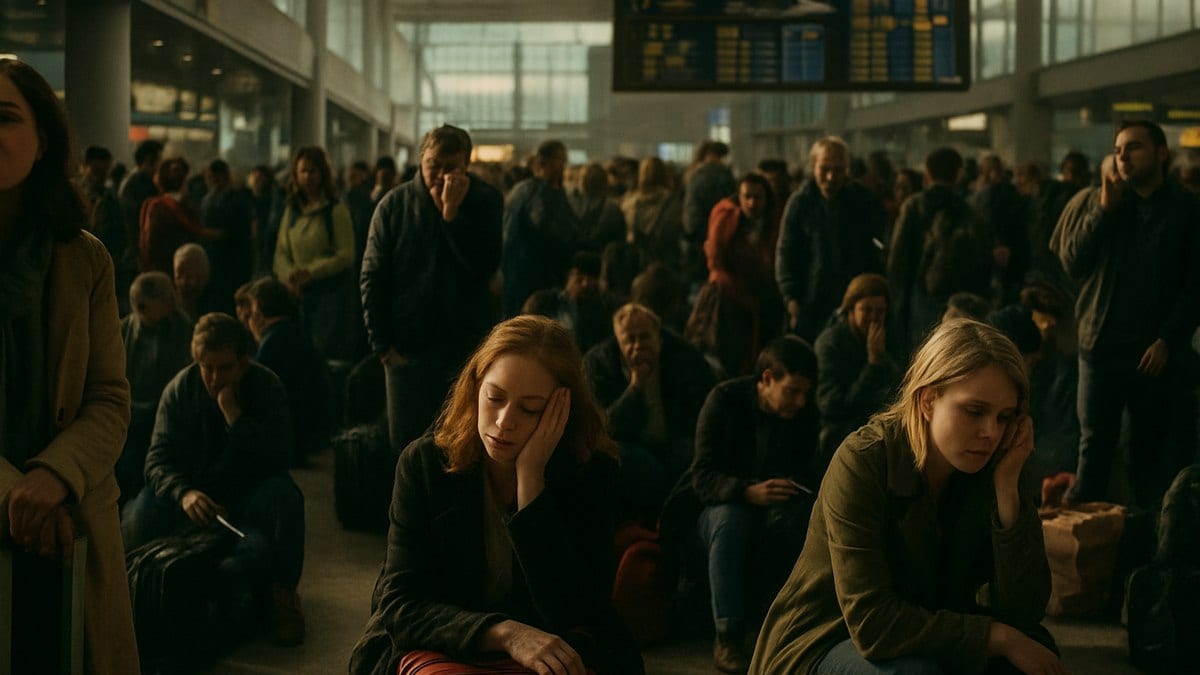
Spain’s two largest hubs, Madrid Barajas and Barcelona El Prat, have emerged as focal points of the disruption. Photographs and local coverage from Madrid show crowded departure halls and long lines at check-in counters as the first main Easter getaway day coincided with the start of coordinated strike action. In Barcelona, Catalan news outlets reported delays on the opening day of the Groundforce stoppage, initially averaging between 20 and 50 minutes for many affected flights.
Groundforce is responsible for ramp and baggage services for a substantial portfolio of international carriers at these airports, including Air France and its partners, Lufthansa group airlines and a mix of long haul operators. Publicly available information shows that some British Airways flights and services for other European carriers are also supported by the same handling network at particular terminals, increasing the risk of knock-on disruption even where airlines themselves are not directly involved in the dispute.
As delays have stretched, anecdotal accounts from passengers describe departure boards peppered with late flights and terminal staff struggling to keep queues moving. In several cases, aircraft have reportedly been boarded and pushed back while bags lag behind, prompting concerns among travellers about arrivals without luggage at downline destinations. Travel rights organisations have highlighted the tension this creates for airlines, which must balance the need to keep aircraft moving with the risk of compounding baggage backlogs.
At regional hubs such as Palma de Mallorca and Alicante, which are heavily reliant on inbound holiday traffic from northern Europe, the handling slowdown has an outsized effect. Local radio in Palma reports several hundred flights scheduled each day over the Easter weekend, only slightly below last year’s totals, meaning there is limited slack in the system to recover from even brief stoppages on the ramp.
Ryanair, easyJet and Legacy Carriers Warn of Knock-on Chaos
As the ground handling dispute escalated into the heart of the Easter travel period, airlines serving Spain moved to warn customers about likely delays and baggage issues. Low cost giants Ryanair and easyJet, which together operate hundreds of weekly services into Spanish sun destinations, have updated advisory pages and pre-travel emails urging passengers to arrive earlier than usual and keep essential items in cabin baggage where possible.
Legacy carriers including British Airways, Lufthansa and Air France have also highlighted the risk of disruption on routes touching affected airports. According to published guidance from airline and airport websites, travellers are being encouraged to monitor flight status closely on the day of departure and to allow extra time for check-in and bag drop. Some carriers have preemptively adjusted schedules or swapped aircraft to create more ground time at Spanish airports, in an effort to absorb slower turnaround speeds caused by reduced handling teams.
Despite these mitigation efforts, the sheer concentration of Easter traffic into a relatively tight window is limiting what airlines can do. Industry data for early spring already point to elevated average delay minutes across European networks, and the Spanish strikes are now feeding into broader congestion. Travel commentators note that when a major leisure market experiences industrial action, the effect can ripple through departure boards at London, Frankfurt, Paris, Dublin and other key hubs as aircraft and crews are held up on the Iberian Peninsula.
Package holiday operators and online travel agencies are meanwhile fielding a spike in queries from nervous customers who fear missing cruise departures, villa check-ins or onward train connections. Although most flights are still operating, extended queues and late‑running services are forcing many travellers to reconfigure plans on the fly, particularly those with tight connections or same‑day transfers.
Passengers Confront Long Queues, Missed Connections and Lost Bags
Across social media and passenger forums, a consistent picture is emerging of long queues, creeping delays and confusion over luggage. Travellers report arriving three or even four hours ahead of departure at Spanish airports, only to face bottlenecks at check‑in where limited handling staff are trying to process full holiday departures for multiple airlines at once.
Inside terminals, baggage drop areas have become particular choke points as strike periods begin or resume. When ground operations pause, bags accumulate in back‑of‑house areas and at check‑in belts, increasing the risk that luggage will not be loaded in time once flights are cleared to depart. Travel rights platforms tracking the situation warn that some passengers may arrive at their destination before their suitcases, with recovery times for misrouted or delayed baggage stretching beyond the usual 24 to 48 hours in the busiest locations.
Missed connections are another growing concern. Spain functions as a key link in many European and transatlantic itineraries, and a relatively modest delay out of a UK or German airport into Madrid or Barcelona can spiral into a missed onward flight when handling teams are working through a backlog. Reports from consumer groups and travel advocates suggest that rebooking desks and call centres are already under strain as airlines juggle limited spare seats during one of the peak leisure weekends of the year.
At the same time, not every airport and time slot is experiencing severe disruption. Some passengers flying early in the morning or outside the announced strike windows report relatively smooth journeys, underscoring how uneven the impact can be. For many travellers, however, the uncertainty itself has become part of the Easter ordeal, with plans reshaped around the possibility that flights might be delayed or bags temporarily lost even if services nominally remain on schedule.
What Travellers Can Expect in the Days Ahead
With strike notices covering dates through Easter Monday and beyond, passengers heading to or from Spain in the coming days should brace for ongoing disruption. Publicly available strike schedules suggest that intermittent stoppages are likely to persist at least through early April, with the potential for further escalation if talks between unions, handling firms and airport stakeholders stall.
Travel experts recommend that passengers build in as much flexibility as possible. This includes allowing generous connection times, particularly when changing terminals or airlines, and avoiding last‑train or last‑ferry links on the same day as an inbound flight from Spain. Where feasible, travellers are being advised to prioritise carry‑on baggage for essentials such as medication, valuables and one or two days of clothing, in case checked luggage is delayed in transit.
Passengers departing from the United Kingdom and other European countries for Spanish destinations should also review their rights under European passenger protection rules. According to consumer guidance that has been widely shared in recent days, entitlement to compensation or rebooking can depend on whether a delay or cancellation is judged to be within an airline’s control. Industrial action by third‑party ground handlers sits in a complex area of that framework, making it important for travellers to retain boarding passes, booking confirmations and receipts in case claims are pursued later.
For now, Spain remains open and flights are largely operating, but the Easter airport experience has become markedly more stressful. With schools still on holiday in several key markets and return traffic set to peak at the end of the long weekend, the combination of packed terminals, reduced ground staff and tight aircraft rotations means that the Easter travel nightmare is unlikely to ease quickly for those caught in the middle of Spain’s latest airport labour dispute.