

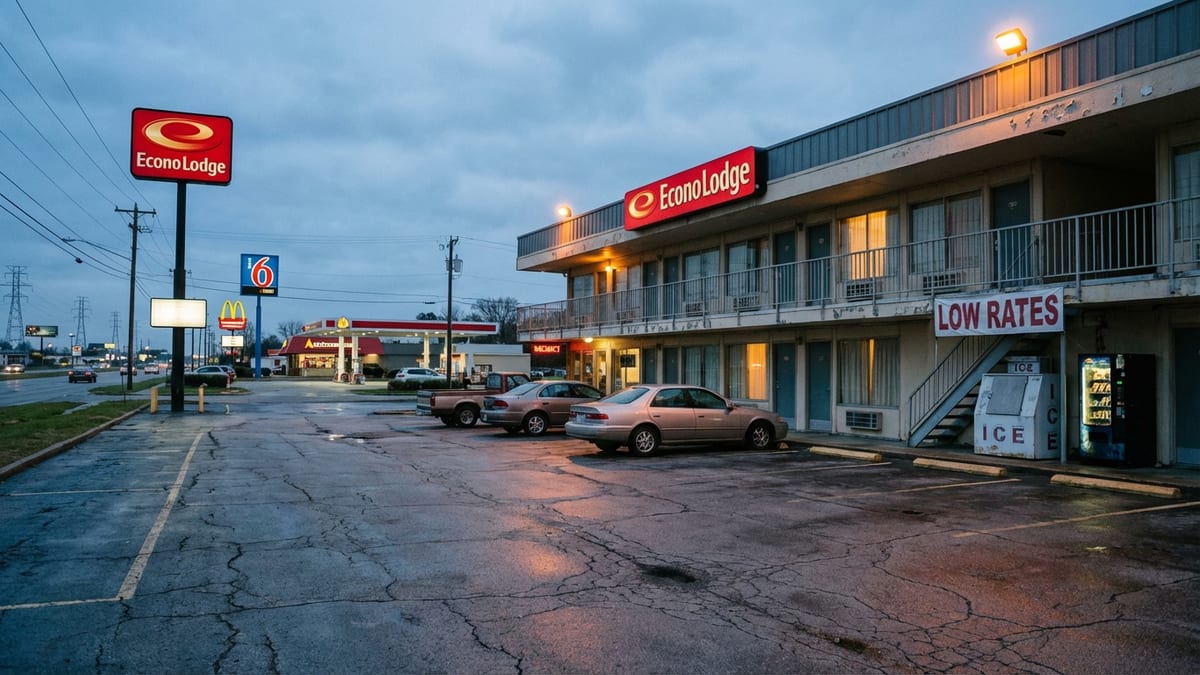
I booked a handful of stays at different Econo Lodge locations across the United States over several months because I wanted to answer one simple question for myself: is Econo Lodge actually worth it, or is it the kind of budget brand that only looks cheap on paper?
What I found was a chain that can be decent value if I walked in with the right expectations, but also one where inconsistency from property to property is the rule rather than the exception. My experience ranged from “this is perfectly fine for a night on the road” to “I wish I had paid twenty dollars more for something else.”
Why I Chose Econo Lodge in the First Place
I did not end up at Econo Lodge by accident. I chose it as a deliberate budget experiment during a long road trip, comparing it against other economy chains like Motel 6, Super 8, Days Inn, and Red Roof Inn. The brand positions itself at the very low end of the Choice Hotels portfolio, promising basic comfort, free Wi-Fi, and usually some form of complimentary breakfast. On paper, it looked like a way to keep my nightly costs under control without dropping into the truly sketchy unknowns of independent roadside motels.
Another factor was availability. In smaller highway towns, when I searched same-day, Econo Lodge was often one of the few branded options still showing multiple rooms under about 80 to 110 dollars after taxes and fees. Other chains either sold out or hovered just above my informal budget ceiling. I also liked that bookings went through the Choice Hotels system so I could earn points and see photos, recent reviews, and basic policies in one place instead of gambling on a motel with almost no online footprint.
Going in, my expectations were modest. I was not looking for style or amenities, just a clean bed, a functioning shower, reliable Wi-Fi to catch up on work, and a sense that the door lock and neighborhood did not put me immediately on edge. I have stayed in enough budget roadside properties to know that at these prices, perfection is impossible. What I hoped was that Econo Lodge would at least hit a minimum line of consistency in cleanliness and maintenance. That turned out to be more complicated than I expected.
Price vs Value: What I Actually Paid
Across several stays in different states, my nightly rates at Econo Lodge generally landed between about 65 and 95 dollars before taxes when booked a day or two ahead, and as high as 110 to 130 dollars after taxes and fees when booking same-day in busier areas or on weekends. In very small towns, I was able to find rates closer to the lower end of that range. In more popular highway junctions or near mid-size cities, the rate crept up fast, especially at short notice.
On the surface, those prices are still cheaper than midscale brands, but they are not the rock-bottom deals many travelers expect when they hear the Econo Lodge name. There were nights when I realized I was paying only 15 to 25 dollars less than a Holiday Inn Express or a Fairfield Inn down the street. At that point, the value calculation gets tight because those midscale places almost always offer a better breakfast, more consistent room quality, and a generally calmer atmosphere.
That said, there were properties where the price felt fair. On a midweek night in a smaller town, paying around 75 dollars after tax for a clean, reasonably quiet room, microwave, mini-fridge, working TV, free parking, and functional Wi-Fi felt like a good deal. I did not feel cheated, and for a quick one-night stopover, I do not need more than that. The problem was that I never quite knew if I would get that solid experience or one of the more worn-down, neglected properties where the rate no longer seemed justified.
Checking In: First Impressions and Front Desk Reality
My first impressions at each Econo Lodge started at the front desk, and that experience varied almost as much as the rooms. At one location off a major interstate, the check-in process was efficient and friendly. The lobby was small but clearly cared for, with a bright front desk, coffee station, and the faint smell of cleaning products instead of stale air. The staff looked tired but made an effort to be welcoming, outlining breakfast hours, Wi-Fi details, and local restaurant options without me having to ask.
At another property in a busier city, the lobby felt more like a security checkpoint than a place of welcome. There was a thick pane of glass between me and the night clerk, who spoke in short, clipped sentences and seemed primarily concerned with making sure I was not planning to cram extra guests into the room. I do not blame staff for setting boundaries, but the tone signaled that the hotel had had more than a few issues with problem guests, and that set my expectations for noise and general vibe before I even got the key.
Check-in policies themselves were relatively standard: government-issued ID, a credit card for incidentals, and a signed agreement about noise, smoking, and occupancy. The official check-in time was typically around 3:00 p.m., with checkout at 11:00 a.m. or noon. Early check-in was hit-or-miss. At some locations, if my room was ready by 1:00 p.m., staff gave it to me without any fuss. At others, I was told flatly to come back at 3:00 p.m. even when the parking lot was half empty. It was not rude, just inflexible.
One detail that did nag at me in certain locations was the visible wear of the public areas. Hallway carpets with noticeable stains, scuffed baseboards, and doors that looked like they had been forced open a few too many times gave some properties a tired, almost apathetic feel. Not every Econo Lodge looked like this, but when it did, I went to my room braced for more disappointment.
Room Comfort: Bed, Cleanliness, and the Little Things
Once inside the room, my experience was a mix of reassurance and frustration. On the positive side, I never encountered outright filth. The beds were made with clean sheets, and the bathrooms had been wiped down. I did not walk into any horror scenes of trash left behind or obvious mold crawling up shower walls. For a budget chain, that baseline mattered a lot to me, and in this respect Econo Lodge generally met it.
Still, there were corners where housekeeping clearly struggled to keep up or simply did not have enough time. In several rooms, I noticed dust buildup on lamp bases and behind TVs, small crumbs in the corners of carpets, and a faint, lingering smell of old smoke or dampness despite the rooms being labeled non-smoking. One room had a chair with a visible stain that I ended up avoiding entirely. None of this made the room unusable, but it chipped away at my sense of comfort.
The beds themselves were surprisingly variable. In one newer or recently refreshed property, the mattress was firm but supportive, the linens felt reasonably fresh, and the pillows, though standard-issue polyester, were not lumpy. I actually slept better than expected that night. At another older property, the mattress sagged toward the middle, creating that subtle rolling effect whenever I shifted my weight. Combined with a louder heating unit that kicked on and off through the night, my sleep there felt restless and shorter than it should have for a long drive the next day.
Lighting and noise control also played a big role in how comfortable I felt. Some rooms had blackout curtains that actually covered the entire window frame, helping block out parking lot lights and early morning sun. Others had curtains that hung awkwardly short, letting light bleed in from the sides. Soundproofing was minimal across all locations. I could hear TVs from adjacent rooms, people talking in the hallway, and doors slamming with the dull thud you only get in older motels. If you are a light sleeper, Econo Lodge is hit-or-miss without earplugs or a white noise app.
Facilities, Breakfast, and What “Included” Really Means
One reason I chose Econo Lodge over ultra-basic options like some independent motels was the promise of a free breakfast. In practice, “breakfast” at Econo Lodge should be translated as “something to put in your stomach before you hit the road” rather than “a meal that sets you up for the day.” At most locations, what I found was a small continental setup: coffee, tea, orange juice, cartons of milk, a few pastry options, bread and a toaster, sometimes bagels, and pre-packaged cereals. A couple of properties added hard-boiled eggs or a basic waffle maker.
The quality of that spread varied. At one property, the coffee was surprisingly decent, the pastries tasted fresh rather than stale, and the breakfast area, though small, was clean and constantly restocked. Grabbing a quick bite there felt like a genuine perk. At another, the juice machine was out of order, several items ran out before the posted end time, and I got the sense the breakfast was more a box to tick on a brand standards sheet than something the staff really cared about. I ended up grabbing a coffee and heading to a nearby fast-food place instead.
Other facilities were sparse, which is not surprising at this price point. Some Econo Lodge locations had small seasonal outdoor pools. When open and maintained, they looked fine for a quick dip, but not like places I would spend an afternoon. Many properties did not offer any kind of fitness center, or if they did, it was a small room with one treadmill and a stationary bike, sometimes out of order. Vending machines for drinks and snacks were common but not always fully stocked.
Wi-Fi, which is practically a utility at this point, was free at every property I stayed in, but performance fluctuated. Checking email, browsing, and basic streaming usually worked, but I had at least one night where the connection kept cutting out, which made remote work frustrating. When I mentioned the issue to the front desk, the response was apologetic but resigned, as if slow or overloaded Wi-Fi was a known limitation they could not easily fix.
Location, Parking, and Safety: How It Felt on the Ground
Econo Lodge properties tend to cluster near highways, busy arterials, and commercial strips with gas stations and fast food. That is part of their appeal for road-trippers: pull off the interstate, refuel, check in, and be back on the road early the next day. In that sense, the locations worked for me. I never had trouble finding food options within a short drive, and sometimes within walking distance, which was convenient after long driving stints when I did not want to get back in the car.
Parking was consistently free, which I appreciated. Most properties had open surface lots directly around the building, and I never struggled to find a space near my room. However, the open nature of those lots did raise some mild safety concerns. At a couple of locations, I noticed groups hanging around the parking lot late into the night, sometimes talking loudly, sometimes just loitering. It did not feel overtly dangerous, but it did make me more careful about locking the car, not leaving anything visible inside, and limiting trips outside after dark.
Inside the hotel, safety measures were basic. Exterior doors at some properties required a key card after a certain hour, but others seemed to remain unlocked around the clock. Room doors had traditional deadbolts, and some had additional swing latches, though in one older property that latch was partially broken and did not line up properly. I reported it at the front desk, and while the staff noted it, I did not see any immediate fix during my overnight stay.
Overall, I did not have any serious incidents, but I also never fully forgot that I was staying in a lower-end property where security is inherently lighter than in a major business hotel. If you are traveling alone or with valuables, I would recommend doing what I did: park under a light, keep most belongings either with you or out of sight, double-check your locks, and trust your instincts about the surrounding area once you arrive.
Service, Housekeeping, and How Problems Were Handled
In budget hotels, I do not expect concierge-level service, but I do expect basic responsiveness and courtesy when something goes wrong. On that count, my Econo Lodge experiences were mixed but rarely outright bad. At the better-run properties, staff were proactive. One front desk agent, seeing I had just checked in after a clearly long drive, offered late checkout unprompted and pointed out the quieter side of the building for my room. That small gesture shifted my impression of the whole stay.
Housekeeping interactions were minimal, which suited me. I generally decline daily cleaning on short stays. On the mornings when I did request extra towels or toiletries, most properties responded within a reasonable time. However, one location never delivered the towels I asked for, and when I went down to the desk later that night, I was told housekeeping had already gone home and they had limited extras available. I ended up making do with what I had, which was annoying but not catastrophic.
Maintenance was where the cracks showed most clearly. I encountered minor issues like a flickering bathroom light, a slow-draining sink, and a TV remote that only worked if I held it at a very specific angle. When I reported those, the responses ranged from immediate help to a polite shrug. In one case, the staff member offered to move me to a different room, which I appreciated, even though I ultimately declined because I was too tired to pack up again. In another, I was told it would be “looked at tomorrow,” which did not help for that night’s stay.
What stood out overall was that the attitude of individual managers and owners made a noticeable difference. Some Econo Lodge properties felt like they were working hard within budget constraints to keep things presentable and functional. Others felt like they were coasting on the brand name, doing just enough to remain open but no more. That inconsistency made it hard for me to trust the logo alone as a guarantee of a certain standard.
Who Econo Lodge Is Really For (And When It Is Not)
After several stays, I came away convinced that Econo Lodge can make sense for a very specific type of traveler, under specific conditions. If you are a road-tripper or long-distance driver looking for a cheap, functional place to crash for one night near a highway, and you keep your expectations modest, Econo Lodge can be worth it. The key is to treat it as a utilitarian stop rather than part of the travel experience itself.
Where Econo Lodge falls short is for travelers who value atmosphere, quiet, or consistency above all else. If you are on a romantic getaway, traveling with small children who need a very clean-feeling space to play on the floor, or sensitive to noise, you might be happier paying the extra 20 to 40 dollars for a more reliable midscale brand. That price difference often buys better soundproofing, more comfortable bedding, and a breakfast that feels like breakfast instead of a snack.
Budget alone is also not a sufficient reason in every situation. There were nights when I saw Econo Lodge pricing so close to better brands that the savings did not justify the potential drawbacks. In those cases, I regretted not checking a bit more carefully before defaulting to the cheapest option. The value calculus changed when I found truly low rates in quieter towns, where the property felt less beaten-up and the crowd less transient.
If I were to repeat the experience, I would be more selective. I would still book Econo Lodge, but I would scrutinize recent guest reviews and photos for each specific property rather than relying on the brand. I would also avoid locations in particularly busy or rough-feeling commercial strips if it only saved me a small amount compared with a better alternative nearby.
The Takeaway
Staying at multiple Econo Lodge properties gave me a realistic sense of what this budget chain offers, and what it does not. It is not a hidden gem or an underpriced secret. It is a basic, sometimes worn, sometimes surprisingly decent roadside option that lives or dies by how well each individual property is managed and maintained. When things go right, you get a clean bed, a hot shower, a simple breakfast, and a safe night’s sleep for less than the midscale competition. When things go wrong, you get thin walls, tired furnishings, and small annoyances that pile up and make you question whether the savings were worth it.
I would still consider Econo Lodge in the future, but not automatically. For me, it is worth it when I am on a tight budget, only need a quick overnight near a highway, and can verify through recent reviews that a particular location is decently maintained. In those scenarios, I am comfortable making the trade-off. If I am traveling for pleasure, staying more than one night, or have any special reason to want a quieter, more polished environment, I will likely look elsewhere, even if it costs a bit more.
Ultimately, Econo Lodge is for travelers who prioritize price and location over everything else and who understand that “good enough” is exactly what they are getting. If you go in with that mindset, keep your stay short, and choose your specific property carefully, Econo Lodge can be a reasonable, if unexciting, part of your journey. If you expect more, you will probably leave thinking that a few extra dollars per night would have been money well spent.
FAQ
Q1: Is Econo Lodge generally clean enough to feel comfortable?
In my experience, Econo Lodge rooms were usually clean at a basic level, with made beds and wiped-down bathrooms, but they sometimes showed wear and minor lapses like dust in corners or stained furniture. I felt comfortable enough for short stays, but I would not describe the cleanliness as meticulous.
Q2: How does Econo Lodge compare to other budget chains like Motel 6 or Super 8?
Overall, my Econo Lodge stays felt roughly on par with other budget chains: very dependent on the individual property. Some locations were a bit better maintained than nearby competitors, while others felt equally worn. I would not choose Econo Lodge purely on brand; I would compare specific properties and recent reviews.
Q3: Is the free breakfast at Econo Lodge worth factoring into the price?
The free breakfast is a nice extra if you only need coffee and a quick bite, but it is usually limited to simple continental items. I would not book Econo Lodge for the breakfast alone, but I appreciated it on mornings when I wanted to get back on the road quickly.
Q4: Are Econo Lodge hotels safe for solo travelers?
I did not encounter major safety issues, but some locations felt rougher around the edges, especially at night in open parking lots. As a solo traveler, I locked my car carefully, parked under lights, double-checked room locks, and trusted my instincts about the surrounding area. With those precautions, I felt reasonably safe, but I remained aware of my surroundings.
Q5: Do Econo Lodge rooms have Wi-Fi that is good enough for work?
Wi-Fi was free at every property I stayed in and usually adequate for checking email, browsing, and basic streaming. However, I did have at least one stay where the connection was unstable and slow, which made remote work frustrating. I would not rely on Econo Lodge Wi-Fi for bandwidth-heavy tasks without a backup plan.
Q6: What are the typical check-in and checkout times at Econo Lodge?
Most Econo Lodge locations I used had check-in around 3:00 p.m. and checkout between 11:00 a.m. and noon. Early check-in was possible at some properties if rooms were ready, but others were strict about not releasing keys before the posted time.
Q7: Is Econo Lodge a good option for families with kids?
It can work for families on a tight budget who just need a place to sleep, but I would be selective. Some properties felt too worn or noisy for me to feel fully relaxed with small children. If the price difference is small, I would lean toward a slightly higher-tier brand for more consistent cleanliness and quieter surroundings.
Q8: Can I rely on Econo Lodge for multi-night stays, not just one-night stopovers?
Personally, I found Econo Lodge better suited to one-night stays. For longer visits, small issues like thin walls, limited breakfast, and dated furnishings became more noticeable. I would only book a multi-night stay if I had strong recent evidence that a particular property was well maintained.
Q9: Are Econo Lodge locations usually close to restaurants and services?
Yes, most of the Econo Lodge properties I stayed at were near highways or commercial strips with gas stations, fast-food outlets, and basic restaurants nearby. That convenience is one of the brand’s strengths for road-trippers.
Q10: Under what conditions do I personally think Econo Lodge is worth it?
For me, Econo Lodge is worth it when I am on a road trip, need a budget-friendly one-night stop near a highway, see a clear price advantage over better brands, and can confirm through recent reviews that the specific property is reasonably clean and safe. Outside those conditions, I usually prefer to spend a bit more for a more consistent experience.